Bambang Pamungkas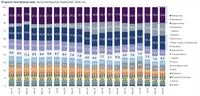
Jakarta, CNBC Indonesia – Financial habits and consumer behavior across Indonesia are undergoing a subtle yet profound structural transformation. A prominent social phenomenon known colloquially as the "lifestyle downgrade"—wherein individuals intentionally lower their consumption standards, trim non-essential expenditures, and prioritize fiscal prudence—has captured widespread public attention. Amplified heavily across social media platforms throughout late 2026, this grassroots movement reflects a broader societal adaptation to escalating living costs, economic uncertainties, and shifting personal income dynamics. While some citizens adopt these austerity measures proactively to fortify their personal balance sheets, others are compelled by necessity, carefully aligning their monthly outlays with tighter economic margins.
The colloquial term "lifestyle downgrade" broadly characterizes a deliberate pivot toward simpler, more cost-effective living standards. Everyday examples of this cultural shift are ubiquitous: consumers trading premium artisanal coffee for affordable alternatives, opting for economical public or private transportation, curtailing holiday frequencies, or deferring the purchase of high-end consumer electronics such as smartphones in favor of retaining legacy devices. This cultural zeitgeist transcends mere internet chatter; it was formally acknowledged in an official opinion piece published by the Ministry of Finance on October 12, 2026. The Ministry highlighted that social media discourse is increasingly dominated by real-world narratives of citizens recalibrating their daily expenditures to match their genuine financial capacities.
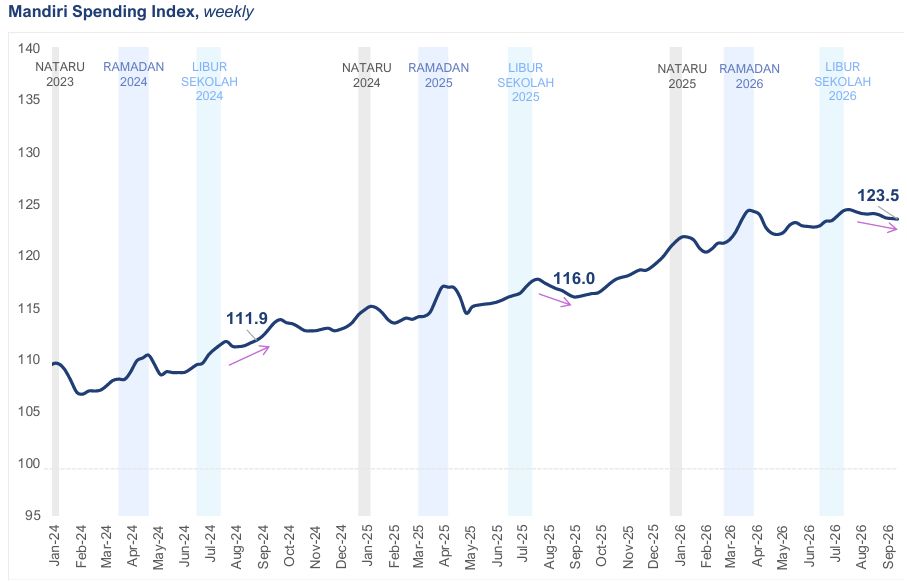
Concurrently, hard economic data substantiates these behavioral shifts. The Mandiri Spending Index (MSI), a comprehensive economic tracker compiled by the Office of Chief Economist at Bank Mandiri, provides a granular look into these evolving spending patterns. Analyzing data leading up to September 13, 2026, the MSI reveals a resilient yet decelerating consumer landscape. Although aggregate economic activity and purchasing power continue to expand on an annual basis, month-to-month momentum has noticeably softened, accompanied by a fundamental restructuring of household budget allocations.
The Chronology and Metrics of Retail Slowdown
To fully comprehend the trajectory of modern Indonesian consumer behavior, one must examine the chronological progression of the Mandiri Spending Index throughout the third quarter of 2026. The weekly consumption index stood at 123.5 during the second week of September 2026, registering a slight contraction from 123.6 the preceding week. On a week-on-week basis, the retail spending gauge weakened by 0.05%, marking a persistent four-week downward streak heading into mid-September.
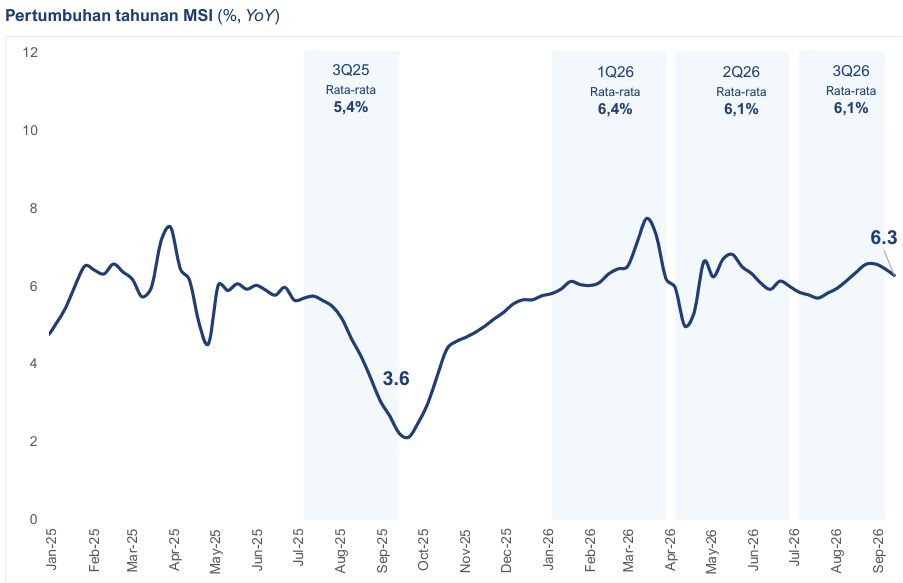
Despite this localized weekly softening, a year-on-year (YoY) comparison demonstrates that consumption remains in positive territory. Consumer spending growth for the second week of September reached 6.3% YoY, cooling marginally from the 6.4% growth recorded during the first week of the month. Expanding the timeframe across the broader fiscal calendar, the average consumption growth for the third quarter of 2026 up to the second week of September settled at 6.1%. This mirrors the 6.1% growth rate observed in the second quarter of 2026, though it represents a moderation compared to the more robust 6.4% expansion registered in the first quarter. Nevertheless, Q3 performance remains noticeably elevated compared to the corresponding period in 2025, which logged a consumption growth rate of 5.4%.

Beneath these macroeconomic headline figures lies a compelling story of internal reallocation. Rather than uniformly cutting back or universally expanding purchases, Indonesian consumers are exhibiting hyper-selective spending habits. Certain sectors are capturing a larger share of the household wallet, while others experience sharp cutbacks, mapping closely onto the lifestyle downgrade narrative where priorities are ruthlessly reevaluated.
Shifting Wallet Shares: Supermarkets and Restaurants Gaining Ground
A striking development within the September 2026 MSI data is the relative rebound observed in food-service and grocery retail sectors. Contrary to the assumption that all discretionary dining would plummet during a lifestyle correction, consumer outlays for restaurants and supermarkets actually demonstrated measurable resilience.
Specifically, the proportion of total consumer spending allocated to restaurants reached 19.6% in September 2026, expanding from 19.0% in August. A more pronounced acceleration occurred within the supermarket category, where the spending share jumped from 16.3% in August to 17.4% in September. Combined, these two consumer staples and dining categories accounted for 37.0% of total recorded expenditures in September, rising from 35.3% the previous month. This represents a substantial 1.7 percentage point increase in total spending share over the span of a single month, although the combined proportion remains fractionally shy of the 37.9% recorded in September 2025.
Annual performance metrics further validate this resilience. Restaurant expenditures grew by 5.1% YoY in September 2026, while supermarket outlays increased by 4.5% YoY—a marked improvement over the stagnant growth figures registered during the same period in the prior year. Analysts note that this does not necessarily imply households are hoarding wealth or universally consuming greater volumes of goods; rather, it underscores a strategic reallocation of funds toward fundamental sustenance and accessible social dining experiences, even as broader economic pressures mount.
Contraction in Luxury, Fashion, and Electronics
Conversely, categories traditionally associated with discretionary splurging and lifestyle inflation have absorbed the brunt of the recent retrenchment. The most dramatic contraction was observed in the smartphone and mobile device sector. In August 2026, handphone purchases constituted 17.6% of total consumer spending; by September, this share eroded significantly down to 16.3%.
A parallel cooling trend affected household goods, which saw their budget share slip from 8.9% to 7.9%. The fashion and apparel sector similarly retreated, dropping from 7.0% of total monthly expenditures in August to 6.5% in September. This targeted reduction aligns seamlessly with the theoretical framework of the lifestyle downgrade, wherein consumers routinely defer capital-intensive hardware upgrades and wardrobe overhauls, opting instead to maximize the lifecycle of existing possessions.
Interestingly, exceptions exist within technical and health-related expenditures. Outlays for general electronics registered a modest uptick from 5.9% to 6.1%, while healthcare spending climbed from 5.5% to 5.8%. These variances demonstrate that consumer retraction is far from uniform; households are consciously pruning lifestyle luxuries while safeguarding health and essential functional technologies.
Divergent Trends in Leisure, Travel, and Mobility
The nuances of modern consumption are similarly pronounced within the recreation, entertainment, and transit sectors. When facing financial tightening, leisure activities such as paid streaming subscriptions, hobby maintenance, and vacations are historically among the first budgetary items to face suspension.
According to the Mandiri Institute data, weekly recreational spending displayed an erratic trajectory, ticking upward by 0.27% in the second week of September. This minor weekly lift was primarily driven by hobbies, entertainment sub-segments (which rose 0.48%), and jewelry purchases (up 0.22%). However, viewed through a longer lens, annual figures reveal persistent underlying weakness: hobby and entertainment spending contracted by 2.7% YoY, while outlays for commercial flight tickets tumbled by 4.8% YoY.
This hesitancy regarding long-distance travel and air transit contrasts sharply with spending on daily mobility. Fuel expenditures expanded by 6.6% YoY, automotive-related outlays grew by 6.3% YoY, and overall transportation spending surged by 10.7% YoY. This dichotomy highlights that while discretionary leisure travel is being heavily scrutinized and curtailed, absolute outlays required to sustain daily economic commuting and fundamental workforce participation remain non-negotiable pillars of the modern Indonesian household budget.
Macroeconomic Implications and Fact-Based Analysis
The simultaneous proliferation of the lifestyle downgrade discourse on social media and the empirical realities captured by the Mandiri Spending Index point toward a maturing consumer base. Economic analysts observing these trends emphasize that the Indonesian populace is not entering a phase of total economic paralysis. Rather, consumer resilience is being maintained through hyper-rationalized allocation strategies.
By cutting back on high-ticket luxury goods, fashion, and discretionary air travel, households are successfully preserving liquidity to manage core living expenses, including groceries, dining out, and daily commuting. This calculated selectivity acts as a shock absorber against broader macroeconomic headwinds, allowing consumers to maintain a semblance of normalcy and social activity without endangering their long-term financial solvency.
Ultimately, while macroeconomic indices confirm that aggregate retail growth remains positive on an annualized basis, the internal composition of these expenditures is undergoing a permanent evolution. The modern Indonesian consumer is increasingly pragmatic, proving adept at navigating financial pressures through targeted austerity and deliberate lifestyle calibration.
CNBC Indonesia Research