Nasution Nanang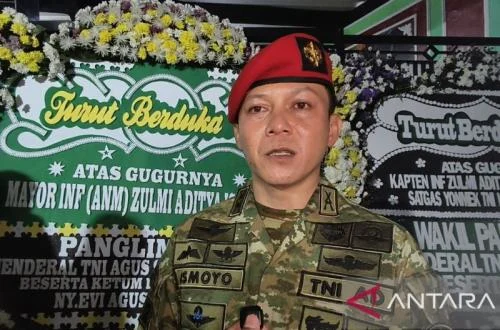
The Indonesian National Armed Forces (TNI) stood in solemn tribute as its highest commander, General Agus Subiyanto, led a full military funeral ceremony for Major Infanteri (posthumous) Zulmi Aditya Iskandar. Major Zulmi, a revered officer, tragically lost his life while serving in a United Nations peacekeeping mission in Lebanon. The poignant ceremony, a testament to the nation’s profound respect and gratitude, was scheduled to take place in Cimahi, West Java, on Sunday, April 5th, in the morning hours. This somber event underscores the inherent sacrifices made by Indonesian peacekeepers on the global stage, reinforcing the nation’s unwavering commitment to international peace and security. The presence of the Panglima TNI as the inspector of the ceremony highlights the deep reverence and national appreciation for Major Zulmi’s dedication and ultimate sacrifice in the pursuit of global peace.
A Hero’s Final Journey: The Sacrifice of Major Zulmi Aditya Iskandar
Major Infanteri Zulmi Aditya Iskandar was not merely a soldier; he was a beacon of hope and an ambassador of peace, representing Indonesia’s dedication to global stability. His deployment to Lebanon was part of the United Nations Interim Force in Lebanon (UNIFIL), a critical mission established by the UN Security Council to ensure peace and stability in a region often plagued by conflict. For Major Zulmi, this mission was a fulfillment of his oath to protect, serve, and uphold the principles of peace, even if it meant venturing into the world’s most volatile zones. The "Anumerta" designation, meaning posthumous, signifies that his promotion to Major was granted after his death in the line of duty, an honor reserved for those who make the ultimate sacrifice for their nation and for humanity. This recognition elevates his sacrifice, acknowledging his bravery and unwavering commitment to his duties. His passing is a stark reminder of the perils faced by peacekeepers daily, operating in complex environments where the line between peace and conflict can be razor-thin. These brave men and women serve as a buffer between warring factions, deliver humanitarian aid, and help rebuild societies, often at immense personal risk. Major Zulmi’s role within the UNIFIL contingent would have involved complex tasks, potentially ranging from patrolling the Blue Line (the line of withdrawal between Lebanon and Israel) to engaging with local communities, providing security, and monitoring ceasefires. Such duties demand not only military prowess but also exceptional diplomatic skills, cultural sensitivity, and an unshakeable resolve to maintain peace amidst simmering tensions. His service embodied the spirit of selflessness that characterizes all peacekeepers, making his loss particularly poignant for the TNI and the nation.
The UNIFIL Mandate and Indonesia’s Enduring Commitment
The United Nations Interim Force in Lebanon (UNIFIL) was originally established by the UN Security Council resolutions 425 and 426 on 19 March 1978, to confirm the withdrawal of Israeli forces from Lebanon, restore international peace and security, and assist the Government of Lebanon in ensuring the return of its effective authority in the area. Over the decades, its mandate has evolved, particularly after the 2006 conflict, to include monitoring the cessation of hostilities, accompanying and supporting the Lebanese Armed Forces as they deploy throughout the south, and extending their authority. Currently, UNIFIL maintains approximately 10,000 peacekeepers from 49 troop-contributing countries, operating in a complex geopolitical landscape. Indonesia has been a steadfast contributor to UNIFIL since 2006, deploying thousands of its finest military and police personnel as part of the Garuda Contingent (Kontingen Garuda). These contingents, often comprising engineering units, medical teams, logistics support, and infantry battalions, have been instrumental in various roles, from infrastructure development and humanitarian assistance to force protection and maintaining security in their areas of operation. Indonesia’s participation in UN peacekeeping missions dates back to 1957, with its first deployment to the United Nations Emergency Force (UNEF) in Egypt. Since then, the nation has sent over 40,000 personnel to more than 29 UN missions across the globe, embodying its constitutional mandate to participate in the establishment of a world order based on freedom, eternal peace, and social justice. This commitment is deeply embedded in Indonesia’s foreign policy, often referred to as "bebas aktif" (independent and active), which seeks to contribute actively to global peace and stability. Major Zulmi’s service was a continuation of this proud legacy, cementing Indonesia’s reputation as a reliable and dedicated partner in global peace efforts. His presence in Lebanon, along with hundreds of his compatriots, was a tangible expression of this commitment, offering stability and hope to a region yearning for lasting peace. The risks inherent in these missions are ever-present, ranging from unexploded ordnance and improvised explosive devices to direct engagements in volatile areas, underscoring the daily courage required of every peacekeeper.
A Nation’s Farewell: The Chronology of Repatriation and Homage
The journey of Major Zulmi’s remains back to his homeland was a carefully orchestrated sequence of solemn protocols, reflecting the gravity of his sacrifice and the nation’s deep respect. Following his tragic passing in Lebanon, a complex repatriation process was initiated, involving meticulous coordination between the United Nations, the Indonesian Ministry of Foreign Affairs, and the TNI. His body was transported from the mission area, undertaking a long journey across continents, a testament to the logistical efforts required to bring a fallen hero home.
The first significant moment of his return to Indonesian soil occurred on Saturday, April 4th, when the aircraft carrying his remains touched down at Soekarno-Hatta International Airport in Jakarta. It was approximately 6:00 PM Western Indonesian Time (WIB). Upon arrival, a formal military reception ceremony was conducted on the tarmac, marking the official handover of the fallen peacekeeper. Senior military officials, representatives from the Ministry of Foreign Affairs, and members of his grieving family were present to receive him with full military honors. The atmosphere was profoundly somber, with flags draped, salutes rendered, and a moment of silent reflection, a poignant acknowledgment of a hero returning home. This initial ceremony, often unseen by the wider public, is a crucial part of the military’s tradition of honoring its fallen, ensuring that their return is met with the highest respect.
From Soekarno-Hatta, Major Zulmi’s remains were then transported by air to Bandara Husein Sastranegara in Bandung, West Java, bringing him closer to his final resting place and his family’s embrace. The subsequent journey from the airport to his home in Cikendal, Kelurahan Cipageran, Kecamatan Cimahi Utara, Kota Cimahi, was a poignant procession. Escorted by military police and watched by grieving citizens who lined parts of the route, the convoy arrived at the family residence around 9:15 PM WIB on the same Saturday evening. This segment of the journey, often marked by hushed crowds and respectful silence, allows local communities to pay their respects and share in the collective grief.
At the family home, a private yet deeply spiritual ceremony took place. The traditional Islamic funeral prayer, known as Shalat Jenazah, was performed, allowing family members, close friends, and local community leaders to offer their final respects and prayers according to Islamic rites. This moment of intimate farewell provided a brief respite for the family to grieve in their private space before the public military ceremony. The final leg of his journey was set for Sunday morning, where he would be laid to rest at the Taman Makam Pahlawan (Heroes’ Cemetery) in Cimahi, a sacred ground reserved for those who have dedicated their lives to the nation. Each step of this chronology, from his return to the final burial, was imbued with deep respect and national pride, honoring a life cut short in the service of peace. The meticulous planning and execution of these events reflect the TNI’s unwavering commitment to its personnel, even in death.
The Pinnacle of Respect: A Full Military Funeral
The decision for the Commander of the Indonesian National Armed Forces, General Agus Subiyanto, to personally preside over the funeral ceremony underscores the immense significance of Major Zulmi’s sacrifice and the high esteem in which he was held by the TNI. Lieutenant Colonel Infanteri Heri Ismoyo, the Commander of Battalion 22, Group 2 Kopassus (Indonesia’s elite special forces), confirmed this arrangement, emphasizing the solemnity and honor that would characterize the event. "Certainly tomorrow (Sunday) a military funeral ceremony will be carried out with full honors," he stated from the house of mourning, reflecting the collective sentiment of the armed forces. His statement highlights that this is not merely a routine procedure but a deeply meaningful gesture of national gratitude.
A military funeral, particularly one led by the Panglima TNI, is not merely a ceremonial act; it is a profound national tribute. It involves a precise set of protocols, steeped in centuries of military tradition, designed to convey the nation’s deepest gratitude and respect for a serviceman who has made the ultimate sacrifice. These protocols typically include a gun salute, symbolizing a final volley fired in honor of the deceased; the draping of the national flag (Sang Saka Merah Putih) over the casket, representing the nation’s embrace; a military escort and pallbearers comprising comrades-in-arms; and the presence of senior officers and soldiers in full dress uniform. The solemn bugle call of "Taps" or a similar military lament typically resonates, signifying the end of a soldier’s duty and a farewell to their spirit. These elements are meticulously orchestrated to create an atmosphere of profound respect and remembrance. For the family, such a ceremony offers a measure of comfort, knowing that their loved one’s service and sacrifice are recognized and honored at the highest levels of government and military leadership. It also serves as a powerful symbol for the wider community, reminding them of the dedication and bravery of those who serve to protect national interests and promote international peace. The attendance of General Subiyanto himself transforms the event into a poignant statement from the entire Indonesian armed forces, reaffirming their solidarity with the fallen hero and his grieving family, and publicly acknowledging the profound cost of peace.
Indonesia’s Steadfast Commitment to Global Peace: The Legacy of Kontingen Garuda
Indonesia’s role in international peacekeeping is a cornerstone of its foreign policy, deeply rooted in its constitutional mandate to contribute to world peace. The "Kontingen Garuda" or Garuda Contingent, is the collective term for Indonesian military and police personnel deployed under the UN flag. Since its inaugural deployment to the United Nations Emergency Force (UNEF) in Egypt in 1957, Indonesia has consistently been among the top contributors of uniformed personnel to UN peacekeeping operations. This commitment stems from the Preamble of the 1945 Constitution, which states, among other things, that the government shall "participate in the establishment of a world order based on freedom, eternal peace, and social justice."
Over the decades, Indonesian peacekeepers have served in numerous challenging environments, from the Congo and Vietnam to Bosnia-Herzegovina, Cambodia, and the Middle East. Their missions have encompassed a broad spectrum of activities, including election monitoring, humanitarian aid delivery, demining operations, security sector reform, and protecting civilians. For instance, in Congo (MONUC/MONUSCO), Indonesian forces have been crucial in stabilizing volatile regions and protecting civilians. In Darfur (UNAMID), they provided essential security and logistical support. Each deployment, each mission, adds another chapter to Indonesia’s rich history of peacekeeping, demonstrating its commitment beyond its national borders. As of early 2024, Indonesia ranks among the top ten troop-contributing countries globally, with thousands of personnel currently deployed in various missions, including UNIFIL, MINUSCA (Central African Republic), MONUSCO (DR Congo), and UNMISS (South Sudan).
The contribution is not just about numbers; it’s about the quality and professionalism of the personnel. Indonesian peacekeepers are renowned for their discipline, adaptability, and cultural sensitivity, often excelling in community engagement and civil-military cooperation. They are trained not only in combat and security protocols but also in humanitarian principles, cross-cultural communication, and conflict resolution. This holistic approach ensures their effectiveness in complex operational environments, often leading to stronger bonds with local populations and more sustainable peacebuilding efforts. The sacrifice of Major Zulmi Aditya Iskandar serves as a stark reminder of the inherent dangers and profound responsibilities that come with this commitment. His life, and the lives of other fallen peacekeepers, are etched into the fabric of Indonesia’s dedication to global peace, reinforcing the nation’s resolve to continue its vital role in fostering stability and security worldwide. Their legacy inspires future generations of Indonesian soldiers and police officers to uphold the same ideals of service and sacrifice, ensuring that Indonesia remains a leading force for peace.
**A