Nasution Nanang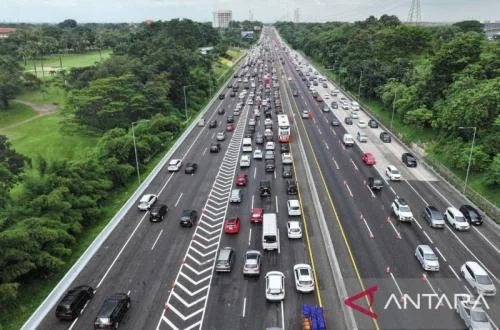
Bekasi, Indonesia – The Mohammed Bin Zayed (MBZ) Elevated Toll Road witnessed persistently high vehicle mobility on H+1 of Eid al-Fitr 1447 Hijriah, Sunday, March 23, 2026, as millions of Indonesians continued their post-holiday journeys. PT Jasamarga Jalanlayang Cikampek (JJC) reported a significant surge in traffic volume, particularly for vehicles departing the capital region, underscoring the enduring tradition of annual holiday travel. Desti Anggraeni, GM Operations and Maintenance at PT JJC, confirmed that the volume of vehicles leaving Jakarta and heading towards Cikampek escalated by a remarkable 114 percent compared to normal daily traffic, indicating the commencement of the return flow (arus balik) for many holidaymakers or continued travel to other destinations.
The Eid al-Fitr holiday, locally known as Lebaran, is a pivotal cultural and religious event in Indonesia, marking the end of the fasting month of Ramadan. It invariably triggers one of the world’s largest annual mass migrations, colloquially termed "mudik," where urban dwellers return to their hometowns and ancestral villages to celebrate with family. Following the festivities, a corresponding "arus balik" sees millions reverse their journeys, returning to major cities like Jakarta, Surabaya, and Bandung. This cyclical phenomenon places immense pressure on Indonesia’s transportation infrastructure, particularly its toll road network, which serves as a critical artery connecting the populous western regions of Java to its central and eastern parts. The MBZ Elevated Toll Road, a vital segment of the Trans-Java Toll Road system, plays a crucial role in facilitating this movement, especially for those traveling from Jakarta to areas further east.
Chronology of Holiday Travel Peaks
The pattern of holiday travel in Indonesia during Eid al-Fitr typically unfolds in distinct phases. The "mudik" period usually commences approximately a week before Eid, peaking on the eve of the holiday. During this phase, traffic density is overwhelmingly directed out of major urban centers. Following the main Eid al-Fitr celebrations, which often span two to three days, the "arus balik" begins. While some travelers opt to return immediately on H+1 or H+2, many extend their stay, leading to a staggered return flow that can last up to a week after Eid. The data from PT JJC on H+1, March 23, 2026, clearly indicates that this day marked the beginning of a significant return wave, with high traffic volumes in both directions, albeit with a stronger outward push from Jakarta. This early surge suggests that a substantial portion of the populace either celebrated Eid in areas relatively close to Jakarta or were embarking on further holiday excursions.
Historically, the Indonesian Ministry of Transportation, in collaboration with various agencies including the National Police and state-owned toll road operators like Jasa Marga, dedicates extensive resources to managing this annual migration. Plans often include implementing contraflow lanes, imposing odd-even license plate restrictions, and providing real-time traffic updates to mitigate congestion and enhance safety. For the 2026 Eid period, similar comprehensive strategies would have been in place, reflecting lessons learned from previous years, where traffic management techniques were continually refined to accommodate an ever-growing number of private vehicles.
Detailed Traffic Data Analysis for MBZ
The figures released by PT JJC provide a granular insight into the traffic dynamics on the MBZ Elevated Toll Road. The eastward flow, primarily from Jakarta towards Cikampek and further east, recorded an astonishing 49,892 vehicles on H+1. This represents a monumental increase of 114.67 percent compared to the normal daily average of 23,241 vehicles. This significant deviation from the baseline underscores the sustained outbound movement from the capital region. A deeper dive into the daily breakdown reveals varied intensities:
- Morning (06:00 – 12:00 WIB): The highest surge was observed in the morning, with an increase of 157.36 percent. This suggests that many travelers opted for an early start to avoid the midday heat or to reach their destinations well before the evening.
- Afternoon (12:00 – 18:00 WIB): Traffic remained elevated but saw a comparatively lower increase of 64.79 percent. This period might have experienced a brief lull as some travelers paused for lunch or rest, or as the initial morning rush subsided.
- Evening (18:00 – 24:00 WIB): The evening hours witnessed another substantial increase of 131.75 percent. This could be attributed to those who delayed their departure or to the typical evening peak experienced on weekends and holidays.
Concurrently, the westbound traffic, primarily from Cikampek towards Jakarta, also experienced a notable uptick, signalling the initial phase of the "arus balik." A total of 45,429 vehicles traversed the MBZ Toll Road towards Jakarta, marking a 36.45 percent increase from the normal volume of 33,293 vehicles. While not as dramatic as the eastbound surge, this still represents a substantial rise:
- Morning: A 55.66 percent increase indicated an early return for some.
- Afternoon: A 22.15 percent increase, the lowest of the day, possibly due to people settling into their return journey or making stops.
- Evening: A 46.63 percent increase, indicating a sustained return flow into the night.
Cumulatively, the MBZ Elevated Toll Road recorded an astounding 95,321 vehicles travelling in both directions on H+1 Eid al-Fitr. This near 100,000-vehicle count on a single day on one specific toll segment highlights the sheer scale of mobility across the nation during this festive period. The robust figures demonstrate that even on H+1, the holiday spirit was still driving considerable movement, either as part of the initial "mudik" for some who delayed their travel, or the nascent phase of the "arus balik" for others.
Broader Traffic Landscape Across Indonesia
The high mobility observed on the MBZ Toll Road is not an isolated incident but rather a microcosm of a nationwide phenomenon during Eid al-Fitr. Other critical arteries across Indonesia, particularly those forming part of the Trans-Java Toll Road network, would have exhibited similar, if not higher, traffic volumes. Key segments like the Cipali (Cikopo-Palimanan) Toll Road, the Jakarta-Cikampek (Japek) Toll Road, and routes connecting to the Merak-Bakauheni ferry crossing (serving Sumatra-Java traffic) typically bear the brunt of the "mudik" and "balik" surges.
In 2025, the Ministry of Transportation projected that over 100 million people would participate in the Eid al-Fitr exodus, a figure that was likely to be replicated or even surpassed in 2026 due to factors such as increased vehicle ownership, improved economic conditions allowing more people to travel, and the expansion of the toll road network making inter-city travel more convenient. This massive movement necessitates extensive coordination among various stakeholders, including toll road operators, police, local governments, and public transport providers. The demand for fuel, rest area facilities, and emergency services also sees a corresponding spike, creating logistical challenges that require meticulous planning and execution.
Official Responses and Traffic Management Strategies
In anticipation of such high traffic volumes, government bodies and related agencies would have already put in place a series of measures. The Ministry of Transportation, for instance, typically works closely with the National Police Traffic Corps (Korlantas Polri) to implement dynamic traffic management strategies. These include:
- Contraflow (Law enforcement-directed temporary lane reversal): To maximize road capacity in the direction of heavier flow.
- One-Way Systems: On specific toll road segments during peak hours to streamline traffic.
- Odd-Even Plate Restrictions: Often applied to certain sections or dates to reduce the number of private vehicles.
- Rest Area Management: Strict monitoring of rest area capacity to prevent overcrowding and spillback onto the main road.
- Information Dissemination: Utilizing various channels such as radio, social media, variable message signs (VMS), and mobile applications to provide real-time traffic updates and alternative routes.
Desti Anggraeni of PT JJC reiterated the importance of user safety, urging drivers to ensure their physical condition is optimal, that their vehicles are well-maintained, and to remain vigilant regarding potential weather changes. This standard advice is crucial, as fatigue, vehicle breakdowns, and adverse weather conditions like heavy rain can significantly increase the risk of accidents during high-volume travel periods. Jasa Marga, the parent company of PT JJC, maintains a 24-hour call center (133), an active Twitter presence (@PTJASAMARGA), and the Travoy 4.5 application for iOS and Android, all of which are vital resources for drivers seeking information or assistance on toll roads.
Economic and Social Implications of Mass Mobility
The mass mobility during Eid al-Fitr carries profound economic and social implications for Indonesia. Economically, the "mudik" and "balik" phenomenon injects billions of rupiah into local economies across the archipelago. Small and medium-sized enterprises (SMEs) in destination towns and along travel routes, including food vendors, local transport services, and souvenir shops, experience a significant boost in sales. Tourism destinations, whether natural attractions or cultural sites, also see a surge in visitors, contributing to the regional GDP. However, this economic uplift in rural and provincial areas often comes at the expense of a temporary slowdown in major urban centers, as a significant portion of their workforce and consumer base temporarily departs.
Socially, Eid al-Fitr is a powerful testament to the strong familial and communal bonds in Indonesian society. The tradition of returning home, often spanning generations, reinforces cultural identity and provides an annual opportunity for families to reconnect. This collective experience of shared travel, despite its challenges, fosters a sense of national unity and shared tradition. The ability to travel safely and efficiently to celebrate with loved ones is a significant aspect of public welfare, making the smooth operation of transportation networks during this time a matter of national importance.
Challenges and Future Outlook for Infrastructure
The persistent high traffic volumes, as exemplified by the MBZ Toll Road figures, highlight the ongoing challenges and future demands on Indonesia’s infrastructure. While significant strides have been made in expanding the toll road network, the annual increase in vehicle ownership and population growth mean that demand continues to outstrip capacity during peak periods. Future infrastructure development will likely focus on:
- Capacity Expansion: Adding more lanes to existing toll roads and constructing new ones.
- Intelligent Transportation Systems (ITS): Implementing advanced technologies for traffic monitoring, incident detection, and dynamic routing to optimize flow.
- Intermodal Integration: Improving connections between toll roads, public transportation hubs (train stations, bus terminals, airports), and ferry ports to offer more diverse travel options and reduce reliance on private vehicles.
- Sustainable Solutions: Exploring greener transportation alternatives and encouraging carpooling to mitigate environmental impact.
The consistent high mobility during Eid al-Fitr serves as a powerful reminder of the dynamism of Indonesian society and the critical role that robust, well-managed infrastructure plays in supporting its cultural traditions and economic activities. As the nation continues to grow, the ability to effectively manage these annual mass movements will remain a key indicator of its progress and resilience.
In conclusion, the data from the MBZ Elevated Toll Road on H+1 Eid al-Fitr 1447 Hijriah underscores the formidable scale of post-holiday travel in Indonesia. With nearly 100,000 vehicles traversing this vital artery in a single day, the figures vividly illustrate the ongoing human movement that defines this significant national holiday. The sustained efforts of toll road operators, alongside government agencies, remain crucial in ensuring safe, efficient, and well-coordinated travel for millions of Indonesians returning to their daily routines or continuing their holiday journeys.