Nasution Nanang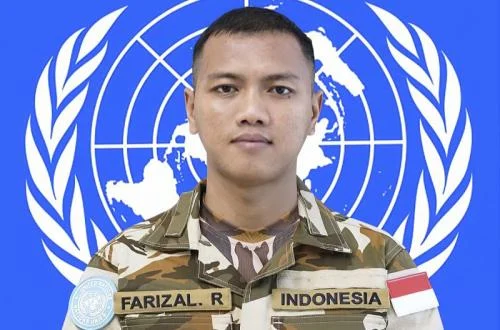
Banda Aceh, Indonesia — Praka Farizal Romadhon, a dedicated soldier of the Indonesian National Armed Forces (TNI), was tragically killed on Sunday, March 29, 2020, following an artillery attack in Southern Lebanon. The incident, which also left three other Indonesian peacekeepers injured, cast a somber shadow over Indonesia’s long-standing commitment to global peace missions under the United Nations banner. Farizal, described by his peers and superiors as a pious, friendly, and highly dedicated individual, was serving with the United Nations Interim Force in Lebanon (UNIFIL) when the shelling struck the Indobatt UNP 7-1 area in the town of Adshit Al-Qusyar. His untimely death serves as a poignant reminder of the inherent dangers faced by men and women in uniform who dedicate their lives to maintaining stability in volatile regions across the globe.
Praka Farizal Romadhon, a member of the Infantry Battalion 113/Jaya Sakti (Yonif 113/JS), was part of the Mechanized Battalion Task Force of the Indonesian Garuda Contingent XXIII-S. His mission in Lebanon began in April 2019, with a scheduled return to Indonesia in May 2020, a homecoming he would tragically never make. Farizal leaves behind his wife, Fafa Nur Azila, and their two-year-old child, Shanaya Almahyra Elshanu, whose lives are now irrevocably altered by this profound loss. His superiors lauded his unwavering loyalty and exceptional dedication to duty, qualities that resonated deeply with those who served alongside him. Kolonel Inf Mustafa Kamal, the Head of Information for the Iskandar Muda Military Command (Kapendam Iskandar Muda), conveyed the profound grief felt by the military community, emphasizing Farizal’s exemplary character and the void his passing leaves.
The Attack in Southern Lebanon: Details and Context
The artillery strike that claimed Praka Farizal’s life occurred amidst a period of heightened tensions in the volatile region of Southern Lebanon. While the precise origin and target of the shelling were immediately subject to investigation, the area routinely experiences cross-border skirmishes and military activities, particularly involving Israeli forces and Hezbollah militants operating within Lebanon. UNIFIL’s mandate is to monitor the cessation of hostilities, accompany and support the Lebanese Armed Forces (LAF) in Southern Lebanon, and ensure humanitarian access, all within a complex and often hostile operational environment. The attack on a UN position, regardless of intent, underscores the fragile peace and the constant threat of escalation that peacekeepers navigate daily.
The Indobatt UNP 7-1 post, situated in Adshit Al-Qusyar, is one of many strategically located positions manned by UNIFIL forces along the Blue Line, the demarcation line between Lebanon and Israel. These posts are designed to observe, report, and act as a deterrent to conflict. However, their static nature also makes them vulnerable to indirect fire, such as artillery or rocket attacks, especially when fighting erupts between various factions. The immediate aftermath of the strike saw a rapid response from UNIFIL medical teams and support personnel. Besides Praka Farizal’s fatality, Praka Rico Pramudia sustained severe injuries, while Praka Bayu Prakoso and Praka Arif Kurniawan suffered minor wounds. All injured personnel received intensive medical treatment, highlighting the immediate and critical care protocols in place for such emergencies.
Indonesia’s Enduring Commitment to Peacekeeping
Indonesia has a proud and extensive history of contributing to UN peacekeeping missions, a commitment that dates back to 1957 with the dispatch of its first contingent, the Garuda I, to the United Nations Emergency Force (UNEF) in Egypt. Over the decades, Indonesia has grown to become one of the largest troop-contributing countries (TCCs) globally, consistently deploying thousands of its highly trained military and police personnel to various conflict zones. As of recent years, Indonesia typically ranks among the top ten TCCs, with significant deployments in missions such as UNIFIL in Lebanon, MINUSCA in the Central African Republic, and MONUSCO in the Democratic Republic of Congo.
The Indonesian Garuda Contingent (Kontingen Garuda) is celebrated for its professionalism, discipline, and cultural sensitivity, often engaging in civil-military cooperation projects that benefit local communities alongside their primary security duties. Their presence in Lebanon under UNIFIL dates back to 2006, following the devastating conflict between Israel and Hezbollah. Since then, thousands of Indonesian soldiers have served in the mission, earning a reputation for diligence and effectiveness. This long-standing commitment is rooted in Indonesia’s constitutional mandate to participate in maintaining world order based on freedom, eternal peace, and social justice, making the sacrifice of Praka Farizal Romadhon a profound national loss but also a testament to this unwavering dedication.
UNIFIL’s Mandate and the Perilous Mission
UNIFIL was established by the UN Security Council Resolutions 425 and 426 in March 1978, initially to confirm the withdrawal of Israeli forces from Lebanon, restore international peace and security, and assist the Government of Lebanon in restoring its effective authority in the area. Its mandate was significantly expanded following the 2006 conflict by Resolution 1701, authorizing UNIFIL to monitor the cessation of hostilities, support the Lebanese Armed Forces in establishing an area free of unauthorized armed personnel, and facilitate humanitarian access to civilian populations.
The mission operates in a highly complex and often dangerous geopolitical landscape, bordered by a long-standing, unresolved conflict. Peacekeepers from over 40 countries serve under UNIFIL, collectively working to prevent a relapse into full-scale war. They conduct patrols, establish observation posts, engage in liaison with both Lebanese and Israeli forces, and respond to incidents along the Blue Line. The primary threats peacekeepers face include landmines and unexploded ordnance, targeted attacks from non-state armed groups, and being caught in the crossfire during escalations between belligerents. The attack on the Indobatt UNP 7-1 position underscored these inherent dangers, reminding the international community of the daily risks UNIFIL personnel undertake to uphold peace. Since its inception, UNIFIL has suffered numerous casualties, with hundreds of peacekeepers losing their lives in the line of duty, a grim statistic that highlights the ultimate sacrifice made in the pursuit of peace.
Chronology of Events and Immediate Aftermath
The tragic sequence of events began on Sunday, March 29, 2020. Praka Farizal Romadhon, along with his fellow Indonesian peacekeepers, was on duty at the Indobatt UNP 7-1 position in Adshit Al-Qusyar, Southern Lebanon. The exact time of the artillery strike was not immediately disclosed, but the impact was swift and devastating. The shelling directly hit the UN post, causing immediate casualties.
- Sunday, March 29, 2020: Artillery shell strikes Indobatt UNP 7-1 position. Praka Farizal Romadhon is killed. Praka Rico Pramudia sustains severe injuries. Praka Bayu Prakoso and Praka Arif Kurniawan suffer minor injuries.
- Immediate Aftermath: UNIFIL forces secure the area, provide first aid to the injured, and transport them to medical facilities. The incident is immediately reported up the chain of command within UNIFIL and to the respective national contingents.
- Following Days: The Indonesian military leadership, including the Head of Information for the TNI Headquarters (Kapuspen Mabes TNI), Mayjen Aulia Dwi Nasrullah, is informed and initiates the complex process of repatriating Praka Farizal’s remains. The Indonesian Embassy in Beirut (KBRI Beirut) plays a crucial role in facilitating the administrative procedures and logistical arrangements.
- Repatriation Process: Praka Farizal’s body is respectfully moved to the East Sector Headquarters (HQ) awaiting transfer. This process involves close coordination between UNIFIL, the Indonesian government, and Lebanese authorities, adhering to international protocols for fallen peacekeepers.
Repatriation Efforts and Support for Families
The repatriation of a fallen peacekeeper is a solemn and meticulously planned operation. Mayjen Aulia Dwi Nasrullah confirmed that the administrative process for Praka Farizal’s return to Indonesia was immediately underway, with the full support of the Indonesian Embassy in Beirut. Such a process typically involves forensic identification, official documentation, and careful logistical planning to ensure the dignified transfer of the fallen soldier. The body would be transported by air, often with military honors, back to Indonesia, where further ceremonies would take place before his final resting place.
Beyond the immediate repatriation, the TNI has a comprehensive support system for the families of fallen soldiers. This includes financial assistance, psychological counseling, and long-term care for dependents. The profound impact on Praka Farizal’s wife, Fafa Nur Azila, and their young child, Shanaya Almahyra Elshanu, is immense, and the military’s commitment extends to ensuring their well-being in the wake of this tragedy. This support underscores the military’s understanding of the collective sacrifice made by soldiers and their families in service to the nation and global peace.
The Broader Regional Tensions
The incident involving Praka Farizal Romadhon cannot be viewed in isolation but rather as a grim manifestation of the simmering tensions in Southern Lebanon. The region is a flashpoint, characterized by a complex interplay of actors: the Lebanese Armed Forces (LAF), UNIFIL, various Palestinian factions, and Hezbollah, a powerful Shiite political party and militant group supported by Iran. Across the Blue Line, Israel maintains a significant military presence, often responding to perceived threats or actual incursions from Lebanese territory.
In the period leading up to and around March 2020, there were periodic reports of cross-border incidents, aerial incursions, and general instability. These often involve Israeli surveillance flights over Lebanese airspace, which Lebanon considers a violation of its sovereignty, and occasional rocket fire from Lebanon into Israel. Such actions, regardless of their scale, heighten the risk of miscalculation and escalation, turning the UNIFIL area of operations into a dangerous battleground. The artillery attack on the UN position, therefore, likely occurred within this broader context of regional volatility, where peacekeepers are inadvertently caught in the crossfire of deeply entrenched conflicts.
Official Responses and Calls for Investigation
Immediately following the attack, official statements from various parties began to emerge. The Indonesian National Armed Forces expressed its deep sorrow and condemned the attack. Mayjen Aulia Dwi Nasrullah, while confirming the casualties and repatriation efforts, also stated that the TNI was awaiting the results of an investigation by UNIFIL to ascertain the full details of the attack, including its perpetrators and precise circumstances. Such investigations are standard procedure for incidents involving UN personnel and are crucial for accountability and for informing future safety protocols.
UNIFIL itself would have launched a thorough investigation, likely involving its internal security and intelligence units, to determine the trajectory of the shelling, identify the type of ordnance used, and gather any available intelligence to pinpoint responsibility. These investigations are critical not only for justice but also for UNIFIL’s operational safety, enabling the force to adapt its posture and procedures to mitigate future risks. International condemnation typically follows attacks on peacekeepers, reinforcing the principle that UN personnel are protected under international humanitarian law and that attacks against them may constitute war crimes. The Indonesian government would also likely issue a diplomatic protest, either through the UN or directly to relevant parties, depending on the investigation’s findings.
Implications for Future Peacekeeping Operations
The death of Praka Farizal Romadhon carries significant implications for Indonesia’s peacekeeping efforts and for UNIFIL’s operations. For Indonesia, it is a stark reminder of the sacrifices involved in contributing to global peace. While such incidents can impact morale, Indonesia’s long history of peacekeeping suggests a steadfast commitment despite the dangers. The TNI’s announcement of increased vigilance for its peacekeepers serving abroad underscores a pragmatic approach to enhancing safety measures, potentially involving revised tactical procedures, improved defensive postures at UN posts, and enhanced intelligence sharing.
For UNIFIL, the incident highlights the ongoing challenges of its mandate in a region perpetually on the brink. It may prompt a review of existing security protocols, force protection measures, and rules of engagement. The incident serves as a grim statistic in the broader narrative of peacekeeping, where the pursuit of peace often comes at the ultimate cost. It reinforces the need for robust political solutions to underlying conflicts, as peacekeepers can only manage the symptoms, not cure the disease of war. The international community is reminded that the safety of peacekeepers is paramount and directly linked to the willingness of belligerents to respect UN mandates and international law. Praka Farizal Romadhon’s sacrifice will undoubtedly resonate through the ranks of the TNI and the wider UN peacekeeping community, serving as a powerful, albeit tragic, testament to the enduring human cost of maintaining peace in a fractured world. His memory will endure as a symbol of courage, dedication, and the ultimate sacrifice made in service to humanity.