Nasution Nanang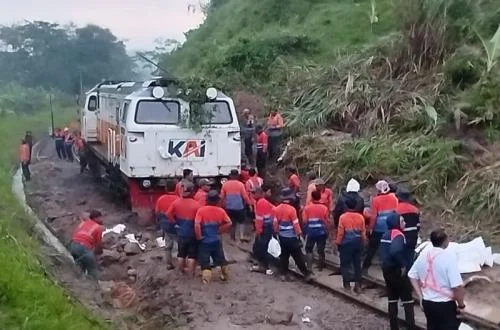
PT Kereta Api Indonesia (KAI) Daerah Operasi (Daop) 2 Bandung has confirmed a 100 percent refund policy for all passengers impacted by the significant disruption to train services following a major landslide in the Maswati-Sasaksaat section of West Bandung. The incident, which occurred on Wednesday, April 1st, 2024, resulted in the complete blockage of the crucial rail line connecting Bandung to Jakarta and Cirebon, prompting immediate cancellations and partial rerouting of numerous train journeys. In addition to the full refunds, KAI has proactively deployed a fleet of buses to provide alternative transportation, demonstrating its commitment to passenger welfare and operational responsibility in the face of unforeseen natural disasters.
The critical railway stretch between Maswati and Sasaksaat, a vital artery for passenger and freight movement in West Java, experienced a substantial landslide on the afternoon of April 1st. Heavy rainfall, characteristic of Indonesia’s wet season, is believed to have contributed to the instability of the terrain, leading to a massive volume of earth and debris cascading onto the tracks. The severity of the incident was underscored by reports that the landslide material not only completely covered the main line but also impacted a locomotive, causing it to derail. This immediate and severe obstruction necessitated the immediate suspension of all rail traffic through the affected sector, triggering widespread disruptions across KAI Daop 2’s network.
Chronology of the Incident and Immediate Response
The landslide was first reported on Wednesday, April 1st, 2024, around 1:00 PM local time, when ground crews detected unusual ground movement followed by the collapse of a section of the embankment near the Maswati-Sasaksaat tunnel. Within minutes, the main railway line became impassable. Emergency protocols were swiftly activated by KAI Daop 2. Initial assessments revealed that a considerable volume of soil, rocks, and vegetation had inundated the tracks, rendering them unsafe for passage. Furthermore, a locomotive that was either passing through or stationed nearby at the time of the incident was reportedly struck by the falling debris, resulting in a derailment. While details regarding potential injuries to personnel aboard the locomotive were not immediately released, the primary concern quickly shifted to passenger safety and the integrity of the rail infrastructure.
By late afternoon, as the full extent of the damage became clear, KAI Daop 2 announced the immediate cancellation of several key services and partial disruptions to others. This decision, though difficult, was paramount for passenger safety. Public relations teams were mobilized to disseminate information through various channels, including official KAI websites, social media platforms, and direct communications with affected passengers. The announcement of a 100 percent refund policy came shortly after, aiming to mitigate the financial burden on travelers whose plans had been unexpectedly upended. Simultaneously, KAI began coordinating with local bus operators to arrange alternative transport, particularly for passengers stranded at stations or those whose journeys were halted mid-route. Engineering teams, equipped with heavy machinery and specialized tools, were dispatched to the landslide site to commence preliminary assessment and initial clearing operations, even as intermittent rain continued to fall, complicating efforts.
KAI’s Comprehensive Passenger-Centric Response
Manajer Humas KAI Daop 2 Bandung, Kuswardojo, officially confirmed the implementation of the 100 percent refund policy. "This measure is taken as a form of our responsibility due to the cessation of operations for several train services caused by the landslide material blocking the main track," Kuswardojo stated. He emphasized that passengers affected by the cancellations could process their refunds for the full ticket value, providing a clear and unequivocal commitment to financial restitution. This policy applies universally to all passengers, irrespective of whether their journey was completely cancelled or only partially disrupted.
The refund mechanism has been designed for ease of access, allowing passengers to initiate the process at designated KAI counters at any station, or through digital channels where applicable, within a specified timeframe following the incident. KAI’s proactive approach in offering full refunds immediately underscores its understanding of the inconvenience and financial implications such such unforeseen events can have on travelers. It also reflects a standard operating procedure for KAI during significant service interruptions, aiming to maintain passenger trust and loyalty.
Beyond financial compensation, KAI recognized the immediate need for continued mobility for many passengers. As a result, a robust alternative transportation plan was swiftly put into action. A fleet of buses was procured and deployed to transport passengers who still wished to continue their journeys to their intended destinations. For instance, passengers from Bandung intending to travel towards Jakarta or Cirebon, whose train services were cancelled, were offered bus transfers from Bandung stations to points beyond the affected landslide zone, from where they could potentially resume their rail journey or complete it via bus. Similarly, passengers traveling in the opposite direction were met at unaffected stations and bused to their final destinations. The logistics involved in coordinating these bus services, especially during an emergency, are complex, requiring rapid assessment of passenger numbers, route planning, and effective communication to ensure smooth transitions. This dual approach of full refunds and alternative transport highlights KAI’s multi-faceted strategy for crisis management, prioritizing both financial fairness and practical solutions for its clientele.
Affected Routes and Broader Impact on Connectivity
The landslide had a far-reaching impact on various train services operating under KAI Daop 2. According to internal data, several popular routes experienced either total cancellations or significant partial disruptions. Among those fully cancelled were the KA Parahyangan (train numbers 134B, 139B, 140B), which are crucial services connecting Bandung with Jakarta. The Parahyangan service is particularly vital, catering to a substantial number of daily commuters and business travelers between Indonesia’s capital and the West Javan provincial capital. Its cancellation alone can disrupt thousands of individual travel plans and have ripple effects on local economies dependent on this inter-city connection.
In addition to the total cancellations, several other prominent inter-city and regional services faced partial disruptions. These included the KA Harina, which typically serves routes connecting Bandung with cities further east and north; the KA Papandayan, another significant inter-city service; the KA Serayu, a popular long-distance route; the KA Ciremai, connecting Bandung to the northern coastal city of Cirebon; and the KA Commuter Line Garut, a regional service important for local residents. Partial cancellations often mean that trains can only operate up to a certain point before the affected section, requiring passengers to disembark and find alternative transport for the remainder of their journey, or utilize KAI’s provided buses.
The Maswati-Sasaksaat section is strategically important as it forms a critical bottleneck in the railway network. It is part of the main line that connects the heavily populated Bandung region not only to Jakarta but also to the northern coastal cities like Cirebon, which then serve as gateways to Central and East Java. Any prolonged closure of this segment can severely hamper regional mobility and trade, impacting tourism, business travel, and the movement of goods. The disruption underlines the vulnerability of key infrastructure to natural phenomena, especially in geologically active and rain-prone regions like West Java. The ripple effect extends beyond KAI’s immediate operations, potentially affecting bus terminals, airport traffic (as travelers seek alternatives), and local businesses reliant on smooth transportation networks.
The Challenging Road to Restoration and Infrastructure Resilience
As of Thursday, April 2nd, Kuswardojo stated that KAI was still intensely focused on normalizing the affected railway line as quickly as possible. Despite the continued challenge of rainfall, which complicates earthmoving and stabilization efforts, technical personnel remained deployed at the site around the clock. The restoration process for a major landslide of this scale is inherently complex and time-consuming. It involves several critical stages: initial site assessment to determine the volume of material and geological stability, heavy equipment mobilization (excavators, bulldozers, dump trucks), debris removal, track inspection for structural damage, ballast replacement, rail realignment, and potentially embankment stabilization measures to prevent future occurrences. The fact that a locomotive was also derailed adds another layer of complexity, requiring specialized equipment for re-railing and recovery.
The geographical context of the Maswati-Sasaksaat area is crucial to understanding the challenges. West Bandung, like many parts of West Java, is characterized by its mountainous and hilly terrain. Such landscapes, combined with intense and prolonged rainfall during the wet season (typically from October to April), make them highly susceptible to landslides. KAI has historically invested in infrastructure resilience, including slope reinforcement, drainage improvements, and regular geological surveys along its mountainous routes. However, the sheer force and volume of material in a significant landslide can overwhelm even robust preventative measures.
KAI’s commitment to expediting the normalization process reflects not only its operational mandate but also its understanding of the critical role the railway plays in national infrastructure. The railway line between Bandung and Jakarta, in particular, has seen increased usage in recent years, complementing road and air travel. Ensuring its rapid and safe restoration is paramount for maintaining regional economic vitality and connectivity. Engineering teams work under immense pressure, prioritizing safety while striving for efficiency. Their efforts often involve close coordination with geological experts and local disaster management agencies to ensure that the cleared path remains stable and safe for future train operations. Lessons learned from such incidents often contribute to refining KAI’s disaster preparedness and infrastructure maintenance protocols, driving continuous improvement in rail safety and resilience against natural hazards.
Broader Implications and Forward Outlook
The Sasaksaat landslide incident, while a localized event, carries broader implications for Indonesia’s transportation sector and national infrastructure resilience. For KAI, it represents a test of its contingency planning, crisis communication strategies, and operational agility. The swift implementation of a 100 percent refund policy and the provision of alternative transportation are positive indicators of KAI’s commitment to passenger service and crisis management. However, such disruptions inevitably incur significant financial costs, not only from refunds but also from the extensive resources required for track repair, equipment deployment, and potential revenue losses from cancelled services.
Economically, the prolonged closure of a key rail link can have a noticeable impact on local businesses, tourism, and supply chains. Businesses reliant on the timely transport of goods or the flow of customers between Bandung, Jakarta, and Cirebon may experience delays and losses. Tourists planning weekend getaways or business travelers with critical meetings face unforeseen hurdles, potentially shifting their travel preferences towards other modes of transport or postponing trips altogether. While the direct economic impact of a single, albeit severe, landslide might be localized, the cumulative effect of such incidents across the country during the rainy season underscores the vulnerability of critical infrastructure.
Looking ahead, the incident reinforces the importance of continuous investment in infrastructure maintenance and upgrades, particularly in regions prone to natural disasters. This includes advanced geological monitoring systems, slope stabilization projects, and robust drainage solutions. KAI’s ongoing efforts to normalize the track "as quickly as possible" even "under the downpour of rain" demonstrates the determination of its workforce. While there were no immediate cancellations for Thursday morning’s departures, the situation remained fluid, with KAI continuously monitoring the progress of restoration and communicating updates to the public.
Ultimately, the incident serves as a stark reminder of the challenges posed by nature to human infrastructure. KAI’s response, characterized by transparency, passenger-centric policies, and relentless restoration efforts, aims to minimize the impact and restore confidence. As the nation navigates the complexities of natural phenomena, the resilience of its transport networks and the efficacy of its crisis management protocols remain paramount for sustained development and public welfare. The dedication of KAI’s personnel on the ground, working under challenging conditions, is a testament to the organization’s commitment to ensuring the safety and continuity of Indonesia’s vital railway system.