Nasution Nanang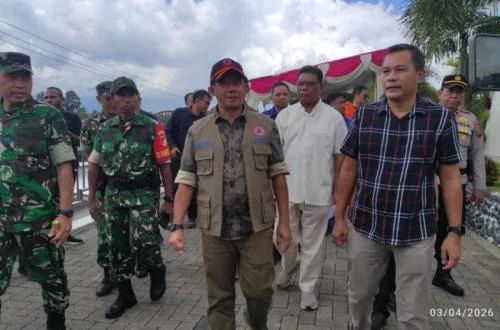
The Head of the National Disaster Management Agency (BNPB), Lieutenant General Suharyanto, undertook a critical visit to the Bunda Hati Kudus Yesus Parish Church in Rumengkor, Minahasa Regency, on Friday, April 3, 2026. This visit followed a powerful 7.6 magnitude earthquake that had struck the region just a day prior, causing significant tremors and damage across parts of Sulawesi and Maluku. The primary objective of the BNPB chief’s visit was to conduct an immediate assessment of the structural integrity of the church building, a vital community hub, particularly as it prepared for the solemn observances of Good Friday, a pivotal religious holiday for the Catholic community.
The earthquake, registered at 7.6 on the Richter scale, had sent shockwaves through the eastern Indonesian archipelago, underscoring the nation’s perennial vulnerability to seismic activity. Rumengkor, nestled within the Minahasa Regency of North Sulawesi, found itself among the areas impacted, with the Bunda Hati Kudus Yesus Church sustaining visible damage, notably the collapse of its ceiling. This incident not only presented an immediate challenge for the local congregation but also highlighted broader concerns regarding infrastructure resilience in a region frequently tested by geological forces.
Chronology of the Seismic Event and Initial Aftermath
The seismic event that prompted Lieutenant General Suharyanto’s urgent visit occurred on Thursday, April 2, 2026, at precisely 05:48 Western Indonesian Time (WIB). The Indonesian Agency for Meteorology, Climatology, and Geophysics (BMKG) swiftly identified the epicenter of the earthquake as being situated in the sea, specifically 129 kilometers southeast of Bitung, North Sulawesi. Its focal depth was recorded at 33 kilometers, indicating a shallow to moderate-depth earthquake, which often correlates with more significant surface shaking and potential for widespread damage. The initial location provided by BMKG placed the epicenter southwest of Batang Dua Island, Ternate, Maluku Utara, emphasizing the extensive reach of the tremor across provincial boundaries.
Reports from various affected areas began to filter in shortly after the quake. In Manado, the provincial capital of North Sulawesi, the impact was tragically marked by one fatality and several injuries. Structural damage was also reported, including the left wing of the KONI Sario building, a prominent sports complex, and the aforementioned collapse of the ceiling within the Bunda Hati Kudus Yesus Parish Church in Rumengkor. These initial reports underscored the urgency of a coordinated disaster response and the necessity for rapid damage assessments, particularly for structures of public importance and those crucial for community well-being. The timing of the earthquake, just ahead of the Easter Triduum, added another layer of complexity and emotional resonance for the Christian communities preparing for their most sacred days.
BNPB’s Role and Immediate Response
Following the initial reports and BMKG’s analysis, the National Disaster Management Agency (BNPB) activated its protocols for post-earthquake response. As the coordinating body for disaster management in Indonesia, BNPB’s mandate encompasses a full cycle of disaster management: prevention, mitigation, preparedness, response, and recovery. In the immediate aftermath of a significant event like the 7.6 magnitude earthquake, BNPB’s role shifts to rapid assessment, deployment of resources, coordination with local authorities, and provision of humanitarian aid.
Lieutenant General Suharyanto’s visit to Rumengkor was a direct manifestation of this mandate. It served not only as a symbolic gesture of the central government’s concern but also as a practical step to gather first-hand information on the ground. During his visit, the BNPB chief personally inspected the damaged sections of the Bunda Hati Kudus Yesus Church. He engaged with local community leaders and church officials, including Pastor Emanuel Ohoiwutun, the parish leader. Beyond the inspection, the BNPB provided immediate relief in the form of Rp10 million (approximately USD 650) in cash assistance, alongside packages of food supplies specifically tailored for children and elderly members of the church community. This immediate aid, while modest, serves as a crucial initial lifeline and demonstrates the government’s commitment to supporting affected communities.
Suharyanto emphasized that the broader response and repair efforts would require close coordination with the Minahasa Regency Government. This highlights the multi-tiered approach to disaster management in Indonesia, where national agencies like BNPB work in tandem with provincial and district-level disaster management agencies (BPBDs) to ensure effective and localized interventions.
Geological Context and Seismic Vulnerability of Indonesia
Indonesia is famously situated on the Pacific Ring of Fire, an arc of intense seismic activity that encircles the Pacific Ocean. This geological setting makes the archipelago one of the most earthquake-prone regions in the world, experiencing frequent tremors, volcanic eruptions, and tsunamis. The interaction of several major tectonic plates – the Eurasian, Pacific, Indo-Australian, and Philippine Sea plates – creates immense geological stress, which is periodically released in the form of earthquakes.
The region encompassing Sulawesi and Maluku, where this 7.6 magnitude earthquake originated, is particularly complex. It sits at the convergence of multiple microplates and fault systems, including the Sorong Fault, Palu-Koro Fault, and other smaller, localized fault lines. This intricate tectonic environment contributes to the high frequency and intensity of seismic events in the area. Historical data reveals a pattern of significant earthquakes affecting these islands, underscoring the imperative for robust earthquake-resistant infrastructure and comprehensive disaster preparedness measures. For instance, Sulawesi has experienced devastating quakes in recent memory, such as the 2018 Palu earthquake and tsunami, which highlighted the catastrophic potential of such events. The 2026 earthquake, while not immediately triggering a tsunami warning, served as another stark reminder of the ever-present threat.
Understanding this geological context is crucial for appreciating the challenges faced by communities like Rumengkor. Every building constructed in this region, whether a residential home, a school, or a place of worship, must contend with the reality of potential seismic stress.
The Significance of Religious Institutions in Disaster Contexts
Churches, mosques, temples, and other religious institutions often serve as more than just places of worship in Indonesian communities. They are frequently central to social life, acting as community centers, educational hubs, and gathering places for various events. In times of crisis, they can transform into temporary shelters, distribution points for aid, or centers for emotional and spiritual support.
The Bunda Hati Kudus Yesus Parish Church in Rumengkor exemplifies this multifaceted role. Its damage, particularly so close to Good Friday, carried profound implications beyond structural integrity. Good Friday marks the crucifixion of Jesus Christ and is a day of deep spiritual reflection and communal mourning for Catholics worldwide. The inability to conduct services in their primary place of worship due to earthquake damage would undoubtedly be a source of distress for the local congregation, compounding the physical trauma of the disaster with spiritual disruption.
Pastor Emanuel Ohoiwutun’s expression of gratitude for the government’s attention and his hope for swift realization of aid underscores the community’s reliance on both material and spiritual restoration. The church’s reconstruction or repair is not merely about rebuilding a physical structure; it is about restoring a sense of normalcy, community cohesion, and spiritual solace for the parishioners. The timing of the BNPB chief’s visit, therefore, carried significant symbolic weight, acknowledging the cultural and spiritual importance of the site.
Statements and Reactions from Related Parties
Beyond the direct interactions, the broader implications of the earthquake and the subsequent response elicited reactions from various stakeholders.
Lieutenant General Suharyanto (BNPB Head): His statements consistently emphasized the commitment of the central government to support affected regions. "We are here to ensure that the immediate needs are met and to coordinate with the local government for the comprehensive recovery phase," Suharyanto was quoted as saying, highlighting the collaborative approach. He likely underscored the importance of resilience building and adherence to earthquake-resistant building codes in future reconstruction efforts to mitigate risks. His visit also sent a clear message about the national priority placed on disaster response and the well-being of affected communities.
Pastor Emanuel Ohoiwutun (Parish Leader, Bunda Hati Kudus Yesus): The pastor’s gratitude was heartfelt. "We are deeply thankful for the immediate attention and support from the central government, especially the Head of BNPB. This visit brings hope to our community, particularly as we approach the sacred days of Good Friday and Easter. We pray that the promised assistance will be realized swiftly so that our church can once again serve as a beacon of faith and community for our parishioners," Pastor Ohoiwutun likely articulated, reflecting the profound spiritual and communal impact of the damage. His plea for swift action underscored the urgency of restoring the church’s functionality.
Minahasa Regency Government Officials: While not directly quoted in the original brief, local government officials, likely represented by the Regent or Head of the Regional Disaster Management Agency (BPBD) for Minahasa, would have pledged full cooperation with BNPB. Their statements would likely focus on ongoing damage assessments across the entire regency, mobilization of local resources, and the well-being of all affected citizens. They would also likely emphasize the need for sustained national support given the scale of the disaster and the financial implications of comprehensive recovery. "Our immediate priority is to ensure the safety and well-being of all residents affected by this earthquake. We are working closely with BNPB to streamline aid distribution and plan for long-term recovery efforts," a local official might have stated, highlighting the partnership.
BMKG (Indonesian Agency for Meteorology, Climatology, and Geophysics): BMKG’s role is primarily scientific and informative. Their statements would have focused on the technical aspects of the earthquake, its parameters, and ongoing monitoring for aftershocks. They would also likely reiterate public safety advisories, encouraging residents to remain vigilant and follow official guidelines. "We continuously monitor seismic activity and provide real-time information to aid disaster response. We urge the public to remain calm but alert, and to consult official sources for updates," a BMKG spokesperson would typically advise, reinforcing their commitment to public safety through accurate data.
Broader Impact and Implications for Disaster Resilience
The 2026 earthquake and its aftermath in Rumengkor extend beyond immediate damage and aid. They highlight several critical implications for disaster management and community resilience in Indonesia.
Firstly, the event underscores the persistent challenge of infrastructure resilience. While Indonesia has made strides in disaster preparedness, the widespread nature of seismic threats means that many existing structures, particularly older ones, may not meet modern earthquake-resistant building standards. The damage to both public buildings like the KONI Sario complex and community structures like the church signals a need for ongoing structural assessments, retrofitting programs, and strict enforcement of building codes for new constructions.
Secondly, the incident reinforces the importance of effective inter-agency coordination. The successful management of a disaster of this scale requires seamless collaboration between national bodies like BNPB, provincial governments, local BPBDs, military and police forces, and civil society organizations. Suharyanto’s emphasis on coordinating with the Minahasa Regency Government is a testament to this principle. Clear lines of communication, shared data, and unified command structures are vital for efficient resource allocation and timely response.
Thirdly, the focus on the Bunda Hati Kudus Yesus Church brings to light the socio-cultural dimension of disaster recovery. Rebuilding a physical structure is one aspect; restoring the spiritual and communal fabric is another. Disaster recovery plans must integrate considerations for cultural heritage, religious sites, and social institutions that hold significant meaning for communities. Providing support for these entities contributes not only to physical reconstruction but also to psychological healing and the restoration of community morale.
Finally, this earthquake serves as a renewed call for enhanced public awareness and preparedness. Despite Indonesia’s frequent exposure to disasters, continuous education on earthquake safety protocols, evacuation routes, and emergency kits remains paramount. Regular drills, community-based disaster risk reduction programs, and accessible information can empower individuals and families to respond effectively when disaster strikes, ultimately saving lives and minimizing injuries.
In the long term, the recovery from the 2. April 2026 earthquake in Minahasa will require a sustained commitment from all levels of government and civil society. It will involve not just repairing damaged buildings but also investing in more resilient infrastructure, strengthening early warning systems, and fostering a culture of preparedness that permeates every community. The visit of Lieutenant General Suharyanto to Rumengkor, while addressing an immediate need, also symbolically laid the groundwork for these broader, long-term resilience efforts in a nation perpetually living on the Ring of Fire.