Nasution Nanang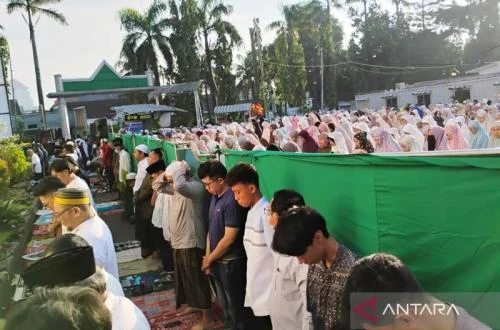
JAKARTA – Thousands of Muhammadiyah congregants in Jakarta, along with millions more across Indonesia, observed Eid al-Fitr prayers on Friday morning, underscoring a prevailing spirit of tolerance and mutual respect despite the recurring differences in determining the start of the Islamic month of Syawal. The focal point of the celebrations in the capital was the Baitusy Syifa Mosque at RS Islam Pondok Kopi, East Jakarta, where the sheer volume of worshippers spilled far beyond the mosque’s confines, transforming adjacent streets and sidewalks into an expansive prayer ground. This early observance by Muhammadiyah, one of Indonesia’s largest Islamic organizations, precedes the official government declaration of Eid al-Fitr, which typically follows the Ministry of Religious Affairs’ Sidang Isbat (official deliberation session) based on moon sighting.
The annual divergence in Eid al-Fitr dates has become a familiar aspect of Indonesia’s vibrant religious landscape. While the government, often aligned with Nahdlatul Ulama (NU), another prominent Islamic organization, primarily relies on the rukyatul hilal (physical sighting of the crescent moon) combined with specific imkanur rukyat (visibility criteria) to declare the beginning of Hijri months, Muhammadiyah consistently employs the hisab wujudul hilal method. This astronomical calculation, which determines the new moon’s conjunction and its presence above the horizon at sunset, allows Muhammadiyah to announce its Eid dates well in advance. For this year, Muhammadiyah’s Central Leadership (PP Muhammadiyah) had decreed Eid al-Fitr to fall on Friday, April 12th, 2024, based on their sophisticated computational methods, while the government’s Sidang Isbat would typically be held a day or two prior to the expected Eid, often leading to a later date. This distinction, while rooted in theological and methodological variations, is widely understood and generally accepted by the diverse Indonesian populace, who often celebrate according to their respective organizational affiliations or local customs.
Understanding the Calendar Dynamics: Hisab vs. Rukyat
The methodological disparity between hisab and rukyat is central to understanding the varying Eid dates in Indonesia. Muhammadiyah’s hisab wujudul hilal method, which translates to "astronomical calculation of the visible crescent," asserts that a new Hijri month begins if the moon has already set after the sun (meaning it was visible, even if for a moment, above the horizon at sunset) at the location of observation. This approach prioritizes scientific astronomical calculation, allowing for precise and predictable calendar declarations years in advance. Adherents to this method argue that it offers certainty and avoids potential human error or environmental factors that might impede actual moon sighting.
Conversely, the rukyatul hilal method, favored by the Indonesian government and many other Islamic organizations including NU, emphasizes the physical observation of the crescent moon. This tradition is rooted in prophetic teachings, where the start of Ramadan and Eid al-Fitr are to be determined by sighting the new moon. In Indonesia, this practice is further refined by the imkanur rukyat (criteria for moon visibility), which specifies minimum angular height and elongation of the crescent moon for it to be considered validly sighted. Historically, this criterion has often been stricter, requiring a more substantial crescent for a valid sighting. The Sidang Isbat, a comprehensive deliberation session involving religious scholars, astronomical experts, and government officials, is convened by the Ministry of Religious Affairs to review sighting reports from across the archipelago and make the final official determination. When the hilal (crescent moon) is not sighted or does not meet the imkanur rukyat criteria, the preceding month (Ramadan) is extended to 30 days.
These two distinct approaches, both valid within Islamic jurisprudence, often lead to different outcomes, especially when the new moon is barely above the horizon or conditions for sighting are unfavorable. Indonesia, with its constitutional commitment to religious freedom and pluralism, has largely managed these differences with a spirit of accommodation, allowing various Islamic groups to follow their respective interpretations while promoting national unity.
A Nation United in Diversity: The Muhammadiyah Congregation
Muhammadiyah, founded in 1912 by Ahmad Dahlan, is one of the oldest and most influential Islamic modernist movements in Indonesia. With an estimated membership ranging from 30 to 60 million adherents, its reach extends across the entire archipelago, operating a vast network of educational institutions (schools, universities), hospitals, orphanages, and mosques. The organization’s commitment to modern education, social welfare, and a reformist interpretation of Islam has shaped much of Indonesia’s social and religious fabric. Therefore, when Muhammadiyah announces its Eid al-Fitr date, it mobilizes a significant portion of the nation’s Muslim population.
The observance of Eid al-Fitr by Muhammadiyah followers on Friday, April 12th, was not confined to Jakarta. From Aceh to Papua, millions of its congregants gathered in thousands of mosques and open fields, performing the special Eid prayer. This widespread observance highlights the organizational strength and cohesive identity of Muhammadiyah, whose members consistently adhere to the decisions of their central leadership. Despite the varied dates, the underlying sentiment across all communities remains consistent: a joyous celebration marking the culmination of a month of fasting, self-reflection, and spiritual devotion during Ramadan.
The Jakarta Observance: A Chronicle of Faith and Community
The scene at Baitusy Syifa Mosque in RS Islam Pondok Kopi, East Jakarta, was a vivid testament to this collective faith. Even before dawn, congregants began to arrive, dressed in their finest traditional and modern Islamic attire – baju koko for men, modest dresses and headscarves for women – carrying prayer mats and an air of anticipation. By 6:00 AM local time, the mosque’s main prayer hall was completely full. The overflow quickly spread into the courtyards, then onto the hospital grounds, and ultimately extended onto the sidewalks and even parts of the public road surrounding the complex. Local authorities and the mosque committee had meticulously prepared for this annual surge, setting up additional sound systems, demarcating prayer lines, and deploying security personnel to ensure a smooth and orderly gathering. Traffic flow around the area was carefully managed to prevent congestion, a common challenge given the massive turnout.
The morning air vibrated with the continuous echo of takbir – "Allahu Akbar, Allahu Akbar, La Ilaha Illallah Wallahu Akbar, Allahu Akbar Walillahil Hamd" – proclaiming the greatness of God. This collective chanting filled the atmosphere with a profound sense of reverence and triumph, signaling the arrival of the day of victory after a month of spiritual struggle and discipline. The prayer itself commenced punctually, led by the Imam, followed by the congregational sermon.
The khutbah (sermon) was delivered by Irwan Akib, who holds the significant position of Chairman of Muhammadiyah Central Leadership for Education, Arts, Culture, and Sports. His address, delivered with gravitas and clarity, focused on the profound spiritual lessons learned during Ramadan. While the full text was not explicitly provided in the original report, the context suggests that his sermon would have underscored themes of gratitude to Allah for enabling the completion of Ramadan, the importance of maintaining piety beyond the fasting month, and the crucial role of unity and tolerance within the Muslim community and the broader Indonesian society. He likely emphasized that Eid al-Fitr is not merely a celebration but a moment for introspection, strengthening family bonds, and extending compassion to others, especially the less fortunate. The message of fostering harmony despite differences in religious practices would undoubtedly have resonated deeply with the diverse assembly.
Following the solemn prayer and sermon, the atmosphere shifted to one of joyful camaraderie. Congregants exchanged warm greetings, embracing friends and family, uttering "Taqabbalallahu Minna Wa Minkum" (May Allah accept from us and from you), signifying mutual prayers for acceptance of their fasting and good deeds. Children, dressed in their new clothes, added to the festive mood, their laughter echoing amidst the greetings.
Voices of Unity: Congregants’ Perspectives
The spirit of tolerance was palpable among the worshippers. Fakhri (33), a congregant who had just completed his prayers, articulated a sentiment widely shared within the Muhammadiyah community. "To me, differences in determining the start of the Hijri month or Eid are not a big issue that needs to be debated," he stated. "We must respect and appreciate every difference." His words reflect a mature understanding of religious pluralism, acknowledging that variations in interpretation are inherent to a diverse faith tradition and that mutual respect is paramount. Fakhri also expressed profound gratitude, "Alhamdulillah, the Eid prayer is over, it was so crowded after passing through the month of Ramadan. May we always be granted health until we meet again in the next holy month." This sentiment encapsulates the spiritual relief and hopeful outlook that defines Eid al-Fitr for many.
Another worshipper, Syahrul (26), echoed Fakhri’s sentiments, emphasizing the normalcy of such calendar differences. "In my opinion, the difference in the timing of Eid al-Fitr is a normal thing and should not be a source of division in society," he remarked. Syahrul further elaborated on the true essence of the celebration: "Eid al-Fitr should be a moment to strengthen brotherhood and reinforce the values of togetherness in a diverse society." His statements highlight the prevailing belief that the overarching goals of faith – unity, compassion, and community building – transcend methodological distinctions in calendar determination. These voices from the ground underscore the success of Indonesia’s pluralistic approach, where differences are acknowledged and managed without undermining social cohesion.
Broader Implications: Social Harmony and Governance
The annual phenomenon of differing Eid al-Fitr dates, particularly between Muhammadiyah and the government/NU, serves as a recurring test and affirmation of Indonesia’s foundational principles of Bhinneka Tunggal Ika (Unity in Diversity) and Pancasila. Far from being a source of serious conflict, these differences are largely absorbed within the societal fabric, showcasing a remarkable degree of religious tolerance and maturity among the populace.
From a governance perspective, the Indonesian government, through the Ministry of Religious Affairs, plays a crucial role in navigating these differences. While its Sidang Isbat aims to provide a unified official date, it also implicitly acknowledges and respects the right of organizations like Muhammadiyah to follow their own methodologies. The government typically issues appeals for mutual respect and understanding, ensuring that public services, transportation, and holiday schedules are managed to accommodate the various observances where possible. For instance, national holidays are usually set based on the government’s official declaration, but many workplaces and schools offer flexibility for those observing an earlier Eid.
Economically, the staggered celebration can have minor, nuanced impacts. While the majority of the population observes the government’s official Eid date, an earlier celebration by a significant minority like Muhammadiyah means that consumption patterns, travel flows, and retail activities begin earlier for some segments of society. This can lead to a more spread-out "Eid rush" in certain sectors, rather than a single, concentrated peak. However, given the overall scale of Eid al-Fitr as a national holiday, these effects are generally well-managed and do not pose significant disruptions to the broader economy.
Looking ahead, discussions about the possibility of a unified Hijri calendar in Indonesia periodically resurface among religious scholars and policymakers. Proponents argue that a single calendar would eliminate confusion and further solidify national unity. However, achieving such a consensus is complex, given the deeply rooted theological and methodological commitments of various Islamic organizations. Any move towards a unified calendar would require extensive dialogue, compromise, and a willingness to reconcile different interpretations of Islamic law and astronomical science. For now, Indonesia continues to embrace its unique approach, where religious diversity is not merely tolerated but celebrated, and where the spirit of Eid al-Fitr, regardless of its precise timing, unites millions in gratitude, reflection, and communal joy. The congregants at Baitusy Syifa Mosque, and millions like them, embody this enduring spirit of a nation that finds strength in its multifaceted faith.