Bambang Pamungkas
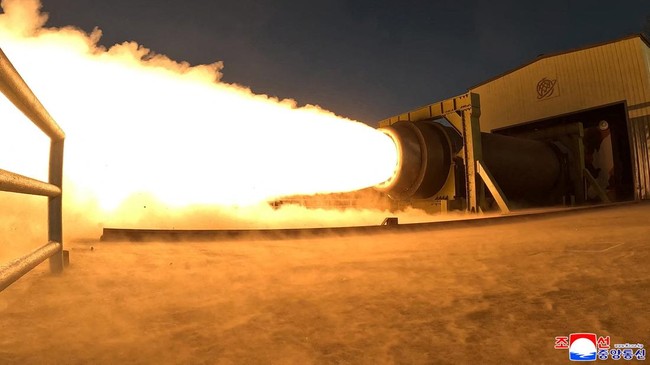
Pyongyang has announced a significant advancement in its strategic weapons program, successfully conducting a ground test of an upgraded solid-fuel rocket engine under the direct supervision of leader Kim Jong Un. This latest development, reported by North Korean state media, underscores the nation’s accelerating efforts to bolster its missile capabilities, particularly its intercontinental ballistic missile (ICBM) arsenal, which analysts believe could soon possess a truly global reach. The test achieved a formidable thrust of 2,500 kilonewtons, marking a substantial increase from a previous test in September of the preceding year, which registered 1,971 kilonewtons. While the official Korean Central News Agency (KCNA) did not specify the exact date or location of the test, it framed the event as a pivotal step in fulfilling the objectives of the country’s latest five-year defense development plan.
The Strategic Significance of Solid-Fuel Technology
The pursuit and successful testing of advanced solid-fuel rocket engines represent a critical leap forward for North Korea’s missile program, offering distinct strategic advantages over traditional liquid-fueled systems. Liquid-fueled missiles, while powerful, require extensive pre-launch preparations, including the meticulous process of fueling, which can take hours or even days. This lengthy procedure makes them highly vulnerable to pre-emptive strikes, as their launch sites can be easily detected and targeted by adversaries. The complex logistics of transporting and handling corrosive liquid propellants also present significant operational challenges and safety risks.
In stark contrast, solid-fuel missiles come pre-packaged with their propellant, allowing for much quicker deployment. They can be stored for extended periods, transported covertly on mobile launchers (Transporter Erector Launchers or TELs), and launched with minimal warning. This "shoot-and scoot" capability dramatically enhances their survivability, making them harder to detect, track, and intercept. The reduced launch signature, with less observable pre-launch activity, adds another layer of operational stealth, complicating the intelligence gathering efforts of rival nations. For North Korea, a country acutely aware of its strategic vulnerabilities, developing a robust solid-fuel ICBM capability is paramount to ensuring the credibility and survivability of its nuclear deterrent, thereby strengthening its negotiating position and perceived security against external threats. This technology is widely seen as a cornerstone of Kim Jong Un’s strategy to develop a "second-strike" capability, ensuring that North Korea could retaliate even if its primary nuclear assets were targeted.
Details of the Enhanced Engine Test and Leadership’s Role
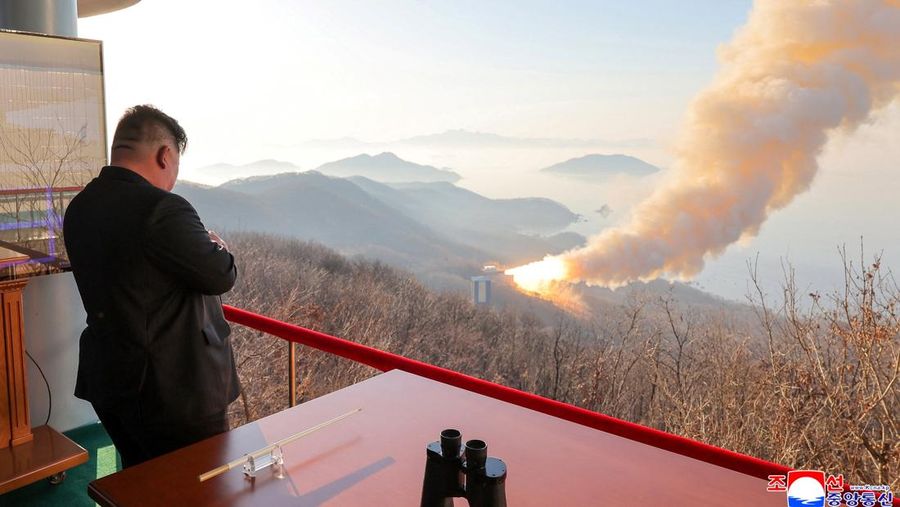
According to the KCNA report, Kim Jong Un personally oversaw the ground jet test of the "first-stage engine of a new-type intermediate-range solid-fuel ballistic missile." His presence at such a critical test is a recurring motif in North Korea’s military narratives, serving to underscore the strategic importance of the endeavor and to project an image of decisive leadership and unwavering commitment to national defense. The report highlighted that the test successfully verified the engine’s technical characteristics, including its thrust vector control and overall stability. The significant increase in thrust to 2,500 kilonewtons from the previous 1,971 kilonewtons indicates a substantial improvement in the engine’s power and efficiency. This enhanced thrust could translate into greater missile range, heavier payload capacity (potentially allowing for multiple warheads or more sophisticated countermeasures), or a combination of both. Such an upgrade is crucial for developing ICBMs that can reliably reach targets across the continental United States, a long-standing strategic objective for Pyongyang.
During the observation, Kim Jong Un reportedly emphasized the "strategic importance" of the new engine, noting that it would "radically upgrade" the country’s strategic attack capabilities. He also issued directives for further development and mass production, signaling an intent to rapidly incorporate this technology into North Korea’s operational missile forces. The state media also published photographs showing Kim Jong Un smiling and clapping alongside military officials as flames erupted from the engine, a familiar tableau designed to convey confidence and success to both domestic and international audiences.
North Korea’s Strategic Rationale and the Five-Year Plan
This latest test is explicitly linked to North Korea’s broader five-year plan for defense development, which was unveiled during the 8th Congress of the Workers’ Party of Korea in January 2021. This ambitious plan outlined a comprehensive strategy to modernize and diversify the country’s arsenal, focusing on several key areas: developing more advanced ICBMs, tactical nuclear weapons, hypersonic missiles, submarine-launched ballistic missiles (SLBMs), military reconnaissance satellites, and nuclear-powered submarines. The emphasis on solid-fuel technology is a central pillar of this plan, aimed at creating a more survivable, responsive, and potent missile force.
Kim Jong Un has repeatedly stressed the necessity of a powerful military to deter what he perceives as hostile policies from the United States and its allies. For Pyongyang, the development of an unassailable nuclear deterrent is not merely a matter of prestige but a fundamental guarantee of national survival. The increasing sophistication of North Korea’s missile technology, particularly its move towards solid-fuel systems, is a direct response to perceived threats and an attempt to shift the strategic balance in its favor. By possessing the ability to launch nuclear-tipped missiles quickly and from unpredictable locations, North Korea aims to complicate any potential pre-emptive strike scenarios by its adversaries, thereby enhancing its overall deterrence posture. This strategy is also likely intended to compel the international community, particularly the United States, to engage with North Korea on its terms, potentially leading to sanctions relief or formal recognition of its nuclear status.
A Chronology of North Korea’s Solid-Fuel Missile Progression
North Korea’s journey toward a solid-fuel missile capability has been a gradual but determined one, marked by a series of tests and declarations.
- Mid-2010s: North Korea began publicly demonstrating its interest in solid-fuel technology, initially through the development of smaller, short-range ballistic missiles.
- 2016: The first successful test of the Pukguksong-1, a solid-fuel SLBM, marked a significant milestone. This demonstrated Pyongyang’s ability to develop and produce solid propellants suitable for ballistic missiles. Subsequent tests of the Pukguksong-1 from a submarine showcased an emerging sea-based deterrent.
- 2017: The Pukguksong-2, a land-based variant of the solid-fuel missile, was successfully tested, highlighting the versatility of the technology and its potential application across different launch platforms.
- 2019-2020: North Korea continued to test various short-range solid-fuel missiles, often referred to as "new tactical guided weapons," demonstrating advancements in maneuverability and targeting precision.
- October 2020: At a military parade, North Korea unveiled what appeared to be a significantly larger solid-fuel ICBM, alongside its massive liquid-fueled Hwasong-17. This display signaled its serious intent to develop a solid-fuel ICBM.
- January 2021: The 8th Party Congress officially outlined the five-year defense plan, explicitly prioritizing the development of solid-fuel ICBMs.
- December 2022: North Korea conducted a static test of a "high-thrust solid-fuel motor," which state media said was intended for a "new-type strategic weapon system," widely believed to be a solid-fuel ICBM. This test achieved 1,971 kilonewtons of thrust.
- April 2023: North Korea successfully test-fired its first solid-fuel ICBM, the Hwasong-18, a monumental achievement that was personally overseen by Kim Jong Un. The missile flew on a lofted trajectory, demonstrating its intercontinental range capability.
- July 2023: A second test of the Hwasong-18 further validated its capabilities, solidifying North Korea’s claim to possess a viable solid-fuel ICBM.
- Current Test (Date not specified by KCNA): The ground test of an upgraded engine achieving 2,500 kilonewtons indicates continuous refinement and enhancement of the Hwasong-18 or development of an even more advanced solid-fuel ICBM. This sustained progress demonstrates a methodical and determined approach to achieving its strategic goals, moving from initial concept to deployment and now to further enhancement.
International Reactions and Condemnations
The international community’s response to North Korea’s continued missile development, particularly its advancements in solid-fuel technology, has been one of consistent condemnation and concern.
- United States: Washington has repeatedly denounced North Korea’s ballistic missile tests as violations of multiple United Nations Security Council resolutions and a threat to regional and global stability. U.S. officials typically reiterate their commitment to the denuclearization of the Korean Peninsula and emphasize the strength of their alliances with South Korea and Japan. They often call on Pyongyang to cease its provocative actions and return to dialogue without preconditions. The U.S. Department of State and the Pentagon are expected to closely monitor these developments, assess the implications for regional security, and maintain a robust defensive posture. The U.S. will likely underscore its readiness to defend its allies and homeland against any threats.
- South Korea: Seoul invariably expresses strong regret and condemnation over North Korea’s missile tests, viewing them as a direct challenge to peace and security on the Korean Peninsula. The South Korean Ministry of Defense usually convenes emergency meetings to assess the situation and enhance surveillance and readiness. There are often calls for North Korea to abide by international norms and resolutions. South Korea frequently highlights its strengthened defense capabilities and its ironclad alliance with the United States, which includes joint military exercises and intelligence sharing.
- Japan: Tokyo views North Korea’s missile program with grave concern, particularly given the potential for missiles to land within its exclusive economic zone or even directly on its territory. Japanese officials typically condemn the tests as a serious threat to Japan’s national security and regional peace. They often coordinate closely with the United States and South Korea, and support international efforts to impose sanctions and pressure North Korea.
- United Nations: North Korea’s ballistic missile tests are in direct contravention of numerous UN Security Council resolutions, which explicitly prohibit the country from conducting any launches using ballistic missile technology. The UN Secretary-General typically issues statements urging North Korea to cease its destabilizing actions and adhere to its international obligations. The Security Council may convene emergency sessions, though recent years have seen increased difficulty in reaching unanimous condemnation due to divisions among permanent members, particularly Russia and China.
- China and Russia: While publicly advocating for peace and stability on the Korean Peninsula and adherence to UN resolutions, both China and Russia have been more reluctant to impose new sanctions or strongly condemn North Korea’s actions. They often call for a resumption of six-party talks and express concerns about the deployment of U.S. missile defense systems in the region. Their stance often complicates international efforts to present a united front against North Korea’s nuclear and missile proliferation.
Analysis of Implications: Technical, Regional, and Diplomatic
The successful ground test of an upgraded solid-fuel rocket engine carries profound implications across several domains.
Technical Implications: The increased thrust to 2,500 kilonewtons suggests that North Korea is not only capable of producing solid-fuel ICBMs but is also continuously refining their performance. This could lead to missiles with:

- Extended Range: Potentially enabling them to strike any target on Earth.
- Heavier Payloads: Allowing for larger, more complex warheads, including multiple independently targetable re-entry vehicles (MIRVs), which would make missile defense significantly more challenging.
- Improved Reliability: Continuous testing and upgrades contribute to the overall reliability and accuracy of the missile system.
- Faster Deployment: The ability to launch from mobile platforms with minimal preparation dramatically reduces the warning time for adversaries, making pre-emptive strikes extremely difficult and complicating counter-strike planning.
Regional Security Implications: This advancement inevitably heightens tensions in Northeast Asia.
- Arms Race: It could provoke further military buildups and defensive enhancements in South Korea and Japan, potentially including the acquisition of more advanced missile defense systems or even offensive capabilities.
- Deterrence Shift: The enhanced survivability of North Korea’s ICBMs strengthens its perceived deterrence posture, potentially making it more assertive in its regional foreign policy.
- Monitoring Challenges: The inherent covertness of solid-fuel missile operations makes monitoring North Korea’s intentions and capabilities much harder for intelligence agencies, increasing the risk of miscalculation.
Diplomatic Implications: The continued development of advanced missile technology further complicates diplomatic efforts to denuclearize North Korea.
- Weakened Bargaining Position: Pyongyang’s growing capabilities diminish the leverage of the United States and its allies, as North Korea sees less incentive to negotiate away a crucial component of its perceived security.
- Sanctions Efficacy: The ongoing progress despite international sanctions raises questions about their effectiveness and prompts discussions about alternative strategies.
- Proliferation Concerns: The transfer of solid-fuel technology to other rogue states or non-state actors remains a significant international concern, especially given North Korea’s history of arms exports.
Future Outlook
North Korea’s relentless pursuit of advanced solid-fuel missile technology, culminating in this upgraded engine test, indicates a clear strategic trajectory: to develop a robust, survivable, and globally capable nuclear deterrent. Experts widely anticipate that Pyongyang will continue to conduct further flight tests of its solid-fuel ICBMs, potentially showcasing new variants or enhanced capabilities. The focus will likely be on improving missile accuracy, developing counter-measures to evade missile defense systems, and potentially miniaturizing warheads for multiple independently targetable re-entry vehicles (MIRVs).
The international community faces a persistent challenge in addressing North Korea’s accelerating weapons program. While sanctions and diplomatic pressure remain the primary tools, their effectiveness in halting Pyongyang’s progress has been limited. The United States and its allies are likely to continue strengthening their joint military exercises and intelligence sharing, while simultaneously seeking avenues for dialogue, albeit under challenging conditions. The long-term implications of a nuclear-armed North Korea with a highly survivable solid-fuel ICBM arsenal will continue to reshape the geopolitical landscape of Northeast Asia and beyond, necessitating careful diplomatic engagement, robust deterrence, and sustained international cooperation to mitigate the risks of proliferation and conflict. The world watches closely as Kim Jong Un’s regime methodically pushes the boundaries of its strategic weapons, each test bringing new questions about stability and security in a volatile region.