Nasution Nanang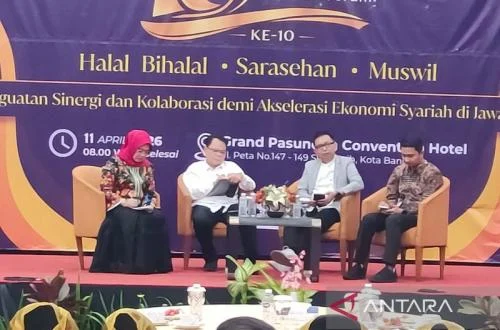
BANDUNG, West Java – The Financial Services Authority (OJK) West Java has issued a strong call for the banking sector, particularly Islamic financial institutions, to embrace innovation and expand their reach to significantly enhance sharia financial inclusion across the province. This strategic imperative was articulated by Muhammad Ikhsan, Head of the Supervision Division for Financial Service Business Actors Behavior at OJK West Java, during his address at the 10th Jabar Islamic Economic Forum (JIEF) held in Bandung on Saturday. The forum served as a critical platform for stakeholders to deliberate on pathways for fostering a more robust and inclusive Islamic economic ecosystem.
Ikhsan underscored the critical need for a multi-pronged approach, emphasizing the development of innovative banking products tailored to diverse community needs. He also highlighted the necessity of broadening physical branch networks to reach even the most remote corners of West Java, ensuring that financial services are accessible to all segments of society, regardless of their geographical location. "The network of offices capable of reaching all corners of the region needs to be improved to boost inclusion," Ikhsan stated, pointing to the persistent challenge of geographical disparity in financial access. Beyond physical infrastructure, the OJK official stressed the indispensable role of digital transformation, advocating for enhanced collaboration with information technology (IT) networks. This collaboration, he argued, is vital for streamlining services, making them more user-friendly and readily available to a tech-savvy populace that increasingly expects simplicity and convenience in their financial interactions. "Collaboration with IT is important to make services simpler and more accessible to the public," he added.
A key challenge identified by Ikhsan was the relative cost structure of sharia banking services compared to conventional offerings. He urged institutions to focus on strategies to lower these service costs, thereby making Islamic finance more competitive and appealing to a wider demographic. "Costs in sharia banking are still quite high compared to conventional. The challenge is to reduce costs so that services are more widespread," Ikhsan explained, highlighting cost as a significant barrier to entry for many potential users. He further noted that forums such as JIEF, organized by the West Java Sharia Economic Community (MES), play a pivotal role in promoting understanding and acceptance of Islamic finance. "Introducing sharia finance to the public can increase literacy and inclusion," he concluded, emphasizing the symbiotic relationship between awareness and participation.
The Significance of Jabar Islamic Economic Forum (JIEF)
The Jabar Islamic Economic Forum, now in its tenth iteration, stands as a cornerstone event for the development of the Islamic economy in West Java. Organized annually by the Masyarakat Ekonomi Syariah (MES) West Java, the forum brings together a diverse array of stakeholders, including government officials, financial regulators, industry practitioners, academics, entrepreneurs, and community leaders. Its primary objective is to foster dialogue, exchange ideas, and forge collaborations that can accelerate the growth of the sharia economic sector. Over the past decade, JIEF has evolved into a vital platform for addressing contemporary challenges and exploring innovative solutions pertinent to Islamic finance, halal industry, social finance, and Islamic philanthropy.
The forum typically features keynote speeches from prominent figures, panel discussions on critical topics, and workshops designed to enhance skills and knowledge within the sharia economic ecosystem. The consistent staging of JIEF underscores the enduring commitment of MES West Java and its partners to nurturing a vibrant Islamic economy that is not only robust but also deeply rooted in principles of justice, equity, and sustainability. The discussions often revolve around policy recommendations, technological advancements, market trends, and capacity building initiatives, all aimed at positioning West Java as a leading region for Islamic economic development in Indonesia. This year’s focus on innovation and inclusivity reflects a strategic pivot towards practical, impact-driven approaches to expand the reach and relevance of Islamic finance.
Indonesia’s Broader Ambition and West Java’s Potential
Indonesia, home to the world’s largest Muslim population, has long harbored ambitions to become a global hub for the Islamic economy. This national aspiration is supported by various government initiatives, including the establishment of the National Committee for Sharia Economics and Finance (KNEKS), which aims to accelerate the development of the country’s sharia economic ecosystem. West Java, with its substantial population of over 50 million and significant economic activity, presents immense potential for the growth of Islamic finance. The province’s large consumer base and burgeoning MSME sector offer fertile ground for sharia-compliant financial products and services.
However, despite this demographic advantage and national impetus, the penetration of Islamic finance in Indonesia, and particularly in West Java, still lags behind conventional banking. As reported by OJK West Java, the financial services sector, while showing resilience, remains heavily dominated by conventional banking. As of Q1 2026, conventional banks commanded a formidable 90.30 percent of total assets, 89.40 percent of third-party funds (DPK), and 88.58 percent of credit in the region. This significant disparity highlights both the scale of the challenge and the vast untapped potential that Islamic finance holds. Bridging this gap requires not only regulatory support but also concerted efforts from financial institutions to innovate, enhance accessibility, and build trust among potential customers. The call for innovation from OJK West Java is therefore a direct response to this prevailing market dynamic, seeking to carve out a larger, more impactful role for sharia-compliant financial services.
Detailed Analysis of Q1 2026 Financial Sector Performance
OJK West Java’s report on the performance of the financial services sector (SJK) up to the first quarter of 2026 paints a picture of overall resilience amidst dynamic global and national economic conditions. This resilience, generally, implies that the sector as a whole maintains healthy capital adequacy, sufficient liquidity, and stable profitability, allowing it to withstand external shocks. However, a deeper dive into specific segments reveals nuanced challenges, particularly within the BPR (Rural Banks) and BPRS (Sharia Rural Banks) sectors.
The total assets of BPR and BPRS in West Java reached Rp34.24 trillion, demonstrating a year-on-year (YoY) growth of 4.92 percent. While this growth indicates continued expansion, it is imperative to analyze it in context. A 4.92 percent growth rate, while positive, may be considered moderate when compared to the growth potential of an emerging market segment or against the often more aggressive growth seen in the conventional banking sector. It suggests that while there is an appetite for sharia-compliant rural banking, the pace of adoption or expansion might be constrained by various factors.
A more concerning trend emerged in the asset quality of BPR and BPRS. The gross Non-Performing Loan (NPL) ratio for these institutions deteriorated significantly, rising from 11.86 percent in January 2025 to 13.63 percent in January 2026. An NPL ratio exceeding 5 percent is generally considered high for the banking sector, indicating a substantial portion of loans are at risk of default. A jump to 13.63 percent signals considerable stress on the loan portfolios of rural banks. This deterioration can be attributed to several factors, including:
- Economic Slowdown: Regional or national economic downturns can impact borrowers’ ability to repay loans, especially small businesses and individuals served by BPR/BPRS.
- Sectoral Vulnerabilities: Exposure to specific economic sectors that faced headwinds (e.g., agriculture, small trade) could lead to higher defaults.
- Risk Management Practices: Challenges in underwriting and monitoring loans, particularly for smaller institutions with limited resources, might contribute to higher NPLs.
- Post-Pandemic Effects: While the immediate impacts of the pandemic may have subsided, lingering economic fragilities or delayed recovery in certain segments could still manifest as rising NPLs.
The direct consequence of this worsening asset quality is evident in the profitability of BPR and BPRS, which experienced a "significant decrease" in January 2026. High NPLs necessitate increased provisioning for bad debts, which directly eats into profits. Additionally, the administrative burden of managing non-performing assets can increase operational costs. This decline in profitability can restrict the ability of BPR and BPRS to lend further, invest in technology, or expand their networks, thus hindering their growth and capacity to contribute to financial inclusion. OJK, in its supervisory role, typically responds to such trends with increased scrutiny, encouraging corrective action plans, and in some cases, pushing for consolidation or restructuring to strengthen the financial health of struggling institutions.
Strategies for Enhanced Inclusivity and Competitiveness
To address the challenges and capitalize on the opportunities, OJK West Java’s recommendations outline a comprehensive strategy:
-
Innovation in Products and Services: Islamic banks need to move beyond conventional offerings and develop products that are highly relevant to the diverse needs of the community. This includes micro-sharia finance solutions for MSMEs, ethical investment products, tailored financing for specific sectors (e.g., green sharia finance), and innovative wealth management services compliant with Islamic principles. Digital platforms can facilitate the rapid deployment of these new products.
-
Strategic Network Expansion: While digital channels are crucial, physical presence remains vital for segments of the population, especially in rural areas where digital literacy or internet access might be limited. Strategic expansion of branchless banking agents, partnerships with local cooperatives, and mobile banking units can significantly improve physical accessibility without necessarily building full-fledged branches.
-
Leveraging Digital Transformation: Collaboration with fintech companies and investment in in-house IT capabilities are paramount. This means developing user-friendly mobile applications, online account opening processes, digital payment solutions, and integrated platforms that offer a seamless customer experience. Digitalization not only enhances convenience but also has the potential to drastically reduce operational costs.
-
Cost Reduction and Competitiveness: Lowering the cost of sharia banking services is a multifaceted challenge. Strategies could include:
- Operational Efficiency: Streamlining internal processes, adopting automation, and optimizing resource allocation.
- Economies of Scale: As the sector grows, larger asset bases can lead to lower per-unit costs.
- Technology Adoption: Digitalization can significantly reduce transaction costs compared to traditional branch-based operations.
- Regulatory Support: Policies that reduce compliance burdens or offer incentives for sharia financial institutions could also play a role.
- Innovative Business Models: Exploring alternative fee structures or profit-sharing models that are inherently more competitive.
-
Enhancing Financial Literacy and Awareness: Continuous educational initiatives are critical to demystify Islamic finance and highlight its ethical and economic benefits. Forums like JIEF are excellent for this, but consistent public campaigns, workshops, and school programs are also necessary to build a well-informed populace that understands and trusts sharia financial products.
Official Responses and Collaborative Ecosystem
OJK’s proactive stance in West Java reflects its broader mandate to ensure a healthy, stable, and inclusive financial sector. Beyond the pronouncements made by Muhammad Ikhsan, the regulatory body actively engages in supervisory oversight, issues guidelines, and promotes financial literacy programs designed to strengthen both conventional and sharia financial institutions. Their emphasis on innovation and inclusion is consistent with national policy goals to deepen financial access for all Indonesians.
The Masyarakat Ekonomi Syariah (MES) West Java, as the organizer of JIEF, plays a crucial role in facilitating dialogue and fostering collaboration among various stakeholders. MES acts as a bridge between the community, industry players, and regulators, helping to translate policy directives into practical initiatives and bringing ground-level feedback to policymakers. Their continued commitment to hosting JIEF underscores the importance of a multi-stakeholder approach to developing the Islamic economy.
From the perspective of Islamic banking institutions, the call for innovation and expansion is generally welcomed, though practical implementation presents its own set of challenges. Banks must weigh the costs of investing in new technologies, expanding physical networks, and developing new products against their profitability targets and risk appetite. They often advocate for supportive regulatory frameworks, incentives for sharia-compliant financing (especially for MSMEs), and access to a skilled talent pool in Islamic finance and technology. Regional and national government bodies also play a role through supportive policies, infrastructure development, and programs that align with the growth of the sharia economy, such as promoting halal tourism or sharia-compliant business development.
Broader Impact and Future Outlook
The successful implementation of OJK West Java’s recommendations for innovative Islamic finance carries significant implications for the region’s economic and social landscape. Increased financial inclusion, particularly through sharia-compliant channels, can unlock substantial economic growth. By providing accessible and affordable financing, especially to MSMEs—the backbone of the Indonesian economy—it can stimulate entrepreneurship, create jobs, and foster sustainable development. The ethical principles embedded in Islamic finance, such as the prohibition of interest (riba) and speculative activities (gharar), and the emphasis on real economic activity, can appeal to a broader segment of society, promoting fairer wealth distribution and community welfare.
Furthermore, a more competitive and innovative Islamic financial sector will inevitably reshape the overall banking landscape, encouraging healthy competition and driving efficiency across both conventional and sharia players. As West Java strives to maximize its potential as a vibrant economic hub, the growth of its Islamic finance sector will be a crucial differentiator. The province could emerge as a leading model for integrating ethical finance principles with modern financial services, setting a precedent for other regions in Indonesia and beyond.
While challenges such as talent development in specialized sharia finance and fintech, overcoming public perception biases, and harmonizing regulatory frameworks remain, the strategic direction set by OJK West Java at the JIEF is a clear signal of commitment. By fostering an environment conducive to innovation, accessibility, and affordability, Islamic finance in West Java is poised for a transformative period, contributing not only to economic resilience but also to a more equitable and inclusive financial future for all its citizens.