Nila Kartika Wati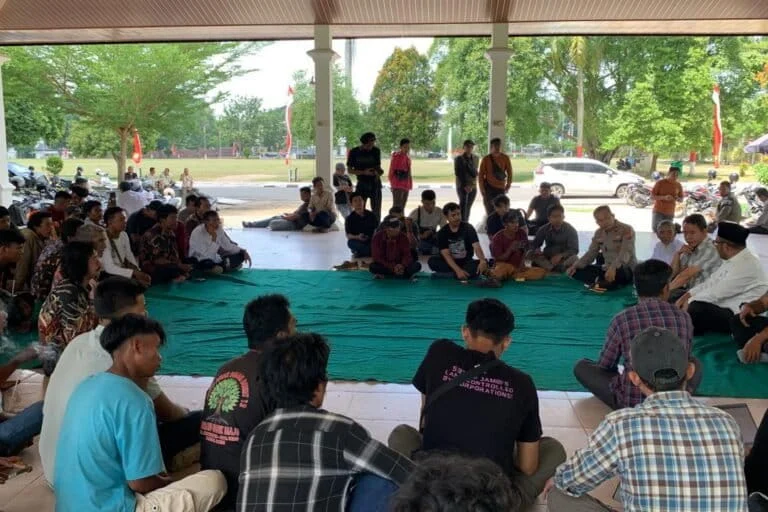
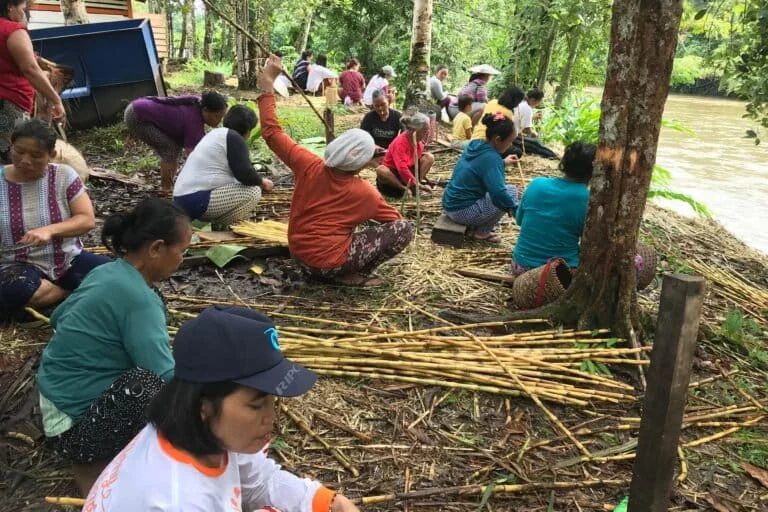
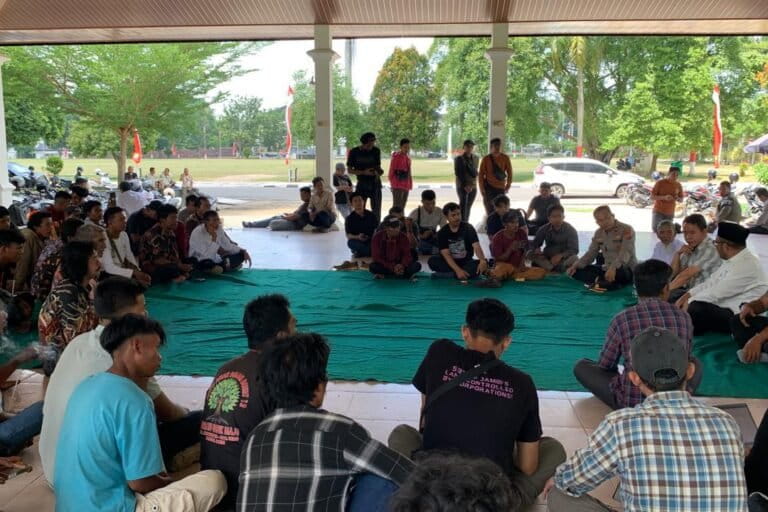
In the fading light of a mid-February evening in 2026, dozens of Orang Rimba—the indigenous nomadic people of Jambi—gathered at the Pendopo of the Jambi Governor’s Office to issue a desperate plea for their survival. Their presence at the heart of provincial power was not a mere visit but a formal demand for state recognition and the protection of their ancestral domains, which have been systematically dismantled over the course of four decades. For the Orang Rimba, also known as the Suku Anak Dalam (SAD), the forest is not merely a landscape or a collection of natural resources; it is their home, their supermarket, their temple, and the very foundation of their cultural identity. As their traditional territories continue to be carved up by palm oil plantations, industrial forest concessions, and infrastructure projects, these indigenous groups are now demanding a moratorium on new permits on their ancestral lands and a legal framework that secures their right to live.
The plight of the Orang Rimba is a stark illustration of the tension between industrial expansion and indigenous rights in Indonesia. Tumenggung Jelitai, one of the community leaders present at the demonstration, encapsulated the modest yet profound nature of their demands. He emphasized that the community is not seeking wealth or modern luxury, but rather the basic right to a "living space" (ruang hidup) for future generations. For the Orang Rimba, the forest provides the essential rhythm of life: a place to hunt, gather, and practice customary laws. However, in the eyes of the state and private corporations, these same forests are often viewed as vacant land or "state forest" (hutan negara) ripe for economic exploitation through concession maps.
A Chronology of Forest Loss and Industrial Expansion
The crisis facing the Orang Rimba did not emerge overnight; it is the result of nearly half a century of systematic deforestation and land reallocation. Between 1982 and 1999, the province of Jambi lost more than 2 million hectares of forest cover. During this 17-year window, the central government issued a series of policies on four separate occasions designed to downgrade the protection status of forest areas. These administrative shifts were primarily intended to accommodate large-scale land-intensive concessions, effectively turning primary rainforests into industrial assets.
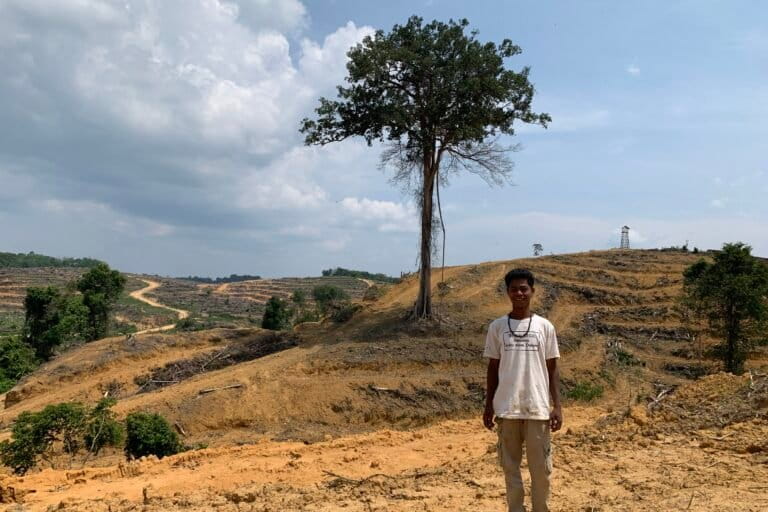
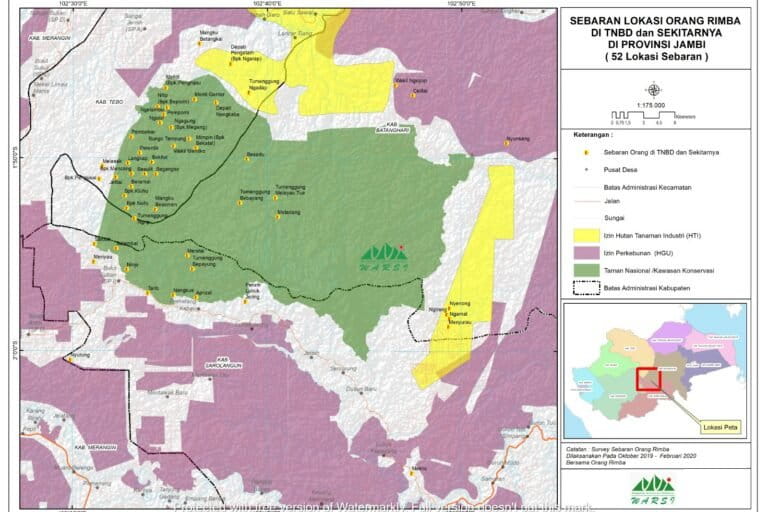
The impact was most severely felt in the areas surrounding the Bukit Duabelas National Park (TNBD), the primary sanctuary for the Orang Rimba. As the buffer zones of the park were partitioned for Hutan Tanaman Industri (HTI—industrial timber plantations), transmigration settlements, and sprawling palm oil estates, the Orang Rimba found themselves increasingly hemmed in. The expansion of the palm oil industry in Jambi has been particularly aggressive. According to data from the Central Bureau of Statistics (BPS) Jambi, the province had only 200,000 hectares of palm oil plantations in 1990. by 2023, that figure had ballooned to nearly 1.2 million hectares—an area equivalent to 18 times the size of Jakarta.
As the industry grew, so did the population of the Orang Rimba, creating a recipe for inevitable social friction. Data from KKI Warsi, an Indonesian conservation NGO, recorded the Orang Rimba population at approximately 6,500 individuals in 2023. While a significant portion remains within the boundaries of the TNBD, many others reside in secondary forests and palm oil plantations along the Trans-Sumatran highway, extending toward the borders of South Sumatra and the southern regions of Bukit Tigapuluh National Park. When these peripheral forests are converted into corporate concessions, the traditional wandering routes of the Orang Rimba are severed, forcing groups toward the edges of highways where they are exposed to traffic hazards and frequent conflicts with outsiders.
Escalating Conflicts and the Human Cost
The conversion of ancestral lands into corporate assets has led to a cycle of violence and legal marginalization. Adi Prasetijo, a social anthropologist from Diponegoro University, has documented a grim timeline of social friction. Between 1997 and 2025, there were at least 20 major social conflicts involving the Orang Rimba, local villagers, and corporate security forces. These clashes resulted in 35 documented victims, including 18 individuals who were killed.
This local crisis reflects a broader national trend of indigenous dispossession. The 2025 Year-End Report by the Indigenous Peoples Alliance of the Archipelago (AMAN) highlights a staggering scale of land grabbing across Indonesia. In 2025 alone, there were 135 cases of ancestral land seizure affecting 109 indigenous communities, covering an area of 3.8 million hectares. Nationally, 162 indigenous individuals were victims of violence or criminalization during this period. Furthermore, AMAN estimates that approximately 7.3 million hectares of indigenous territories currently fall under the control of mining, timber, and plantation concessions.
In Jambi, the overlapping claims between indigenous customary rights and licensed corporate areas have created a permanent state of tension. Tumenggung Jelitai pointed out that many Orang Rimba are now "squeezed" between the boundaries of various companies. He proposed that the government should identify abandoned or underutilized concessions and reallocate them as permanent living spaces for the Orang Rimba. However, he warned that this must be managed carefully by the state to prevent the land from being commodified or sold to outsiders. "The government must intervene fully for the life of the Suku Anak Dalam, not half-heartedly," he asserted.
Allegations of Systemic State Failure
The advocacy group Walhi Jambi (Friends of the Earth Indonesia) has been vocal in its criticism of the government’s handling of the situation. Oscar Anugerah, Executive Director of Walhi Jambi, argues that the state has fundamentally failed to recognize and respect the systems of indigenous communities. He contends that the government often employs administrative and security-based approaches that undermine the authority of traditional leaders (Temenggung) and erode community solidarity.
"This is a form of structural injustice that continues to be tolerated," Anugerah stated. "The state appears more obedient to corporate interests than to the protection of the Orang Rimba. Ancestral territories are seized, and forests are destroyed, while the Orang Rimba are forced to live without certainty and without access to basic services. This is not just negligence; it is a systematic failure of the state."
Walhi Jambi further emphasizes that the lack of legal recognition for indigenous territories is the root cause of the ongoing conflicts. Without a clear legal "umbrella," the Orang Rimba remain vulnerable to criminalization and displacement. Furthermore, the group points to a failure in the delivery of basic rights, such as education and health care. Many Orang Rimba children and families face discrimination in public service access, largely because the existing systems do not accommodate their mobile lifestyle or cultural identity.
Robert Aritonang, Program Manager for Conservation and Marginalized Tribes at KKI Warsi, echoed these sentiments, describing the situation as "structural poverty." He noted that by losing their resources and living space, the Orang Rimba have been forced into a state of absolute poverty and dependency on social welfare handouts. "This is a clear violation of human rights," Aritonang said. "Every human being has the right to a livelihood, as mandated by the constitution. There must be a political will to restore the living spaces and resources of the Orang Rimba."
Government Pledges and the Path to Recognition
In response to the growing pressure, the Jambi provincial government has promised to take action. Sudirman, the Regional Secretary (Sekda) of Jambi, met with representatives of the Orang Rimba and pledged to form a specialized task force or forum to bridge the gap between the community and the government. He acknowledged that the issues facing the Suku Anak Dalam—ranging from land conflicts to lack of education and health services—are complex but not insurmountable.
"We have agreed to form a forum to communicate with the government," Sudirman said. "We will look at two approaches: one for those who wish to settle permanently and another for those who maintain a traditional nomadic lifestyle." He added that a "small team" would be established to accommodate the demands of the Temenggung and the younger generation of the Orang Rimba. However, he cautioned that the process would take time, as it requires coordination between the central, provincial, and district governments.
Jambi Governor Al Haris has previously encouraged indigenous communities to submit formal proposals for the recognition of their customary forests to their respective district or city governments. He cited the example of the Marga Serampas community, which successfully secured 65,000 hectares of customary forest in 2016 through a local regulation (Perda) signed during his tenure as the Regent of Merangin. "I fully support this. It is the only way to save our forests; these vast forests will disappear if we do not create a clear legal umbrella for them," Al Haris stated.
Broader Implications and Ecological Justice
The struggle of the Orang Rimba in Jambi serves as a critical test for Indonesia’s commitment to ecological justice and indigenous rights. The outcome of their demands for land recognition will have far-reaching implications for environmental conservation in Sumatra. Indigenous-managed forests are statistically proven to have lower rates of deforestation than those managed by the state or private entities. By securing the rights of the Orang Rimba, the government could simultaneously achieve conservation goals and fulfill its constitutional obligations to its citizens.
However, the path forward remains fraught with bureaucratic and political challenges. The current legal framework in Indonesia requires indigenous groups to undergo a rigorous and often expensive process to prove their "existence" and the boundaries of their land before they can receive official recognition. For a nomadic group like the Orang Rimba, whose concept of land ownership is fluid and communal, these administrative requirements can be a significant barrier.
As the Orang Rimba wait for the government to move beyond promises and into legislative action, the pressure on their remaining forests continues to mount. Without a swift and decisive shift in policy, the Orang Rimba risk becoming a people without a place—a community "uprooted from its roots," as activists have warned. The resolution of this crisis will determine whether the "living space" Tumenggung Jelitai seeks for his grandchildren will be a vibrant, protected forest or a sterile landscape of industrial monocultures. In the words of Oscar Anugerah, "Recognition of Orang Rimba territory is not an option; it is a constitutional obligation. Without it, ecological justice will remain a mere slogan, while conflict and marginalization continue to be the legacy we leave behind."