Chalifah Fatihah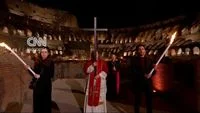
Rome, Italy – On Friday, April 3rd, His Holiness Pope Leo presided over the deeply symbolic Way of the Cross procession at the iconic Colosseum in Rome, marking his first leadership of this significant Good Friday observance since assuming the papacy. The solemn event, a cornerstone of Holy Week for millions of Catholics worldwide, saw the pontiff personally carry a wooden cross, mirroring the journey of Jesus Christ through his final moments of suffering and crucifixion. This deeply spiritual tradition, known as the Via Crucis, retraces the fourteen traditional stations that depict pivotal events from Jesus’ arrest to his burial.
The gathering at the ancient amphitheater, a site historically associated with martyrdom, drew an estimated 30,000 faithful. As dusk settled over the Eternal City, participants illuminated the gathering with the soft glow of thousands of flickering candles, creating a powerful visual testament to their faith and solidarity with Christ’s sacrifice. The air, thick with a palpable sense of devotion, resonated with prayers and hymns, as the procession wound its way around the monumental ruins.
Historical Significance of the Way of the Cross at the Colosseum
The tradition of holding the Way of the Cross at the Colosseum dates back to the 18th century, initiated by Pope Benedict XIV. His decision to associate the site, where early Christians are believed to have been martyred, with the sacred commemoration of Christ’s passion was a profound act of spiritual reclamation and remembrance. The Colosseum, a colossal testament to Roman engineering and a stark reminder of the empire’s brutal entertainment, transforms each Good Friday into a sacred space, echoing with centuries of prayer and devotion. The choice of this location underscores the enduring nature of faith in the face of adversity and the ultimate triumph of spiritual values over temporal power.
For many, the act of the Pope himself carrying the cross is a potent symbol of leadership and solidarity with the suffering of humanity. It is a visual representation of the Church’s shepherd bearing the burdens of his flock, an embodiment of Christ’s own sacrificial love. The wooden cross, often simple and unadorned, becomes a tangible link to the historical events being commemorated, allowing participants to engage with the narrative on a deeply personal and emotional level.
The Fourteen Stations: A Journey of Faith and Reflection
The Via Crucis, or Way of the Cross, is a devotional practice that guides participants through fourteen distinct moments, or "stations," that retrace the path of Jesus from his condemnation by Pontius Pilate to his entombment. Each station is typically marked by a cross and a brief reflection, often accompanied by scripture readings and prayers.
The stations traditionally include:
- Jesus is condemned to death.
- Jesus carries his cross.
- Jesus falls the first time.
- Jesus meets his mother, Mary.
- Simon of Cyrene helps Jesus carry his cross.
- Veronica wipes the face of Jesus.
- Jesus falls the second time.
- Jesus consoles the women of Jerusalem.
- Jesus falls the third time.
- Jesus is stripped of his garments.
- Jesus is nailed to the cross.
- Jesus dies on the cross.
- Jesus’ body is taken down from the cross.
- Jesus is laid in the tomb.
During this year’s procession, Pope Leo’s personal participation in carrying the cross through these stations amplified the spiritual weight of the observance. His visible commitment to embodying the suffering of Christ resonated deeply with the assembled faithful, reinforcing the central message of sacrifice and redemption that lies at the heart of Christianity.
Supporting Data and Context
Good Friday is the solemn day observed by Christians commemorating the crucifixion of Jesus Christ and his subsequent death at Calvary. It is part of the Holy Week, which begins on Palm Sunday and culminates on Easter Sunday, celebrating the resurrection of Jesus. The theological significance of Good Friday lies in the belief that Christ’s sacrifice atoned for the sins of humanity, offering salvation and eternal life to believers.
The attendance of approximately 30,000 individuals at the Colosseum procession underscores the enduring appeal and spiritual importance of this event. This figure represents a significant portion of the global Catholic population, highlighting Rome’s central role in Christian pilgrimage and observance. Such large gatherings are meticulously planned, involving extensive security measures and logistical coordination by Vatican authorities and Italian civil services to ensure the safety and smooth running of the event.
The practice of lighting candles during religious processions is a time-honored tradition symbolizing Christ as the light of the world, the presence of the Holy Spirit, or the prayers and intentions of the faithful ascending to heaven. The collective illumination created by thousands of candles at the Colosseum on Good Friday serves as a powerful visual metaphor for the shared faith and hope of the attendees.
Chronology of the Event
While the exact start time of the procession was not specified in the initial report, the event typically commences in the late afternoon or early evening of Good Friday, allowing for the transition from daylight to the dramatic ambiance of torchlight and candlelight. The procession itself, following the circuit around the Colosseum, can last for several hours, depending on the pace and the length of reflections at each station.
- Pre-Procession: Faithful gather around the Colosseum, many having participated in earlier liturgical services throughout the day. Security checks and final preparations are underway.
- Procession Commencement: Pope Leo, often preceded by other clergy and carrying the cross, begins the Way of the Cross.
- Stations of the Cross: The procession moves through the designated route, pausing at each of the fourteen stations for prayer, scripture, and reflection. The Pope may deliver brief homilies or reflections at key points.
- Conclusion: The procession typically concludes with a final prayer and blessing, often near the Colosseum itself or at a designated sacred site within its vicinity.
Official Responses and Inferred Reactions
The Vatican, through its official communications channels, would have disseminated information regarding the Pope’s participation and the significance of the event. Statements from the Holy See would have emphasized the spiritual dimension of the Way of the Cross, its relevance to contemporary issues of suffering and injustice, and the call to emulate Christ’s sacrificial love.
While direct quotes from other parties were not provided, it can be inferred that the reactions from Catholic clergy and laity would have been overwhelmingly positive and deeply moved. Bishops and cardinals present at the event would have witnessed firsthand the profound spiritual impact on the faithful. The broader Catholic community, both in Italy and globally, would have followed the event through media coverage, drawing inspiration from the Pope’s leadership and the collective act of prayer.
Ecumenical leaders might also offer greetings or acknowledgments of the solemnity of Good Friday, recognizing the shared Christian heritage of commemorating Christ’s passion, even if theological interpretations of the events differ.
Broader Impact and Implications
Pope Leo’s direct involvement in carrying the cross at the Colosseum carries significant implications for the Church and its followers. It signals a papacy that is not only focused on doctrinal leadership but also on a deeply personal and visible engagement with the core tenets of Christian faith. This approach can strengthen the connection between the pontiff and the faithful, fostering a sense of shared journey and spiritual endeavor.
In a world often characterized by conflict, division, and suffering, the Way of the Cross serves as a powerful reminder of hope, redemption, and the enduring strength of faith. The image of the Pope leading this procession at such a historically resonant site offers a message of spiritual resilience and the universal call to compassion and solidarity.
Furthermore, the event serves as a significant cultural and religious pilgrimage for Rome, drawing international attention and reinforcing the city’s status as the spiritual heart of Catholicism. The economic impact, through tourism and related services, is also a notable consequence, though the primary focus remains resolutely spiritual. The enduring tradition of the Way of the Cross at the Colosseum, amplified by the Pope’s personal participation, continues to be a profound expression of faith, a testament to historical memory, and a beacon of spiritual hope for millions across the globe.