Nasution Nanang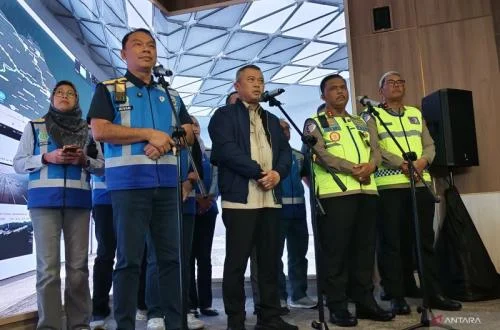
The innovative "Presisi Local One-Way" traffic management scheme, meticulously implemented across segments of the Trans-Java Toll Road to facilitate the smooth return flow of travelers during the Lebaran 2026 holiday period, was officially terminated on Sunday, March 29, 2026, at precisely 24:00 WIB. The conclusion of this critical operation was marked by a formal announcement led by Minister of Transportation Dudy Purwagandhi, accompanied by the Head of the National Police Traffic Corps (Kakorlantas Polri), Inspector General Pol. Agus Suryonugroho, and the President Director of PT Jasa Marga (Persero) Tbk, Rivan A Purwantono. The ceremony took place at the Jasa Marga Traffic Management Center (JTMC) located on the Jatiasih Toll Road in Bekasi, West Java, signifying the successful conclusion of a complex logistical undertaking designed to mitigate the perennial challenges of post-Eid al-Fitr mass migration.
Background: Navigating Indonesia’s Annual Lebaran Exodus
Lebaran, or Eid al-Fitr, marks the end of the Islamic holy month of Ramadan and is one of Indonesia’s most significant cultural and religious holidays. It triggers the largest annual mass migration in the country, known as "mudik" (exodus to hometowns) and "arus balik" (return flow). Millions of Indonesians travel across provinces, often using the extensive Trans-Java Toll Road network, to reunite with families. This annual phenomenon consistently presents immense challenges for traffic management, public safety, and infrastructure capacity. The sheer volume of vehicles, ranging from private cars to buses and motorcycles, can overwhelm even modern highways, leading to severe congestion, extended travel times, and increased accident risks.
In anticipation of the 2026 Lebaran period, authorities had projected a substantial increase in vehicle movements compared to previous years, driven by sustained economic growth and improved infrastructure connectivity. Forecasts from various agencies, including the Ministry of Transportation, typically estimate tens of millions of people participating in the mudik and arus balik, with a significant percentage utilizing the Trans-Java Toll Road. Managing this massive human and vehicular flow requires a highly coordinated, multi-agency approach, involving the Ministry of Transportation, the National Police, and toll road operators like Jasa Marga. Their collective goal is to ensure safety, efficiency, and comfort for travelers while minimizing disruption.
The "Presisi" Initiative: A Coordinated Strategic Response
The "Presisi" initiative, often associated with the National Police’s doctrine of "Prediktif, Responsibilitas, Transparansi Berkeadilan" (Predictive, Responsibility, Transparency with Justice), underscores a modern, data-driven approach to public service. In the context of traffic management, the "Presisi Local One-Way" scheme was a testament to this philosophy. It was not merely a reactive measure but a carefully planned, dynamic strategy designed to anticipate and respond to real-time traffic conditions.
The core principle of the one-way scheme is to temporarily convert certain sections of a multi-lane highway to flow in a single direction, effectively doubling the capacity for the dominant traffic stream. This is a critical intervention during peak periods like the Lebaran return flow when the volume of vehicles heading towards major urban centers (like Jakarta) vastly outnumbers those traveling in the opposite direction. The "local" aspect implies that these one-way sections are implemented flexibly, activated and deactivated based on observed traffic density, rather than a blanket, fixed-duration application across the entire toll road. This flexibility is crucial for minimizing inconvenience to local communities and non-Lebaran traffic.
Implementation of such a scheme demands sophisticated coordination. Police personnel are deployed to manage entry and exit points, guide drivers, and ensure adherence to temporary rules. Toll road operators provide real-time traffic data from surveillance cameras, vehicle sensors, and communication systems. The Ministry of Transportation oversees overall policy, coordination, and resource allocation. The "Presisi" framework ensures that decisions are made based on predictive analysis, immediate responsiveness to changing conditions, and transparent communication with the public.
Chronology of Implementation and Monitoring
The operational timeline for the Lebaran 2026 traffic management began well in advance of the holiday itself, with extensive planning meetings, simulations, and public awareness campaigns. As the arus balik period commenced following Eid al-Fitr, the "Presisi Local One-Way" scheme was progressively activated in stages to address burgeoning traffic volumes heading westward towards Jakarta and surrounding areas.
Initially, to alleviate congestion in critical bottlenecks, the one-way scheme was first implemented on a localized segment from Kilometer (KM) 55 to KM 70 of the Trans-Java Toll Road. This section often experiences high density due to its proximity to major interchanges and rest areas. As the return flow intensified and traffic began to build up further east, authorities swiftly escalated their response. The "Presisi Local One-Way" was then extended in a phased approach. The first major intervention, referred to as "tahap satu Presisi," involved extending the one-way system further. Subsequently, a more extensive "tahap dua" was implemented, stretching from KM 263 – a significant entry point for traffic from Central and East Java – all the way to KM 70. This comprehensive stretch effectively created a dedicated high-capacity corridor for returnees, allowing for a more consistent and higher average speed of travel.
Throughout its activation, the scheme was under constant, real-time surveillance. Jasa Marga’s JTMC, equipped with advanced CCTV networks, vehicle counting sensors, and communication tools, provided continuous data streams to a joint command center. This enabled law enforcement and transportation officials to monitor traffic density, identify potential choke points, and assess the effectiveness of the one-way operation. The decision to terminate the scheme was not arbitrary but directly informed by these live data feeds. As the peak of the return flow subsided and traffic movements were consistently observed to be "landai" – a term indicating smooth, manageable, and below-capacity flow – the need for the extraordinary measure diminished. This data-driven decision-making process ensured that the scheme was only in effect for as long as it was absolutely necessary, minimizing disruption to regular traffic patterns.
Statements from Key Officials: Acknowledging Success and Caution
During the official closure ceremony, the leading officials provided insights into the operation’s success and offered final guidance to the public.
Minister of Transportation Dudy Purwagandhi formally declared the cessation of the "Presisi Local One-Way" at 24:00 WIB, marking the effective end of the intensive traffic management period. He expressed satisfaction with the overall execution and the resultant smooth flow of traffic, attributing it to the meticulous planning and seamless coordination among all involved agencies. "The successful implementation and conclusion of this local one-way scheme underscore the effectiveness of our collaborative efforts," Minister Purwagandhi stated. "However, my message to any remaining travelers is clear: please continue to exercise extreme caution on the roads. Adhere to speed limits, maintain safe distances, and follow all instructions from our dedicated officers who are still deployed to ensure your safety." His remarks emphasized both the success achieved and the continued importance of individual responsibility for road safety, even as peak congestion subsided.
Inspector General Pol. Agus Suryonugroho, Kakorlantas Polri, elaborated on the police’s instrumental role in the operation. He highlighted the strategic planning that went into determining the segments and timing for the one-way implementation. "Our primary objective throughout this Lebaran arus balik was to ensure the safety and smooth passage of all motorists," Irjen Pol. Suryonugroho explained. "The staged implementation of the local one-way, from KM 55-70, then the intervention of Presisi stages one and two from KM 263 to KM 70, was a dynamic response to real-time traffic intelligence. This flexible approach allowed us to effectively manage unprecedented volumes without significant gridlock." He further noted that the real-time monitoring capabilities and the professionalism of police personnel on the ground were crucial in making timely decisions, including the eventual termination of the scheme once traffic movement became consistently "landai."
Rivan A Purwantono, President Director of PT Jasa Marga (Persero) Tbk, provided the perspective of the toll road operator. He underscored Jasa Marga’s commitment to supporting government initiatives for traffic management and ensuring optimal service for toll road users. "Our infrastructure, technology, and operational teams worked tirelessly to support the ‘Presisi’ scheme," Purwantono remarked. "From providing accurate traffic data through our JTMC to ensuring the readiness of our facilities, every effort was made to contribute to the success of this operation. The smooth flow observed, leading to the early termination of the one-way, is a testament to the combined efficiency of planning, execution, and the public’s cooperation." He also highlighted the importance of clear communication channels between authorities and the public, often facilitated by Jasa Marga’s social media and information platforms, to keep travelers informed about traffic conditions and policy changes.
Supporting Data and Broader Context of Traffic Management
The success of the "Presisi Local One-Way" scheme is best understood within the context of extensive data and the broader strategies employed during Lebaran 2026. While specific, granular data for Lebaran 2026 will be fully compiled in subsequent reports, historical trends and preliminary observations provide significant insights.
Typically, the Trans-Java Toll Road handles millions of vehicle movements during the peak arus balik period. For instance, in previous years, daily traffic volumes on key segments could exceed 200,000 vehicles, significantly higher than normal operating capacities. The implementation of the one-way system effectively increased the theoretical capacity of the designated lanes by approximately 100%, allowing for a substantial improvement in average speed and a reduction in travel time. Without such interventions, a journey that might typically take 8-10 hours could easily extend to 15-20 hours or more during severe congestion.
Beyond the one-way scheme, several other supporting measures contributed to the overall traffic fluidity:
- Contraflow Implementation: In sections where the one-way was not active, dynamic contraflow lanes were often used to provide additional capacity for the dominant direction, offering another layer of flexibility.
- Rest Area Management: Strict controls were put in place at rest areas to prevent overcrowding, which can cause significant backups onto the main toll road. This included temporary closures or diversions if capacity was exceeded.
- Alternative Routes and Information: Public awareness campaigns encouraged travelers to consider alternative non-toll routes or to adjust their travel times to off-peak hours. Real-time traffic information was disseminated via radio, social media, and electronic message boards.
- Enforcement and Patrols: A significant deployment of police and military personnel ensured compliance with traffic regulations, provided assistance to stranded motorists, and responded swiftly to incidents.
- Fuel and Logistics: Coordination with fuel stations and logistics providers ensured adequate supplies along the toll road to prevent shortages.
The "Presisi" approach also relies heavily on technology. Intelligent Transportation Systems (ITS) comprising variable message signs, traffic cameras, loop detectors, and radar sensors provided the backbone for real-time data collection. This data was fed into sophisticated analytical models, enabling predictive capabilities regarding traffic flow and congestion points. The ability to visualize traffic patterns dynamically on large screens at the JTMC allowed commanders to make informed decisions about when and where to activate or deactivate traffic schemes with precision.
Implications and Future Outlook
The successful conclusion of the "Presisi Local One-Way" for Lebaran 2026 carries several significant implications for future traffic management in Indonesia.
Firstly, it reinforces the effectiveness of dynamic, data-driven traffic interventions during periods of extreme demand. The ability to activate and deactivate schemes based on real-time conditions, rather than rigid schedules, proves to be more efficient and less disruptive. This model is likely to be refined and adopted for other major holidays or large-scale events that generate similar traffic surges.
Secondly, it highlights the paramount importance of inter-agency cooperation. The seamless collaboration between the Ministry of Transportation, the National Police, and PT Jasa Marga was critical. This integrated command structure, where information is shared freely and decisions are made collectively, serves as a blueprint for complex public service operations. Continued investment in joint training and communication protocols will further strengthen this synergy.
Thirdly, the public’s understanding and compliance with these complex schemes are vital. Extensive public information campaigns played a crucial role in preparing motorists for the one-way system, explaining its purpose, and guiding them through the temporary changes. This public engagement fosters trust and ensures smoother execution.
From an economic perspective, efficient traffic management during Lebaran contributes positively to the national economy. Reduced travel times translate to less lost productivity, lower fuel consumption for individual travelers, and smoother logistics for goods transport, albeit indirectly during passenger-focused operations. The minimized congestion also enhances the overall experience for travelers, indirectly boosting domestic tourism and supporting local economies along the routes.
Looking ahead, while temporary traffic schemes like the one-way are effective short-term solutions, the long-term challenge of managing Indonesia’s growing vehicle population and increasing travel demand remains. This will necessitate continued investment in infrastructure development, including expanding toll road networks, constructing new arterial roads, and improving public transportation options. Furthermore, advancements in smart city technologies, AI-powered traffic prediction models, and integrated mobility solutions will likely play an increasingly central role in shaping Indonesia’s future transportation landscape.
In conclusion, the successful closure of the "Presisi Local One-Way" traffic scheme on the Trans-Java Toll Road for Lebaran 2026’s return flow stands as a testament to strategic planning, technological integration, and exemplary inter-agency collaboration. It underscores Indonesia’s evolving capacity to manage monumental logistical challenges, ensuring safer and more efficient journeys for its citizens during their most cherished national holidays, while also providing valuable lessons for future endeavors in national traffic management.