Nila Kartika Wati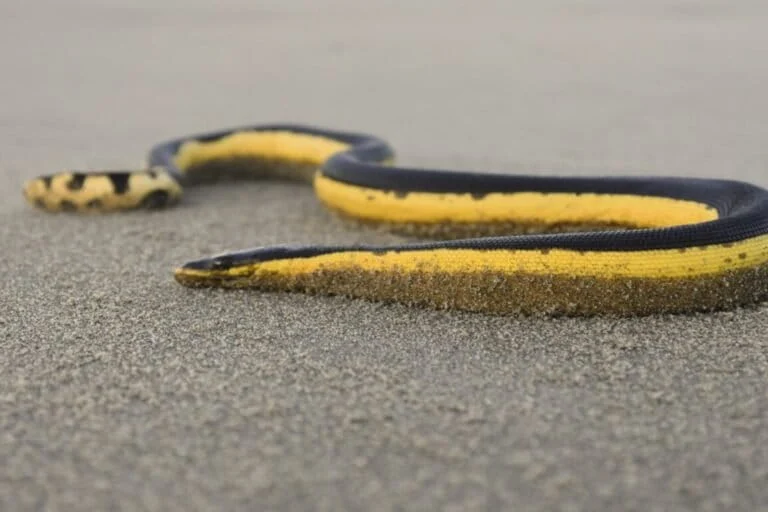
The yellow-bellied sea snake, scientifically known as Hydrophis platurus, represents one of the most remarkable evolutionary transitions in the history of the Squamata order. While the vast majority of the world’s 3,000-plus snake species are tethered to terrestrial or semi-aquatic environments, this specific reptile has achieved a feat of biological engineering that sets it apart: it has completely severed its ties with the land. As the only truly pelagic snake in existence, Hydrophis platurus spends its entire life cycle—from birth to death—within the open columns of the world’s oceans, drifting with currents and navigating the vast blue expanses of the Indo-Pacific without ever needing to touch a solid substrate.
Historically classified as Pelamis platurus, this species is a member of the Elapidae family, making it a close relative of some of the world’s most venomous land-dwelling snakes, including cobras, mambas, and taipans. However, unlike its terrestrial cousins, the yellow-bellied sea snake has undergone a suite of radical anatomical and physiological adaptations that allow it to thrive in a high-salinity, fluid environment. These adaptations have not only made it a master of the sea but have also rendered it virtually helpless on land, where its specialized body is unable to support its own weight or facilitate movement.
The Anatomy of a Marine Specialist
The physical form of Hydrophis platurus is a masterclass in marine adaptation. The most striking feature is its tail, which is laterally compressed into a flat, paddle-like structure. This biological oar provides the snake with incredible propulsion, allowing it to move through the water with a degree of agility that rivals many fish. According to the Guinness World Records, the yellow-bellied sea snake is recognized as the fastest swimming snake in the world, capable of reaching speeds of up to 1 meter per second in short bursts. This speed is a critical survival mechanism, enabling the snake to lunge at prey or evade predators such as sharks and sea birds.
Beyond its external shape, the internal physiology of the snake has evolved for deep-sea endurance. Its nostrils are located dorsally (on top of the snout) and are equipped with specialized valves that snap shut when the animal submerges, preventing saltwater from entering the respiratory system. Furthermore, its right lung has elongated to run almost the entire length of its body cavity. This serves a dual purpose: it acts as a massive oxygen reservoir for long dives—which can last up to 90 minutes—and functions as a hydrostatic organ, allowing the snake to fine-tune its buoyancy at various depths.
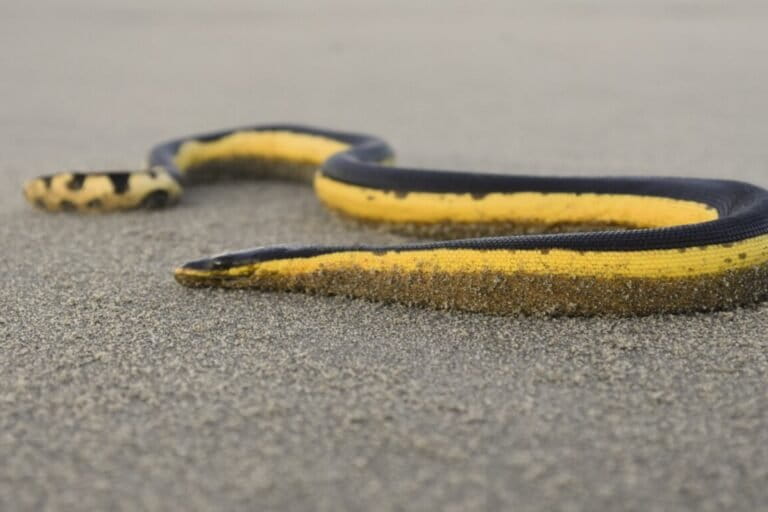
Recent research has also highlighted the snake’s ability to undergo cutaneous respiration. It is estimated that up to 33% of the snake’s oxygen requirements can be met by absorbing dissolved oxygen directly through its skin, while simultaneously venting carbon dioxide. This "underwater breathing" capability significantly extends its dive times, allowing it to remain submerged and hidden from surface predators for extended periods.
A Life Lived Entirely at Sea
What truly distinguishes Hydrophis platurus from other sea snakes, such as the sea kraits (Laticauda spp.), is its total independence from land. Sea kraits are amphibious; they must return to land to digest their food, shed their skin, and, most importantly, lay their eggs. In contrast, the yellow-bellied sea snake is ovoviviparous. It carries its young internally and gives birth to live, fully-formed neonates directly into the ocean. This reproductive strategy eliminates the need for a terrestrial nesting site, allowing the species to colonize the open ocean.
The geographic range of the yellow-bellied sea snake is the most extensive of any snake in the world. It is found throughout the tropical and subtropical waters of the Indian and Pacific Oceans, stretching from the eastern coast of Africa across to the western shores of the Americas. They are often found in "slicks"—areas where converging currents bring together debris, plankton, and small fish. In these slicks, thousands of yellow-bellied sea snakes have been observed congregating, creating a unique floating ecosystem.
The Myth of Saltwater Hydration
For decades, marine biologists operated under the assumption that sea snakes, like many marine birds and turtles, possessed highly efficient salt glands that allowed them to drink seawater and excrete the excess salt. It was believed that the sublingual glands (located under the tongue) in Hydrophis platurus served this exact purpose. However, a groundbreaking study published in the journal PLOS ONE in 2019 by a team of researchers from the University of Florida challenged this long-held consensus.
The study, led by Professor Harvey Lillywhite, followed a population of yellow-bellied sea snakes off the coast of Guanacaste, Costa Rica. The researchers discovered that despite being surrounded by an infinite supply of water, these snakes were frequently in a state of severe dehydration. When offered seawater in a laboratory setting, the snakes refused to drink it. However, when offered fresh water, they drank thirstily, often increasing their body mass significantly in a single sitting.
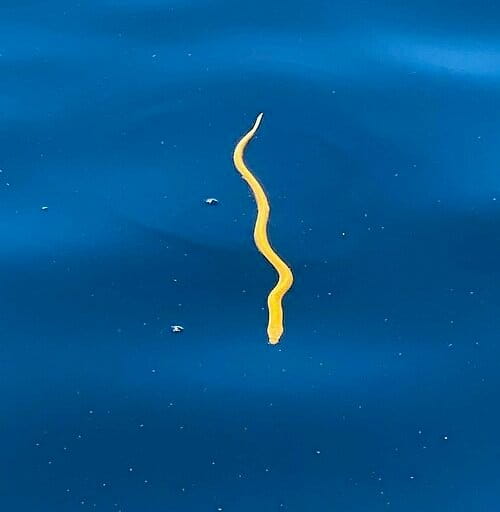
The researchers concluded that Hydrophis platurus relies entirely on "freshwater lenses" that form on the surface of the ocean during heavy rainfall. Because fresh water is less dense than salt water, it sits on top of the ocean for a brief period before mixing. The snakes have learned to exploit these ephemeral layers to rehydrate. During the dry season, which can last six to seven months in parts of the Pacific, these snakes may lose up to 25% of their body mass due to dehydration, essentially waiting for the monsoon rains to survive.
Hunting Strategies and Ecological Role
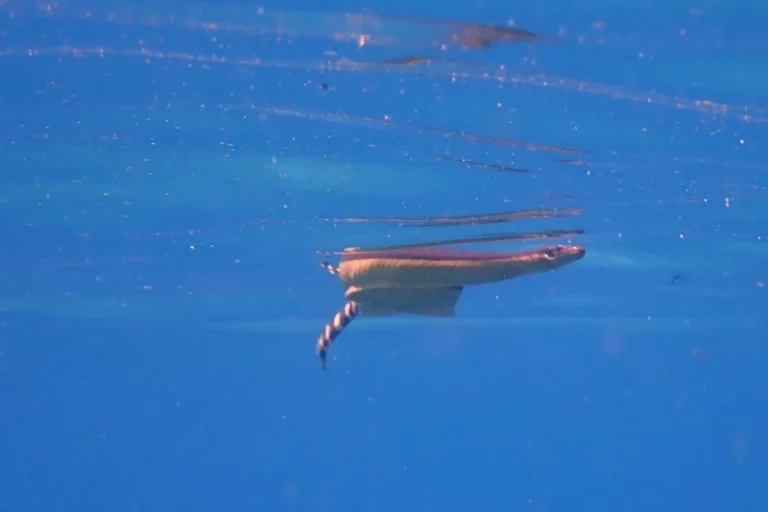
The hunting behavior of the yellow-bellied sea snake is a fascinating example of passive predation. Rather than actively chasing down fast-moving fish, the snake often employs a "sit-and-wait" tactic. By floating motionlessly at the surface, the snake mimics the appearance of a piece of driftwood or a floating branch. Small fish, seeking shelter from the open sun or larger predators, are naturally drawn to floating objects.
Once the prey is within striking distance, the snake utilizes its unique ability to swim backward as effectively as forward. It can strike with a sideways motion of the head, injecting a potent neurotoxic venom that causes rapid paralysis in fish. While their venom is highly toxic to humans—potentially causing respiratory failure and myoglobinuria—encounters are rare because the snakes are generally non-aggressive and possess small fangs located at the back of the jaw.
Climate Change and Future Vulnerabilities
The discovery that these snakes are dependent on rainfall for hydration has significant implications for their conservation in the era of climate change. As global warming alters precipitation patterns, many tropical regions are expected to experience longer and more intense periods of drought. For a species that is already pushed to its physiological limits during the dry season, an extension of these periods could lead to mass mortality events.
"These animals are living on the edge of what is physiologically possible," noted the researchers in the 2019 Florida study. If the "freshwater lenses" become less frequent or if the intervals between storms become too long, the yellow-bellied sea snake may face local extinctions in parts of its range. This vulnerability highlights the complex ways in which marine life is connected to atmospheric processes, proving that even a creature that never touches land is still at the mercy of the weather.
Scientific Significance and Analysis
The existence of Hydrophis platurus provides scientists with a living laboratory for studying the limits of vertebrate adaptation. From an evolutionary perspective, they represent a complete reversal of the process that saw tetrapods move from the sea to the land millions of years ago. By returning to the pelagic zone, they have re-evolved the streamlined efficiency of their fish ancestors while maintaining the complex biological systems of a reptile.
The snake’s reliance on ocean currents also makes it an accidental indicator of ocean health. Because they are often concentrated in current lines, they are among the first organisms to be affected by plastic pollution and oil spills, which also accumulate in these same "slicks." Monitoring the health and distribution of Hydrophis platurus populations can provide vital data on the movement of pollutants and the shifting dynamics of ocean currents.
In conclusion, the yellow-bellied sea snake is far more than just a venomous curiosity of the deep. It is a biological pioneer that has mastered the most challenging environment on Earth. However, its specialized lifestyle comes with a hidden fragility. As we continue to monitor this remarkable species, it serves as a reminder that the health of the ocean’s most unique inhabitants is inextricably linked to the stability of the global climate. The snake that never touches land may ultimately be saved or lost by the rain that falls from the sky.