Nila Kartika Wati
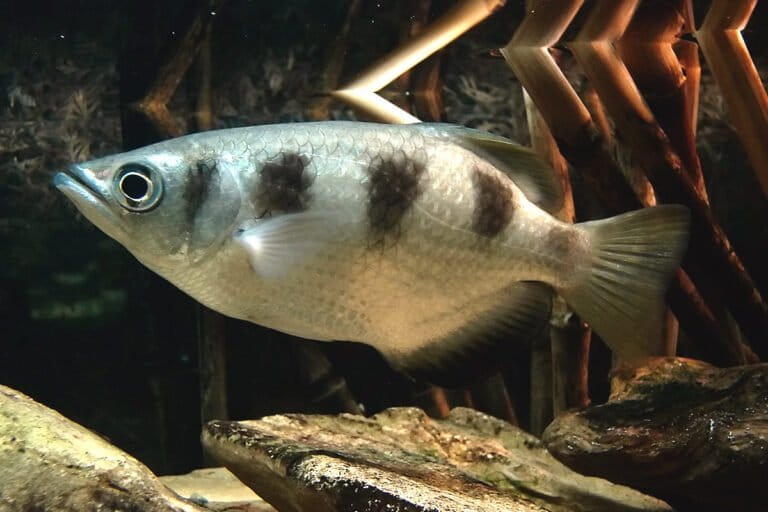
The archerfish, scientifically known as Toxotes jaculatrix, represents one of the most sophisticated examples of evolutionary engineering in the natural world. Inhabiting the brackish waters, mangroves, and estuaries across the Indo-Pacific region, including the sprawling archipelagos of Indonesia, this unassuming creature has mastered a predatory technique that defies the physical challenges of the interface between water and air. While many predators rely on speed or brute strength, the archerfish relies on ballistics, physics, and a remarkable capacity for cognitive adaptation to secure its meals.
Biological Profile and Habitat Dynamics
Measuring typically no more than 20 centimeters in length, the archerfish is characterized by its laterally compressed, silvery body, often adorned with distinctive semi-triangular markings. Its physiology is specifically optimized for its vertical hunting style. The fish possesses a specialized groove in the roof of its mouth, which, when pressed against the tongue, forms a tubular barrel. By rapidly closing its gill covers, the fish forces a jet of water through this tube with high pressure, effectively turning its own anatomy into a biological water cannon.
The species thrives in environments where the boundary between the aquatic and terrestrial realms is fluid. In the tangled roots of mangrove forests, insects such as bees, dragonflies, spiders, and flies often rest on overhanging leaves. The archerfish operates within this zone, targeting prey positioned up to two meters above the water’s surface. This is a distance that requires not only raw power but also an extraordinary degree of ballistic calculation.
The Physics of Refraction and Ballistic Correction
One of the primary obstacles for an aquatic predator targeting aerial prey is the refractive index of water. Light bends as it travels from air to water, meaning the image of an insect viewed from below the surface is displaced from its actual physical location. If the archerfish were to strike based on the visual image alone, it would consistently miss its target.
Research into the predatory behavior of Toxotes jaculatrix, most notably pioneered by Lawrence M. Dill in 1977, revealed that the fish possesses an innate ability to compensate for this optical illusion. Dill’s studies established that archerfish do not aim directly at the observed image of the prey. Instead, they calibrate their firing angle based on the refraction coefficient, essentially performing a complex mental calculation that adjusts the trajectory of the water jet to intersect with the actual coordinates of the insect.
Furthermore, the fish must account for gravity. As the water jet leaves the mouth, it follows a parabolic arc. To ensure that the projectile hits the target with sufficient force to knock it into the water, the fish must account for both the distance of the prey and the curvature of the trajectory. This requires an integration of visual depth perception and mechanical control over the force of the water release.
Advanced Hydrodynamics: The 2014 Breakthrough
The sophistication of the archerfish’s hunting mechanism was further elucidated in a 2014 study published in the journal Current Biology. Researchers discovered that the archerfish does not merely shoot a uniform stream of water; rather, it manipulates the dynamics of the jet to maximize impact.
The study revealed that the fish modulates the speed of the water as it leaves its mouth. Specifically, the tail end of the water jet is ejected at a higher velocity than the leading edge. As the jet travels through the air, the faster rear portion catches up to the slower front, causing the entire volume of water to coalesce into a concentrated mass just before impact. This "mass-loading" effect ensures that the kinetic energy is delivered in a single, high-impact blow, maximizing the likelihood that the prey will be dislodged from its perch.
This level of control is achieved through precise muscular adjustments in the mouth. By subtly altering the shape and size of the oral aperture during the firing sequence, the fish can tailor the jet’s characteristics to the distance and size of the target. For more distant prey, the firing sequence is prolonged, and the aperture is manipulated in real-time to ensure the stream remains coherent across the entire distance.
Cognitive Adaptation and the Learning Curve
Perhaps the most compelling discovery regarding the archerfish involves its capacity for learning, as evidenced by a 2024 study published in the journal eLife. For decades, the precision of the archerfish was categorized as a hard-wired, instinctual behavior. However, recent experimental data suggests that these fish possess a significant capacity for motor learning and adaptation based on experience.
In laboratory settings, researchers introduced external variables, such as controlled crosswinds, designed to deflect the water jets. Initially, the archerfish failed to account for these environmental disturbances, resulting in missed shots. However, after repeated attempts, the fish demonstrated a clear ability to recalibrate their aim. By observing the outcome of their previous shots and adjusting their firing angles accordingly, the fish were able to compensate for the interference and return to a high level of accuracy.
This discovery highlights a phenomenon known as motor adaptation, suggesting that the archerfish possesses a sophisticated neurological framework for processing feedback. It is not merely a biological machine; it is a learner capable of refining its performance through trial and error. This capability allows the fish to thrive in dynamic environments where environmental factors like wind speed, water surface turbulence, and changing light conditions are constantly fluctuating.
Broader Implications for Evolutionary Biology
The archerfish serves as a critical model organism for researchers studying the evolution of cognition and physical precision. Its ability to perform complex mathematical calculations—effectively solving for refraction, gravity, and drag in a split second—raises questions about the neural architecture required for such tasks.
From a broader ecological perspective, the archerfish plays a specialized role in the food web of the Indo-Pacific estuaries. By bridging the gap between terrestrial and aquatic ecosystems, they exert selective pressure on insect populations that would otherwise be beyond the reach of traditional aquatic predators. Their presence ensures a steady flow of nutrients from the canopy and riparian vegetation into the aquatic environment.
The implications of these findings extend into the field of robotics and artificial intelligence. Engineers have long looked to nature for inspiration in designing autonomous systems. The archerfish’s ability to manipulate fluid dynamics and adapt to environmental noise is of particular interest to researchers developing soft robotics and precision-targeting systems. Understanding the "algorithm" the archerfish uses to hit its mark could lead to advancements in underwater-to-air communication and drone technology, where similar refractive and aerodynamic challenges persist.
Conservation Status and Future Outlook
While the archerfish is not currently listed as a threatened species, its habitat—the mangrove forest—is one of the most vulnerable ecosystems on the planet. Coastal development, aquaculture expansion, and water pollution pose significant risks to the brackish water environments that the Toxotes jaculatrix relies on.
The loss of these habitats would not only threaten the survival of this unique species but also result in the loss of a biological "laboratory" that has provided, and continues to provide, invaluable insights into the intersection of biology, physics, and cognition. Continued research into the behavioral ecology of the archerfish is essential, not only for the sake of conservation but also to deepen our understanding of how complex predatory strategies evolve in response to the physical constraints of our world.
As scientific inquiry progresses, the archerfish remains a testament to the ingenuity of natural selection. Whether it is calculating the trajectory of a water jet or learning to outsmart a crosswind, the archerfish reminds us that precision is not the exclusive domain of technology, but a fundamental strategy for survival in the wild. Its existence challenges our perceptions of intelligence in non-mammalian species and underscores the necessity of protecting the complex, interdependent ecosystems that allow such marvels of evolution to flourish.
In conclusion, the archerfish is far more than a simple predator. It is a master of physics, a capable learner, and a vital component of the coastal biodiversity of Asia and the Pacific. As we uncover more about its hunting mechanisms, it becomes increasingly clear that the archerfish is one of the most remarkable architects of the natural world, perfectly adapted to a life of precision in the shadow of the mangroves.