Azin Asro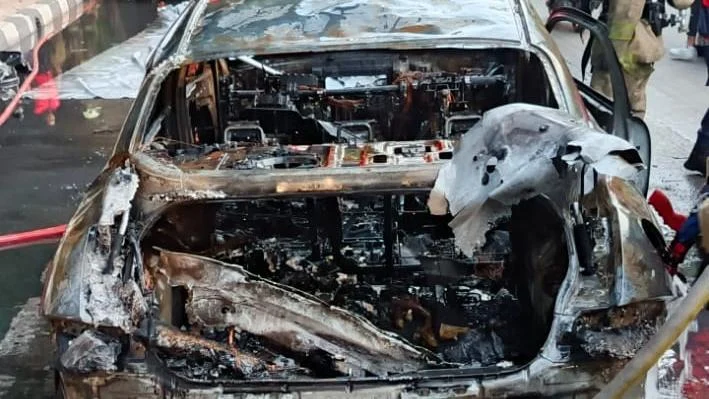
The electric vehicle landscape in Indonesia has faced a significant test following an unexpected road incident in the capital city. A high-end luxury electric sedan, the Hyundai Ioniq 6, was completely engulfed in flames after being involved in a single-vehicle accident in the Slipi area of West Jakarta. The incident, which occurred in the early hours of Friday, September 11, has drawn considerable public attention and raised renewed discussions regarding electric vehicle (EV) safety protocols, structural integrity, and post-collision protocols in tropical urban environments.
Valued at approximately Rp 1.2 billion, the premium zero-emission vehicle suffered catastrophic damage after veering off its intended path and heavily impacting a concrete road divider. While local emergency responders acted swiftly to contain the blaze and prevent human casualties, the incident left a temporary mark on morning rush-hour traffic and immediately triggered a corporate response from the vehicle manufacturer. As automotive authorities and safety advocates examine the sequence of events, the occurrence highlights the complex interaction between modern battery-electric architectures and severe physical trauma resulting from roadway impacts.
Chronology of the Incident: From Impact to Containment
According to official incident reports compiled by the Jakarta Barat Fire and Rescue Sub-department (Sudin Gulkarmat), the sequence of events began shortly after dawn. The Hyundai Ioniq 6 was travelling along the prominent thoroughfare of Jalan Letjen S. Parman when the driver reportedly lost control of the steering mechanism.
Preliminary investigations indicate that the vehicle veered sharply before violently striking the concrete separator designated for the TransJakarta bus rapid transit corridor. The kinetic energy generated by the collision inflicted substantial structural damage to the front section of the car. Eyewitness accounts and subsequent municipal findings suggest that the severe physical blow compromised the vehicle’s electrical framework, resulting in an immediate short circuit.
Sparks generated by the electrical fault quickly ignited flammable materials within the engine bay or surrounding synthetic components, giving rise to smoke and localized flames. Recognizing the imminent danger, the driver successfully evacuated the cabin prior to the fire escalating, ensuring that no injuries or fatalities were sustained during the ordeal.
Emergency response units received the distress call at approximately 05:04 Western Indonesian Time (WIB). Recognizing the potential hazards associated with lithium-ion battery fires—which demand specialized cooling techniques and extended monitoring periods—authorities mobilized a tactical response unit. Three dedicated fire pump trucks, accompanied by 15 seasoned personnel, were dispatched to the scene.
Arriving at 05:18 WIB, firefighters initiated suppression operations under challenging urban conditions. Utilizing standard and specialized extinguishing agents, the team worked meticulously to suppress the volatile flames. By 06:18 WIB, exactly one hour after operations commenced, the fire was entirely extinguished, and the cooling phase was successfully concluded, allowing authorities to declare the scene cleared of immediate thermal threats.
Traffic Congestion and Urban Mobility Impacts
The timing of the accident compounded logistical challenges across West Jakarta’s arterial road network. Occurring during the formative hours of the morning commute, the incident and subsequent emergency response directly paralyzed a vital segment of the city’s infrastructure.
The Simpang Tomang intersection, a notorious bottleneck connecting major commercial and residential districts, experienced severe traffic compression. Vehicles attempting to navigate from Slipi toward Tomang faced immense gridlock as police and emergency personnel cordoned off lanes to facilitate firefighting operations and the eventual towing of the charred vehicle wreck.
According to real-time traffic updates provided by the National Traffic Management Centre (NTMC) of the Indonesian National Police, congestion persisted well after the flames were extinguished. Friska, a representative from the NTMC Polri call center, noted that as late as 07:25 WIB, heavy vehicle queues remained visible as the wreckage was hoisted onto flatbed tow trucks and cleared from the asphalt. Commuters experienced delays ranging from thirty to forty-five minutes, underscoring the broader societal ripple effects that severe urban vehicular accidents can impose on metropolitan productivity.
Manufacturer Response and Investigation Status
In the wake of the incident, PT Hyundai Motors Indonesia (HMID), the official brand custodian and manufacturing distributor for Hyundai vehicles in the country, initiated a comprehensive technical review. Given the high-profile nature of the vehicle and the sensitivity surrounding electric vehicle safety perceptions among consumers, corporate communications emphasized a methodical and evidence-based approach.

When approached for comment regarding the root cause of the fire and the condition of the high-voltage battery pack, corporate representatives confirmed that internal diagnostic protocols were underway. Rouli Sijabat, General Manager (GM) Brand Interactive for PT HMID, stated that the organization is coordinating closely with relevant field teams to piece together the exact narrative of the event.
"There is no update yet regarding the formal results of the investigation," Rouli Sijabat told automotive media outlet detikOto. "The comprehensive collection of information and physical evidence from various involved parties is still ongoing."
Industry analysts anticipate that Hyundai’s technical engineers will examine the vehicle’s electronic control units (ECUs), structural chassis deformation data, and battery management system (BMS) logs to determine whether the thermal event was directly linked to a lithium-ion cell breach or external arcing caused by the physical impact with the concrete separator. Under standard operating procedures for global automotive brands, post-incident analyses of this magnitude often involve regional and international engineering experts to ensure absolute transparency and adherence to international safety standards.
Contextualizing Electric Vehicle Safety in Indonesia
The incident involving the Hyundai Ioniq 6 serves as a focal point for broader discussions concerning the rapid adoption of electric mobility in Indonesia. As the government aggressively pushes toward net-zero emission targets through fiscal incentives, infrastructure development, and regulatory frameworks supporting electric vehicles, consumer awareness regarding EV safety has become increasingly pronounced.
Statistically, internal combustion engine (ICE) vehicles are involved in vehicular fires globally at rates comparable to or exceeding those of electric vehicles, often stemming from fuel line ruptures, oil leaks, or electrical short circuits following high-impact collisions. However, due to the novelty of electric propulsion systems and the unique chemical properties of high-capacity lithium-ion battery packs, fires involving EVs frequently attract heightened media scrutiny.
Modern electric vehicles, including models built on Hyundai’s advanced Electric-Global Modular Platform (E-GMP) like the Ioniq 6, incorporate multiple layers of passive and active safety measures. These include reinforced structural crash boxes, automatic high-voltage disconnection switches triggered upon airbag deployment, and thermal barriers designed to prevent thermal runaway—a phenomenon where an overheating cell triggers a cascading failure in adjacent cells.
In the case of the Slipi incident, preliminary field data strongly suggests that the fire originated from an external mechanical trauma—specifically, a high-velocity collision with a solid road barrier—rather than a spontaneous internal battery failure. Automotive safety researchers emphasize that any vehicle, regardless of whether its primary energy source is gasoline, diesel, or electricity, is susceptible to fire when subjected to severe structural impacts that sever electrical harnesses or fracture fuel systems.
Broader Implications for Infrastructure and Emergency Preparedness
Beyond manufacturing accountability, the incident has prompted urban planners and emergency response agencies to evaluate their readiness in handling next-generation vehicle emergencies. Electric vehicle fires require specific tactical adjustments compared to traditional vehicular fires, primarily due to the potential for prolonged thermal reactions and the necessity for copious amounts of water to achieve complete core cooling of the battery modules.
Jakarta’s Fire and Rescue Department (Dinas Gulkarmat) has increasingly incorporated EV-specific handling modules into its training programs. The efficient execution demonstrated by the West Jakarta personnel during the Slipi incident—arriving within fourteen minutes of notification and neutralizing the blaze within an hour—underscores the growing competence of local municipal services in managing modern technological hazards on the roadway.
Furthermore, municipal authorities are reviewing infrastructure safety features, such as the design and material composition of highway dividers and busway separators. While these concrete barriers are essential for lane discipline and public transit segregation, the frequency of high-impact collisions highlights the necessity for ongoing urban design improvements to minimize kinetic trauma when vehicles depart from designated lanes.
Conclusion and Future Outlook
The burning of the Hyundai Ioniq 6 in West Jakarta is a sobering reminder of the physical realities governing automotive transport, even as the industry transitions toward sophisticated electrification. While the visual imagery of a luxury electric vehicle consumed by fire carries significant shock value, the factual timeline indicates a standard vehicular accident exacerbated by severe structural impact, followed by a professional and timely emergency response that successfully averted human tragedy.
As PT HMID continues its rigorous internal investigation, consumers and industry stakeholders await the final technical disclosures. The findings will likely offer valuable data points for automotive engineers, insurance underwriters, and safety regulators alike, contributing to the continuous refinement of electric vehicle safety standards in Indonesia’s rapidly evolving transportation ecosystem.