Tyo Susilo
The landscape of desktop display technology is undergoing a continuous evolution, driven by the demands of both productivity-focused professionals and high-end gaming enthusiasts. As desk real estate expands and graphics processing units (GPUs) grow increasingly powerful, display manufacturers are constantly experimenting with new form factors to capture consumer interest. In this competitive ecosystem, prominent hardware manufacturer HKC has officially introduced a groundbreaking addition to the display market: the HKC Tianqi 43H180C. Billed as the world’s first monitor to feature an unorthodox 24:9 aspect ratio paired with a massive 43.8-inch 4K panel, this device bridges the gap between conventional widescreen monitors and ultra-wide cinematic displays. While the announcement has generated significant buzz within the tech community regarding its potential applications, it has also sparked intense debate among hardware analysts and gamers alike regarding its real-world performance, hardware demands, and overall viability for demanding AAA gaming titles and competitive esports.
Chronology and Market Context
The development of ultra-wide monitors has historically been defined by two standard aspect ratios: the traditional 21:9 format, which became popular for media consumption and moderate multitasking, and the more extreme 32:9 super-ultrawide format, which essentially combines two 16:9 monitors side-by-side without a central bezel. While 32:9 displays offered unparalleled horizontal immersion, they often suffered from vertical compression issues, making content at the top and bottom of the screen feel restricted unless paired with massive curved panel designs.
According to initial industry reports originating from major technology portals such as IT Home, HKC’s engineering division sought to solve this geometric dilemma by charting a middle ground. The result of this research and development phase is the Tianqi 43H180C, a panel engineered to deliver the expansive horizontal landscape typical of ultra-wide monitors while preserving the vertical screen height associated with standard 4K displays. By selecting a 24:9 aspect ratio, HKC aimed to provide a display architecture that caters simultaneously to creative professionals requiring timeline real estate and gamers seeking a more natural, immersive field of view. The formal unveiling of the monitor marks a strategic push by HKC to claim a unique market segment, positioning itself ahead of competitors who have largely remained anchored to conventional 16:9, 21:9, and 32:9 configurations.
Technical Specifications and Display Architecture
At the core of the HKC Tianqi 43H180C is a sprawling 43.8-inch display panel boasting a resolution of 5760 by 2160 pixels. This extraordinary pixel count translates to roughly 12.4 million pixels, placing the monitor well above standard 4K UHD displays in terms of sheer rendering load. Unlike 32:9 monitors that often sacrifice vertical resolution to maintain manageable aspect ratios, the 24:9 configuration of the Tianqi 43H180C retains a substantial vertical dimension, ensuring that images do not appear unnaturally letterboxed or vertically compressed.
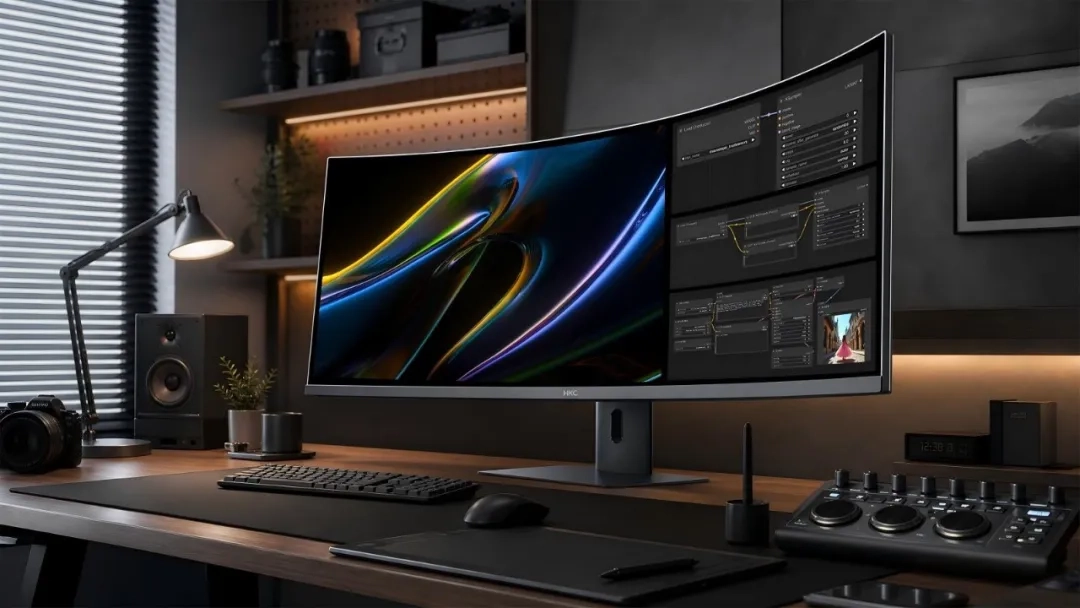
Complementing this high-resolution setup is a maximum refresh rate of 180Hz. For a display of this size and resolution, achieving a 180Hz refresh rate represents a notable engineering achievement, pointing to advanced panel technology and robust signal processing capabilities. The combination of a 4K-class vertical resolution, an extended horizontal span, and a high refresh rate creates a hybrid display profile. It is designed to handle fast-paced motion smoothly while offering the pristine clarity required for detailed text work, video editing timelines, and intricate digital artwork. However, these ambitious specifications also introduce formidable hardware challenges, particularly when the monitor is subjected to real-world gaming workloads.
Evaluating AAA Gaming Performance and Hardware Demands
The integration of high refresh rates and ultra-wide 4K resolutions inevitably raises critical questions regarding GPU compatibility and frame rate stability. When analyzing whether the HKC Tianqi 43H180C can effectively run modern AAA video games, industry analysts emphasize the sheer magnitude of the rendering burden. Rendering 5760 x 2160 pixels at high frame rates requires an immense amount of computational power—significantly more demanding than standard 4K (3840 x 2160) and exponentially heavier than standard 1440p gaming.
Graphically intensive titles such as Cyberpunk 2077, Alan Wake 2, and Black Myth: Wukong are notorious for pushing flagship graphics cards to their absolute limits. When these titles are deployed on a 24:9 ultra-wide 4K canvas, even top-tier GPUs will struggle to maintain native frame rates that approach the panel’s 180Hz ceiling, particularly when demanding graphical features like ray tracing and maximum fidelity presets are enabled. Consequently, hardware experts note that achieving a smooth, high-refresh-rate experience in modern AAA games will heavily rely on aggressive optimization, reduced graphical settings, and the adoption of AI-driven upscaling technologies such as NVIDIA’s DLSS or AMD’s FSR.
Despite these performance hurdles, the display format offers undeniable immersion for compatible titles. In open-world RPGs, flight and racing simulators, and atmospheric action-adventure games, the extra horizontal real estate dramatically widens the player’s peripheral vision. The added vertical resolution ensures that landscapes, cockpit interiors, and character models retain their proper proportions, delivering a cinematic quality that standard 16:9 displays struggle to replicate. For gamers willing to balance visual fidelity with performance scaling, the monitor offers a visually arresting window into virtual worlds.
Esports, Competitive Gaming, and Ergonomic Implications
While the cinematic appeal of the Tianqi 43H180C is evident, its suitability for competitive esports presents a starkly different set of considerations. Fast-paced competitive titles—such as Counter-Strike 2, Valorant, Overwatch 2, and Apex Legends—are intentionally optimized to run at high frame rates, making the monitor’s 180Hz refresh rate theoretically advantageous for tracking fast-moving targets.

However, running these games at a native resolution of 5760 x 2160 still demands substantial GPU muscle compared to traditional 1080p or 1440p esports setups. More importantly, professional and competitive players often encounter ergonomic and mechanical drawbacks when using ultra-wide displays. In high-stakes competitive environments, a player’s field of view must be carefully managed to ensure rapid reaction times. On a 43.8-inch screen with a 24:9 aspect ratio, critical interface elements, mini-maps, and peripheral action are spread across a vast horizontal expanse. This layout requires players to physically move their eyes and heads significantly farther to process crucial visual data, potentially slowing down reaction times compared to standard 16:9 monitors where all essential information remains within a tight focal zone. Additionally, many competitive game developers artificially restrict field-of-view settings to maintain competitive balance, which can result in distorted scaling or tiny target models on ultra-wide screens.
Broader Market Implications and Industry Outlook
The introduction of the HKC Tianqi 43H180C serves as a bellwether for the future of desktop display engineering. By carving out a new category between standard ultra-wides and super-ultrawides, HKC has demonstrated that manufacturers are willing to experiment with niche form factors to satisfy specialized user bases.
From an industry perspective, the success of this monitor will likely depend on how software developers adapt to non-standard aspect ratios. While productivity software and modern operating systems handle custom resolutions with relative ease, game developers must continue to build robust ultra-wide support into their game engines to prevent UI stretching, cutscene letterboxing, and distorted perspective ratios. Furthermore, as next-generation graphics hardware continues to advance, the gap between rendering demands and high-resolution performance will gradually narrow, making ultra-high-resolution ultra-wides more accessible to mainstream enthusiasts.
Ultimately, the HKC Tianqi 43H180C is not positioned as a universal display solution for every consumer. Instead, it represents a specialized, high-performance centerpiece tailored for power users, content creators, and affluent gamers who demand an uncompromising blend of expansive screen real estate, sharp resolution, and fluid refresh rates. As initial units reach the market, consumer reception and technical reviews will ultimately determine whether the 24:9 aspect ratio remains a passing technological novelty or evolves into an established standard in the high-end monitor ecosystem.