
 Bambang Pamungkas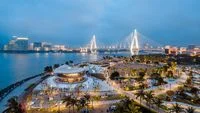
The People’s Republic of China is aggressively advancing one of its most ambitious economic experiments to date by transforming the tropical island province of Hainan into a massive, globally integrated free trade port. Valued at approximately US$113 billion—equivalent to roughly Rp2,000 trillion—this sweeping strategic initiative is designed to fundamentally reshape China’s trade architecture, attract foreign direct investment, and establish a dynamic new commercial gateway to the international community.
Officially designated as the Hainan Free Trade Port (FTP), the multi-billion-dollar project represents a calculated move by Beijing to decouple Hainan’s customs operations from the mainland Chinese territory. By implementing sweeping regulatory relaxations, aggressive tariff cuts, and modernized cross-border investment frameworks, the Chinese government is positioning the southern island as a formidable alternative to traditional financial capitals like Hong Kong, particularly as the global economy navigates persistent uncertainties, geopolitical fragmentation, and shifting supply chain dynamics.
Strategic Customs Separation and Structural Overhaul
At the core of the Hainan FTP initiative is a radical restructuring of customs and administrative barriers. Beijing has deliberately separated Hainan’s customs operations from mainland China, creating a semi-autonomous economic zone characterized by a high degree of trade liberalization and streamlined regulatory oversight. This physical and administrative demarcation allows goods, capital, and personnel to move with significantly reduced friction compared to the tightly regulated mainland market.
Under the newly implemented policy frameworks, the scope of goods eligible for zero-tariff entry into Hainan has expanded dramatically. Previously, only 21% of imported goods qualified for zero-tariff treatment. Under the current framework, that figure has surged to 74%. Furthermore, the categories of duty-free goods have multiplied more than three-fold, expanding to encompass over 6,600 distinct product classifications.
This unprecedented liberalization extends beyond mere import duties. Under the new regulatory architecture, manufactured and processed goods originating in Hainan can enter mainland China completely tariff-free, provided that the local value-added component exceeds 30%. This specific provision creates a powerful incentive for domestic and international manufacturers to establish operational hubs on the island, leveraging Hainan as a staging ground for both international export and mainland distribution. Additionally, foreign entities are being granted unprecedented access to specific service sectors—such as telecommunications, healthcare, and professional services—that remain heavily restricted or entirely closed to foreign investment across mainland China. Cross-border investment procedures have similarly been simplified, replacing cumbersome approval processes with a modernized negative-list management system.
Chronology and Background Context of the Hainan FTP
The journey toward transforming Hainan into a premier free trade port is the culmination of a multi-year policy evolution orchestrated by Beijing. Long recognized primarily as a domestic tourism destination and a tranquil tropical retreat, Hainan’s strategic economic potential began to gain serious policy traction in the late 2010s.
The timeline of Hainan’s economic elevation traces back key milestones:
- April 2018: During a high-profile address celebrating the 30th anniversary of the establishment of Hainan province and its special economic zone, Chinese President Xi Jinping announced the central government’s decision to support Hainan in building a pilot free trade zone and exploring the step-by-step establishment of a free trade port with Chinese characteristics.
- June 2020: The Central Committee of the Communist Party of China and the State Council jointly released the Master Plan for the Hainan Free Trade Port. This comprehensive document laid out clear developmental phases, setting targets for institutional framing by 2025 and a more mature, globally competitive free trade port system by 2035.
- 2021–2023: The National People’s Congress passed the Hainan Free Trade Port Law, providing a robust legal foundation to guarantee policy continuity, protect foreign investment, and establish specialized courts to handle international commercial disputes on the island.
- 2024–Present: The implementation phase accelerated significantly, culminating in the formal customs island-wide operation preparations, massive infrastructure buildouts, and the introduction of expansive zero-tariff and low-tax regimes designed to attract multinational corporations, luxury retailers, and financial institutions.
Geographic Advantage and Integration with Southeast Asia
Beyond domestic economic restructuring, Hainan’s geographical positioning plays a pivotal role in Beijing’s broader geopolitical and commercial strategies. Situated at the southernmost tip of China, Hainan acts as a natural bridge connecting the world’s second-largest economy with the dynamic markets of Southeast Asia.
The island’s proximity to members of the Association of Southeast Asian Nations (ASEAN) makes it an ideal logistical and commercial hub for the Regional Comprehensive Economic Partnership (RCEP) framework. As global supply chains undergo regionalization and near-shoring, the Hainan FTP is engineered to accelerate regional supply chain integration. By facilitating smoother trade flows between mainland China, Southeast Asia, and global markets, Hainan reinforces China’s economic diplomacy and strengthens trade resilience in the Asia-Pacific region.
"Pelabuhan ini dapat menjadi gerbang vital yang memimpin era baru keterbukaan China kepada dunia," stated China’s Vice Premier He Lifeng, emphasizing the central government’s high expectations for the project as a beacon of continued economic engagement with the international community.
Market Reactions and Investor Sentiment
The official rollout and continuous policy upgrades surrounding the Hainan FTP have elicited an immediate and largely positive response from global financial markets. Following recent policy announcements detailing the expansion of zero-tariff categories and streamlined cross-border capital flows, equity markets in both mainland China and Hong Kong experienced noticeable upward momentum. Investors interpreted the move as a tangible signal that Beijing remains committed to market-oriented reforms and international trade, even amidst domestic economic headwinds.
Financial analysts and market observers have increasingly viewed Hainan as a controlled environment where Beijing can experiment with advanced economic liberalization without risking destabilization of the broader domestic financial system.
"The Hainan model essentially offers managed liberalization that will be exceptionally good for re-integrating supply chains, but this model lacks the deep-seated legal system and financial openness that Hong Kong can boast of," noted Xu Tianchen, a senior economist at the Economist Intelligence Unit, during a recent evaluation of the port’s long-term prospects.
Xu’s assessment underscores a vital distinction within the global economic landscape: while Hainan provides unmatched manufacturing, processing, and localized tariff advantages, Hong Kong retains its historical preeminence as an international financial powerhouse backed by common law, deep capital markets, and fully convertible currency regimes. Rather than serving as a direct replacement for Hong Kong, analysts increasingly view Hainan as a complementary industrial and commercial powerhouse tailored to the modern era of supply chain diversification.
Broader Implications for Global Trade and Economy
The implementation of the US$113 billion Hainan Free Trade Port carries profound implications for multinational corporations, regional trading partners, and the global economic order. By lowering barriers to entry, offering corporate income tax caps capped at 15% for encouraged industries, and exempting individual income taxes for high-end and urgently needed talent at a maximum of 15%, Hainan is aggressively courting global human and financial capital.
For multinational enterprises seeking a foothold in the vast Chinese consumer market while simultaneously mitigating geopolitical risks associated with mainland operations, Hainan offers a viable, highly incentivized hybrid environment. Companies can utilize the island as a regional headquarters, a processing and assembly center, or a high-end consumer goods showcase.
However, challenges remain. Ensuring regulatory transparency, maintaining robust intellectual property protections, managing potential capital flight risks, and aligning regional enforcement standards with international best practices will be critical determinants of the project’s ultimate success.
As the Hainan Free Trade Port continues its phased evolution toward its 2035 maturity targets, the global business community will be closely watching whether this monumental experiment can successfully redefine China’s economic interface with the rest of the world. What is certain is that Hainan has transitioned from a tranquil tropical getaway into one of the most closely monitored and strategically vital economic laboratories on the global stage.








