Nila Kartika Wati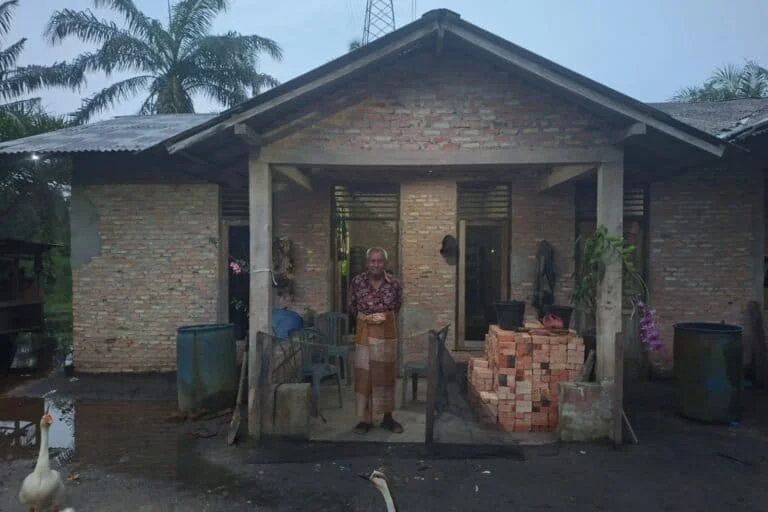
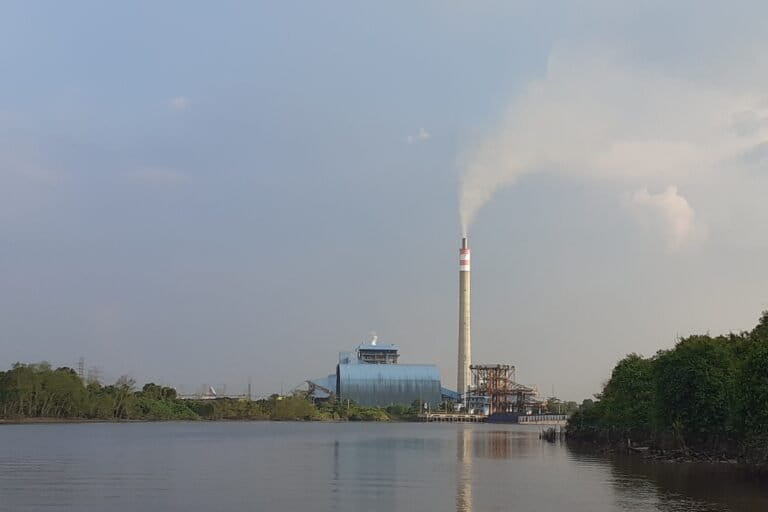
The decision by the Indonesian government to remove Fly Ash and Bottom Ash (FABA), the residual byproduct of coal combustion at coal-fired power plants (PLTUs), from the list of hazardous and toxic waste (B3) has triggered a cascade of unregulated disposal practices that threaten both public health and environmental integrity. At the Tenayan Raya PLTU in Pekanbaru, Riau, this regulatory relaxation has manifested in a concerning trend where toxic ash is no longer treated as a dangerous pollutant but is instead repurposed as makeshift construction fill for local residents. This shift occurs against a backdrop of profound energy irony: while neighbors of the plant live in the shadow of its towering chimneys and deal with its industrial waste, many remain disconnected from the very electricity the facility produces.
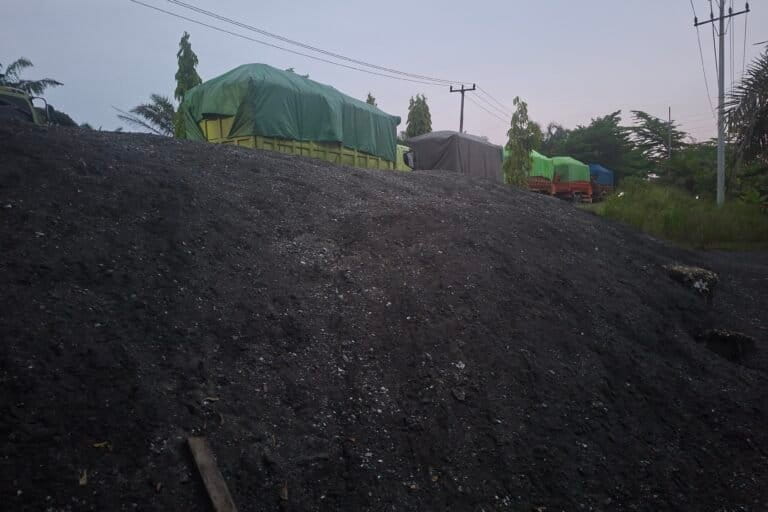
The reality of this policy shift is visible on the ground in Badak Ujung, where Budi Warno, a 71-year-old resident known locally as Seno, has spent months living alongside mounds of grey, powdery residue. Driven by economic necessity rather than a lack of caution, Seno utilized approximately ten truckloads of FABA to elevate the floor of a former stall adjacent to his home. His motivation was simple: the area is prone to flooding during heavy rains, and traditional soil fill is prohibitively expensive, costing roughly Rp200,000 (approximately USD 13) per truckload. By contrast, the coal ash was obtained for free from workers at the Tenayan Raya plant, located just one kilometer away, with Seno only providing "cigarette money" as a gesture of appreciation to the delivery drivers.
However, the convenience of free material comes with a hidden biological cost. When the monsoon rains descend upon Pekanbaru, the piles of ash at Seno’s doorstep transform into a slurry. During recent visits to the site, the ground was observed to be deceptively unstable; vehicles frequently sank into the waterlogged ash. While Seno intends to eventually cap the ash with a layer of cement and sand, financial constraints—exacerbated by recent family medical expenses—have left the toxic material exposed to the elements, where it can easily leach into the local water table or become airborne as fine particulate matter during dry spells.
The Regulatory Shift: From Hazardous Waste to Industrial Byproduct
The deregulation of FABA in Indonesia is a relatively recent phenomenon, rooted in Government Regulation (PP) No. 22 of 2021 on the Implementation of Environmental Protection and Management. This regulation, a derivative of the controversial Omnibus Law on Job Creation, reclassified FABA from coal-fired power plants as "Non-B3 Registered Waste." Previously, under PP No. 101 of 2014, these materials were strictly categorized as hazardous due to their chemical composition.
The government’s rationale for this reclassification was primarily economic. By removing the B3 label, the state aimed to lower the operational costs for the national utility company, PLN, and private power producers, who previously faced high expenditures for specialized storage, transport, and disposal of coal ash. Furthermore, the Ministry of Environment and Forestry argued that FABA could be integrated into a "circular economy," serving as a raw material for bricks, paving blocks, and road base construction.
However, environmental advocates and legal experts argue that this reclassification is a form of "legalized pollution." Eko Yunanda, the Executive Director of Walhi Riau, emphasizes that the management of such waste is not merely a technical hurdle but a fundamental human rights issue. "This is about the basic right of the community to live in a healthy environment," Yunanda stated. He notes that the lack of stringent oversight following the 2021 regulation has led to a "reckless" approach to disposal, where the burden of safety is shifted from the multi-billion-dollar energy industry to uninformed local citizens.
Chemical Hazards and Long-term Health Implications
Scientific analysis of Fly Ash and Bottom Ash reveals a cocktail of heavy metals that pose significant risks to human physiology. FABA typically contains varying concentrations of arsenic, mercury, lead, cadmium, and chromium. These elements are persistent in the environment and do not degrade over time. When FABA is used as open-fill material, as seen in the Tenayan Raya vicinity, these metals can leach into the groundwater through a process known as acid mine drainage or simple aqueous leaching, eventually contaminating the wells that local residents rely on for drinking and bathing.
The health risks associated with chronic exposure to these substances are well-documented in medical literature. Arsenic is a known carcinogen, linked to skin, bladder, and lung cancers. Mercury is a potent neurotoxin that can cause developmental delays in children and neurological disorders in adults. Lead exposure is particularly dangerous for pregnant women and young children, as it can result in permanent cognitive impairment and behavioral issues. Furthermore, the inhalation of fine crystalline silica and other particulate matter found in coal ash can lead to chronic obstructive pulmonary disease (COPD), silicosis, and increased susceptibility to respiratory infections.
The 2021 Constitutional Court (MK) ruling No. 23/PUU-XIX/2021 did offer a slight legal silver lining, affirming that the removal of FABA from the B3 list does not shield companies from civil lawsuits if environmental damage can be proven. However, for residents like Seno, the burden of proof is an insurmountable wall. Proving that a specific health ailment or a contaminated well is the direct result of PLTU waste requires expensive laboratory testing and legal expertise that marginalized communities simply do not possess.
The Mirage of the Circular Economy
Critics argue that the government and industry are using the "circular economy" narrative as a strategic tool for greenwashing. Firdaus Cahyadi, a Program Officer at the TIFA Foundation, suggests that the promotion of FABA for "social interests"—such as building public libraries or health clinics—is a calculated move to create a positive public perception of toxic waste.
In Pekanbaru, the Tenayan Raya PLTU has actively promoted the use of its ash in high-profile community projects. This includes the construction of the Putri Kaca Mayang digital library and the foundations for COVID-19 epidemiology posts at the Tenayan Raya Community Health Center (Puskesmas). While these projects are framed as Corporate Social Responsibility (CSR) initiatives, analysts like Cahyadi believe they serve to "de-politicize" the issue of pollution. By transforming a liability into a "resource," the company saves on disposal costs while simultaneously building social capital, effectively blurring the lines between environmental protection and industrial convenience.
Novita Indri, a campaigner for Trend Asia, points out a critical lack of transparency following the 2021 deregulation. Since FABA was delisted, there has been a noticeable absence of publicly accessible, periodic data regarding the volume of ash produced, its chemical composition, and the specific locations where it is being deployed. This "information vacuum" prevents independent researchers and civil society groups from conducting meaningful impact assessments on the surrounding ecosystems.
Energy Injustice: Living in the Dark Beside a Power Plant
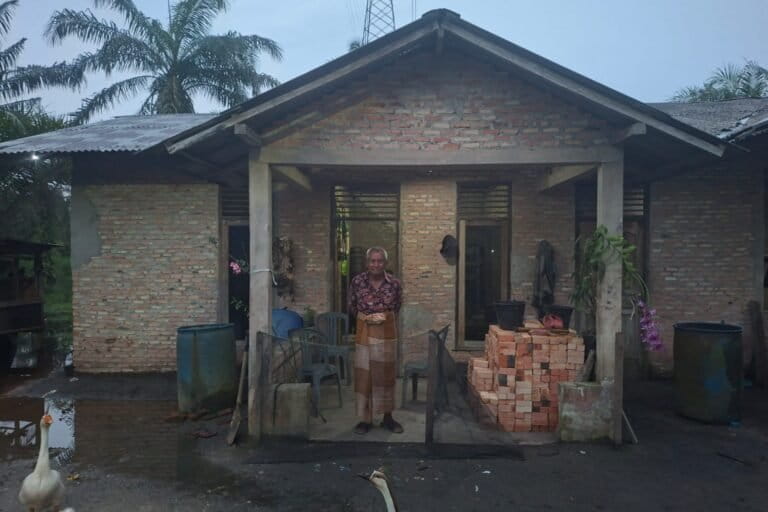
Perhaps the most stinging aspect of the Tenayan Raya situation is the persistent "energy poverty" experienced by those living nearest to the plant. Despite the facility being a critical node in the regional power grid since 2016, Seno and several of his neighbors remain disconnected from the electrical lines.
Seno’s attempts to secure a connection have been met with bureaucratic hurdles. He was reportedly told by utility representatives that he must find at least 15 households in his immediate vicinity to justify the installation of a transformer and poles. In a rural-fringe area where many residents are transient garden keepers or security staff for absentee landowners, meeting such a quota is nearly impossible. For the past year, Seno has relied on a single solar panel he purchased for Rp6.5 million (USD 420)—a significant sum for a retiree—which provides just enough power for evening lights and a mobile phone charger.
Atina Rizqiana, a researcher at the Center of Economic and Law Studies (Celios), views this as a systemic failure. "The government prioritizes energy for industrial hubs and urban centers while neglecting community-based energy infrastructure," she remarked. The centralized nature of the Indonesian grid means that power generated in Tenayan Raya is often bypassed to satisfy the demands of the provincial capital, leaving the local community to deal with the pollution of production without the benefits of consumption.
The Path Forward: Accountability and Transition
The situation at PLTU Tenayan Raya serves as a microcosm of the broader challenges facing Indonesia’s energy landscape. As the country navigates its "Just Energy Transition Partnership" (JETP) and seeks to reduce its reliance on coal, the management of legacy waste like FABA remains a contentious issue. The current "normalization" of toxic waste as building material, without rigorous, site-specific safety standards, creates a long-term environmental debt that future generations will be forced to pay.
Environmental organizations continue to call for a reversal of the FABA deregulation or, at the very least, the implementation of a strict "cradle-to-grave" tracking system that ensures the material is only used in controlled industrial applications where leaching can be prevented. Furthermore, there is a growing demand for "energy justice," requiring that communities hosting large-scale power projects be the first to benefit from the electricity generated, rather than being treated as a dumping ground for the byproducts of progress.
As of the time of this report, management at PLTU Tenayan Raya and its parent entity, PLN Nusantara Power, have remained largely silent on the specific grievances raised by the residents of Badak Ujung. While internal environmental leads at the plant acknowledged requests for interviews, official communication channels have failed to provide a substantive response to questions regarding their waste management protocols and community electrification efforts. For Seno and his neighbors, the wait for both clean air and reliable power continues, hidden beneath the grey dust of Indonesia’s coal-dependent economy.