Nila Kartika Wati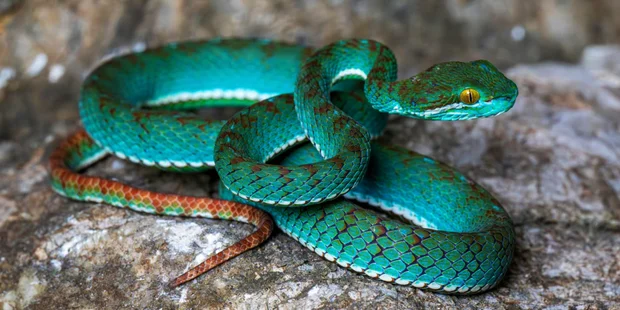
The limestone karst landscapes of Cambodia, characterized by their jagged peaks, labyrinthine cave systems, and hidden subterranean rivers, represent some of the most biologically significant yet critically endangered ecosystems on the planet. Often described by ecologists as "islands of isolation," these geological formations act as evolutionary laboratories where life evolves in near-total separation from the surrounding lowland forests. In a groundbreaking biological survey conducted between November 2023 and July 2025, a team of international and local researchers led by the conservation organization Fauna & Flora has unveiled a startling array of new species, including a visually stunning turquoise pit viper, highlighting the urgent need for formal protection of these "final frontiers" of scientific discovery.
The expedition, which spanned twenty months and involved the exploration of over 60 individual caves across the provinces of Battambang and Stung Treng, sought to document the hidden biodiversity of the Cambodian karst. The results, published in a comprehensive 2026 report, confirm that these rugged terrains harbor a high degree of endemism—species found nowhere else on Earth. The findings are not merely a win for taxonomy but serve as a critical warning: many of these species are confined to single hills or cave systems, meaning the destruction of a single site could result in an immediate global extinction.
The Discovery of the Turquoise Pit Viper and the Ornate Flying Snake
Among the most remarkable finds of the survey was a new species of pit viper belonging to the genus Trimeresurus. Discovered in the Phnom Prampi area of the Proek District, this predator is distinguished by its extraordinary turquoise-blue scales, a color rarity in the reptilian world. This vibrant hue, while seemingly conspicuous, provides a unique form of camouflage within the deep shadows and mineral-stained walls of the karst environment.
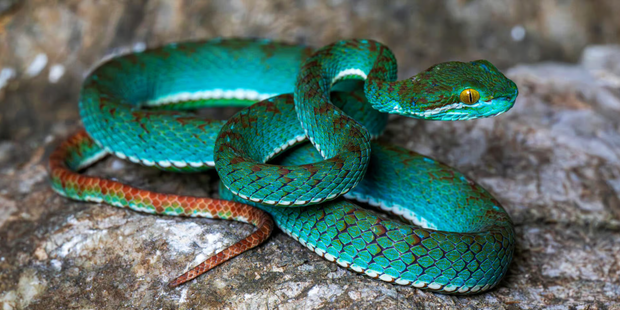
As a member of the pit viper family, the turquoise snake possesses highly specialized biological equipment for hunting in total darkness. Between its eyes and nostrils lie "heat-sensitive pits," sophisticated infrared sensors that allow the snake to detect the thermal signatures of warm-blooded prey, such as bats, rodents, or small birds, with millimetric precision. This evolutionary adaptation is essential for survival in the lightless depths of the karst caves. While the species is currently undergoing formal taxonomic description to receive its official scientific name, researchers have already noted its distinct triangular head shape, a hallmark of highly venomous vipers in the region.
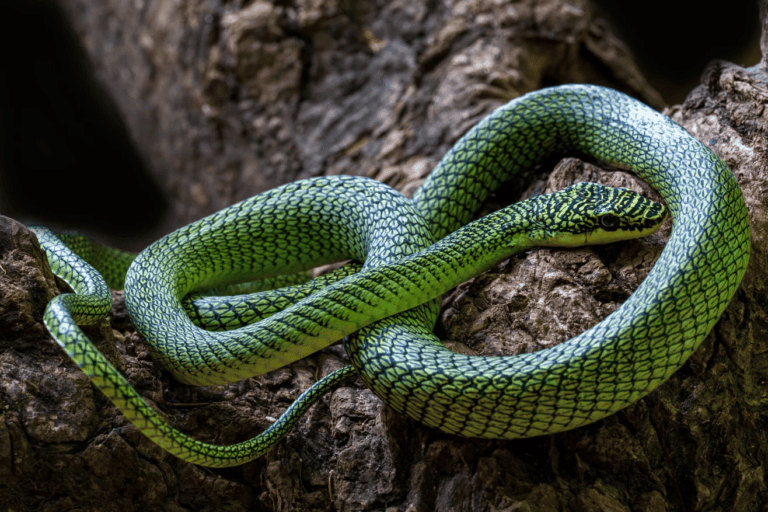
Complementing this find was the documentation of the Ornate Flying Snake (Chrysopelea ornata). Unlike the subterranean viper, this species is a master of the forest canopy surrounding the limestone cliffs. The "flying" snake does not possess wings but utilizes a remarkable feat of natural engineering known as "gliding flight." By flaring its ribs and pulling its underside inward, the snake transforms its body into a concave wing-like shape, allowing it to catch air pressure and glide from tree to tree or from cliff faces to the canopy below. While its venom is mild and poses no threat to humans, its presence is a vital indicator of a healthy, connected ecosystem where the karst and the surrounding forest function as a single unit.
Evolutionary Laboratories: The Speciation of Geckos and Invertebrates
The survey’s findings extend far beyond the headline-grabbing snakes. The data suggests that the karst hills of Battambang and Stung Treng are centers of rapid speciation. Because these hills are separated by vast stretches of flat agricultural land or lowland forest, many small animals cannot migrate between them. This isolation forces populations to adapt to the specific conditions of their "island" hill, leading to the creation of new species over thousands of years.
The research team officially confirmed the discovery of three new gecko species: Cyrtodactylus kampingpoiensis, Hemiphyllodactylus khpoh, and Dixonius noctivagus. These reptiles have adapted to the vertical world of the karst, developing specialized toe pads for gripping slick limestone surfaces and large eyes for nocturnal hunting. Interestingly, the survey noted that even within the species Cyrtodactylus kampingpoiensis, different populations on separate hills showed signs of unique evolutionary trajectories. Genetic analysis is currently underway to determine if these isolated groups have already diverged into separate, distinct species.
The "micro-fauna" of the region also yielded significant results. Two new species of micro-snails, Clostophis udayaditinus and Chamalycaeus aduncus, were discovered. These snails, often no larger than a grain of rice, play a crucial role in the ecosystem by processing organic matter and contributing to the calcium cycle of the karst. Additionally, the team identified two new species of millipedes, Orthomorpha efefai and Orthomorpha battambangiensis, further proving that every level of the food web in these caves is populated by unique organisms.
A Sanctuary for Globally Threatened Megafauna
While the new discoveries focus on reptiles and invertebrates, the Fauna & Flora report emphasizes that the karst landscapes are also the "last stand" for several of Asia’s most iconic and endangered mammals and birds. The rugged, inaccessible nature of the limestone cliffs provides a natural fortress against poaching and habitat encroachment.
The survey confirmed the presence of the Sunda Pangolin (Manis javanica), the world’s most trafficked mammal, within the karst peripheries. The Indochinese Silvered Langur (Trachypithecus germaini), a primate whose populations have plummeted due to hunting and habitat loss, was also observed using the limestone caves as sleeping sites and the surrounding forests for foraging. Furthermore, the Green Peafowl (Pavo muticus), an endangered bird that has disappeared from much of its former range in Southeast Asia, was documented in the area. The survival of these species is intrinsically linked to the integrity of the karst; without the protection of the cliffs, these animals would have few places left to hide from anthropogenic pressures.
Chronology of the Expedition and Methodology
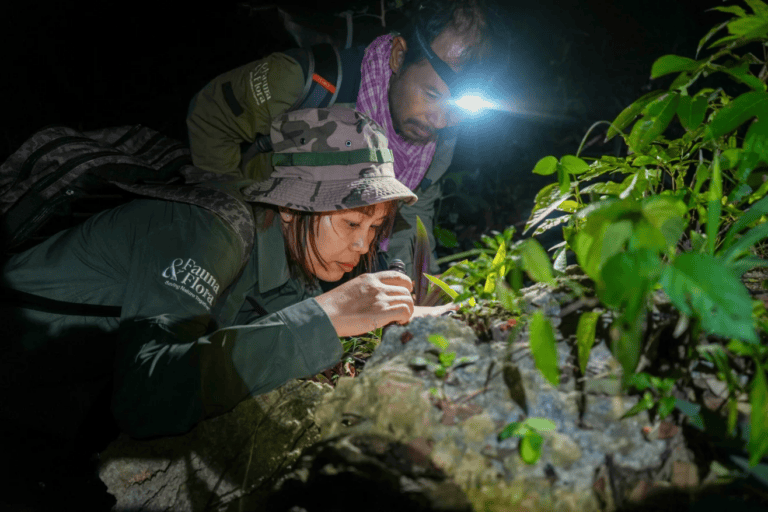
The mission to map this biodiversity was a logistical challenge that required specialized training in spelunking and night-time field research.
- Phase I (November 2023 – May 2024): Initial reconnaissance of the Battambang karst systems. Researchers focused on identifying cave entrances and establishing baseline data on temperature and humidity within the subterranean environments.
- Phase II (June 2024 – February 2025): Intensive biological sampling. This phase involved overnight stays in remote areas to capture the activity of nocturnal reptiles and invertebrates. It was during this period that the turquoise pit viper was first sighted.
- Phase III (March 2025 – July 2025): Data consolidation and genetic sampling. The team worked with local communities to map the threats to these sites, specifically identifying areas targeted for industrial use.
- 2026: Publication of the "Cave and Karst Biodiversity of Battambang and Stung Treng" report, providing the scientific community and the Cambodian government with the evidence needed for conservation action.
Threats: The Cement Industry and Illegal Wildlife Trade
Despite the scientific triumph of these discoveries, the future of the Cambodian karst is precarious. The primary threat is the industrial-scale mining of limestone. Limestone is a key ingredient in cement, and as Cambodia’s infrastructure and urban centers expand, the demand for this resource has skyrocketed.
Conservationists warn that the current "concession" model of mining often fails to account for biodiversity. When a limestone hill is quarried, it is not just the surface that is destroyed; the entire internal cave ecosystem, along with any endemic species living within it, is obliterated. Unlike a forest, which can sometimes be replanted, a karst hill is a geological feature that takes millions of years to form. Once it is mined, the species lost are gone forever.
Secondary threats include the illegal wildlife trade. The very beauty that makes the turquoise pit viper and the ornate flying snake so fascinating to scientists also makes them targets for the exotic pet market. Poachers often infiltrate these remote areas to collect rare reptiles for sale to international collectors, further depleting populations that are already naturally small due to their restricted habitats.
Implications for Conservation and Policy
The findings of the 2023-2025 survey provide a powerful argument for a shift in how Cambodia manages its geological resources. Experts suggest that a "Strategic Environmental Assessment" is necessary to identify which karst hills are of the highest biological value and should be off-limits to the mining industry.
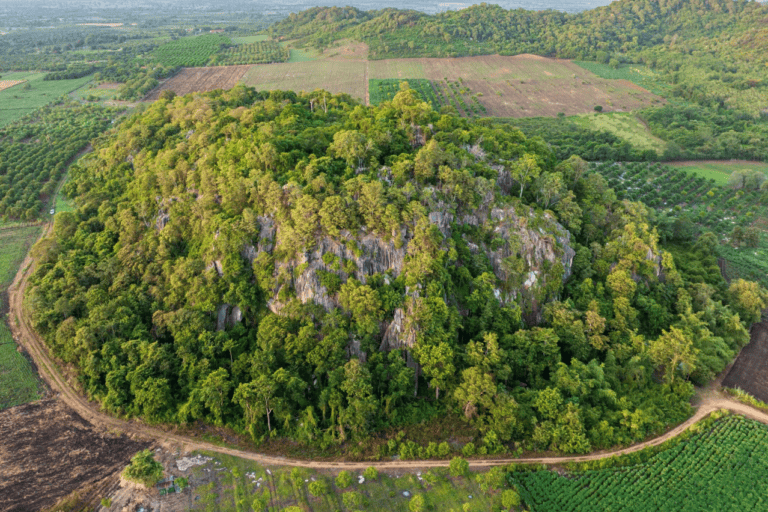
"Each of these hills is a unique chapter in the story of life on Earth," one researcher noted in the report’s conclusion. "We are currently in a race against time to read these chapters before they are erased by the machinery of progress."
The discovery of seven new species in such a short period suggests that hundreds more may still be waiting to be found in the unexplored corners of Cambodia’s limestone mountains. The international community, through organizations like Fauna & Flora, is calling for the establishment of "Karst Protected Areas" that would integrate the protection of the subterranean world with the conservation of the surface forests. This holistic approach is the only way to ensure that the turquoise pit viper and its mysterious neighbors continue to thrive in the shadows of the limestone giants.