Azin Asro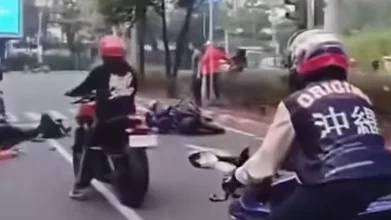
The asphalt of Jalan Asia Afrika in Central Jakarta was supposed to witness nothing more than the customary leisure of a quiet weekend morning, but instead, it became the stage for yet another preventable tragedy involving a high-powered motorcycle. On Sunday, October 4, 2026, a routine Sunday morning ride—widely known among local motorcycle enthusiasts as sunmori—turned into a scene of chaos and devastation when a speeding large-displacement motorcycle, commonly referred to as a moge, violently collided with an online motorcycle taxi, locally known as an ojek online (ojol). The incident, which was promptly captured on video and subsequently went viral across major social media platforms including Instagram, has reignited a fierce public debate regarding the persistent culture of recklessness, arrogance, and disregard for traffic regulations among certain elite riding communities in the Indonesian capital.
The digital footprint of the accident quickly permeated virtual spaces, drawing widespread condemnation from netizens who have grown increasingly intolerant of the perceived impunity displayed by riders of high-end, heavy-duty machines on public thoroughfares. According to digital footage uploaded by the popular urban monitoring account @fakta.jakarta, the sequence of events began with a pack of sport motorcycles roaring down the arterial road at dangerously high speeds. Witnesses on the scene reported that several riders within the convoy were not merely traveling fast, but were actively engaging in perilous stunts, including executing wheelies—a dangerous maneuver where the rider deliberately lifts the front wheel of the motorcycle off the ground while maintaining forward momentum. This exhibition of vehicular acrobatics took place in broad daylight, setting the stage for the catastrophic collision that would unfold moments later near the traffic light intersection opposite the prominent Senayan City shopping mall.
Chronology of the Incident
A detailed reconstruction of the event, compiled from eyewitness testimonies and preliminary field reports, outlines a precise sequence of reckless actions and unfortunate circumstances. The morning traffic along the corridor was relatively light, a characteristic feature of Jakarta’s streets before the typical weekday congestion takes hold. However, this apparent tranquility masked hidden dangers that drivers and riders alike failed to respect.
According to Bayu Lambang, a primary eyewitness interviewed at the scene, the pack of large motorcycles was accelerating aggressively from the direction of Plaza Senayan. As the convoy approached a designated pedestrian zebra crossing located directly in front of a local Lawson convenience store, a prudent and lawful traffic situation unfolded: several regular motorists and conscientious drivers brought their vehicles to a complete stop to yield the right-of-way to pedestrians who were attempting to safely cross the multi-lane road.
While ordinary road users adhered to the fundamental principles of traffic courtesy and pedestrian safety, the oncoming pack of high-speed moges failed to process the changing traffic dynamics ahead of them. The lead riders, traveling at velocities vastly exceeding the legal speed limits for urban arterial roads, were reportedly preoccupied with maintaining their formation and showing off their machinery. Unable to reduce their speed in time due to excessive momentum and inadequate braking distances, the trailing big motorcycle riders found themselves in an inescapable predicament.
One particular moge rider, unable to brake or maneuver around the stationary vehicles, violently plowed into the rear end of an ojol rider’s motorcycle who had lawfully stopped to let pedestrians pass. The impact was described as deafening, sending the vulnerable ojol driver crashing onto the asphalt. Witnesses rushed to the scene to find the ride-hailing driver lying motionless and injured on the street, requiring immediate emergency evacuation while the heavily damaged moge stood crippled nearby. The exact condition of the injured ojol driver remains a subject of intense public concern as local law enforcement agencies gather formal statements and medical evaluations.
The Anatomy of Sunmori Culture and Its Perils
To fully comprehend the gravity of Sunday’s collision, one must examine the socio-cultural phenomenon of sunmori within Indonesia’s urban landscape. Originally conceived as an innocuous recreational activity where motorcycle aficionados would gather in the early hours of Sunday mornings to enjoy the cooler weather, empty roads, and camaraderie of group riding, sunmori has undergone a troubling metamorphosis over the past decade. What was once an exercise in mindful cruising has, in many circles, devolved into an unbridled display of machismo, social status, and reckless endangerment.
Sociological and traffic safety analysts note that the proliferation of high-end motorcycles—ranging from European superbikes to American heavy cruisers—has created subcultures heavily influenced by digital clout and peer validation. The availability of social media platforms has transformed ordinary street riding into content creation, where capturing footage of high-speed maneuvers, aggressive lane-splitting, and prohibited stunts yields algorithmic rewards. Consequently, public roads are frequently treated as private racetracks by individuals who possess the financial capital to purchase high-performance machinery, but often lack the commensurate psychological maturity and defensive driving discipline required to operate them safely.
Data from traffic safety advocacy groups underscore a grim reality: high-displacement motorcycles, while engineered with advanced braking and stability systems, are exponentially more lethal when operated outside of controlled environments. The kinetic energy generated by a machine weighing upwards of 200 to 300 kilograms traveling at speeds exceeding 100 kilometers per hour transforms it into an unguided projectile upon impact. When these physics intersect with the dense, unpredictable traffic environment of Jakarta—where pedestrians, public transport vehicles, and vulnerable gig-economy workers share the asphalt—the margin for error shrinks to near zero.
Expert Perspectives on Defensive Riding and Behavioral Failures
In the wake of the Senayan incident, transportation safety experts have stepped forward to dissect the systemic failures that enable such tragedies to recur with alarming frequency. Sony Susmana, a Senior Instructor at the Safety Defensive Consultant Indonesia (SDCI), provided a sobering analysis of the mindset plaguing contemporary weekend riders. According to Susmana, the fundamental ethos of sunmori has been completely distorted by a culture of false invulnerability.
"When people see empty roads on a Sunday morning, their psychological barrier drops. They mistakenly assume that low traffic volume equates to zero hazard," Susmana explained in a prior evaluation of urban riding habits. "In reality, the exact opposite is true. Empty roads invite higher speeds, and higher speeds compress reaction times. When riders travel in packs, a dangerous herd mentality takes over. The pressure to keep up, to look impressive, and to match the aggressive pace of the group overrides individual common sense and defensive instincts."
Susmana further emphasized that operating a high-displacement motorcycle is an elite physical and mental task that demands exceptional skill, situational awareness, and emotional restraint. Owning a powerful machine does not automatically confer the competence needed to handle emergency evasive maneuvers. The practice of standing up on the footpegs, removing hands from the handlebars, weaving aggressively through traffic, and riding in tight, overlapping formations are not demonstrations of superior skill; rather, they are exhibitions of profound negligence.
"Performing stunts or showing off on public roads is entirely unacceptable," Susmana asserted. "When a sudden obstacle appears—such as a pedestrian crossing the street or a vehicle stopping lawfully—these riders simply do not possess the immediate mechanical control or the mental preparedness required to avoid a collision. Their arrogance strips away their ability to react."
Socio-Economic Vulnerability and the Ojol Community
Beyond the immediate discourse on traffic safety, the Senayan crash has struck a raw nerve regarding socio-economic disparities on Indonesia’s roadways. The victim in this incident—an ojol driver—represents the backbone of the nation’s urban gig economy. Millions of Indonesians rely on ride-hailing platforms for their daily sustenance, working grueling hours under harsh conditions to support their families. For these frontline workers, the road is not a recreational playground, but a precarious workplace.
The stark contrast between affluent leisure riders operating multimillion-rupiah superbikes and working-class ojol drivers struggling to earn a daily fare has transformed this specific accident into a potent symbol of systemic injustice. Public commentary across digital platforms has overwhelmingly highlighted the perceived lack of accountability among wealthy motorists who frequently inflict collateral damage on hardworking citizens. The vulnerability of ojol drivers is compounded by the fact that their vehicles are typically lightweight, utilitarian scooters unequipped to absorb the catastrophic kinetic impact of a high-speed heavy motorcycle.
Labor advocates and community groups have increasingly called for stricter legal enforcement and harsher penalties for reckless drivers whose actions jeopardize the lives of gig workers. While traffic accidents involving ordinary motorists are commonplace, incidents involving high-status convoys often spark intense public anger due to the perceived arrogance of the perpetrators, who have occasionally been documented attempting to intimidate victims or bystanders using their social standing or club affiliations.
Institutional Responses and the Demand for Enforcement
As public outrage mounts, pressure is intensifying on the Jakarta Metro Police’s Directorate of Traffic (Ditlantas Polda Metro Jaya) to implement decisive measures against illegal street racing, unauthorized convoys, and reckless sunmori activities. Law enforcement agencies face an ongoing challenge in policing sprawling metropolitan corridors where motorcycle clubs frequently coordinate impromptu meetups via encrypted messaging applications, bypassing traditional surveillance networks.
Historically, police crackdowns on weekend speeders have tended to be reactive rather than proactive, typically intensifying only after a major accident captures national headlines. Authorities have previously established routine weekend checkpoints, deployed mobile patrol units, and conducted sporadic raids on popular gathering spots such as Senayan, Kemayoran, and various perimeter roads around the city. However, critics argue that fines and temporary vehicle impoundments are insufficient deterrents for affluent offenders. True deterrence, safety advocates argue, requires sweeping regulatory reforms, including mandatory defensive riding certifications, stricter licensing tiers for high-displacement motorcycles, and the systematic prosecution of reckless drivers under criminal statutes when their actions result in severe injury or death.
Furthermore, urban planners and municipal authorities are being urged to reconsider the infrastructural design of major arterial roads in Central and South Jakarta. The inclusion of wider pedestrian crossings, automated speed-enforcement cameras (ETLE), and physical traffic-calming devices could significantly mitigate the hazards posed by high-speed motorists. Without a comprehensive strategy combining rigorous law enforcement, infrastructural improvements, and a cultural shift in how road safety is perceived, early morning leisure rides will continue to pose a lethal threat to the public.
The broader implications of the October 4 collision extend far beyond a single viral video or a damaged motorcycle. It serves as an indictment of a broader societal deficit in empathy, discipline, and respect for the rule of law on public thoroughfares. As the injured ojol driver fights to recover and investigators piece together the final liability determinations, the incident stands as a solemn reminder that the privilege of mobility carries an inescapable moral obligation: the protection of every human life sharing the journey.