Tyo Susilo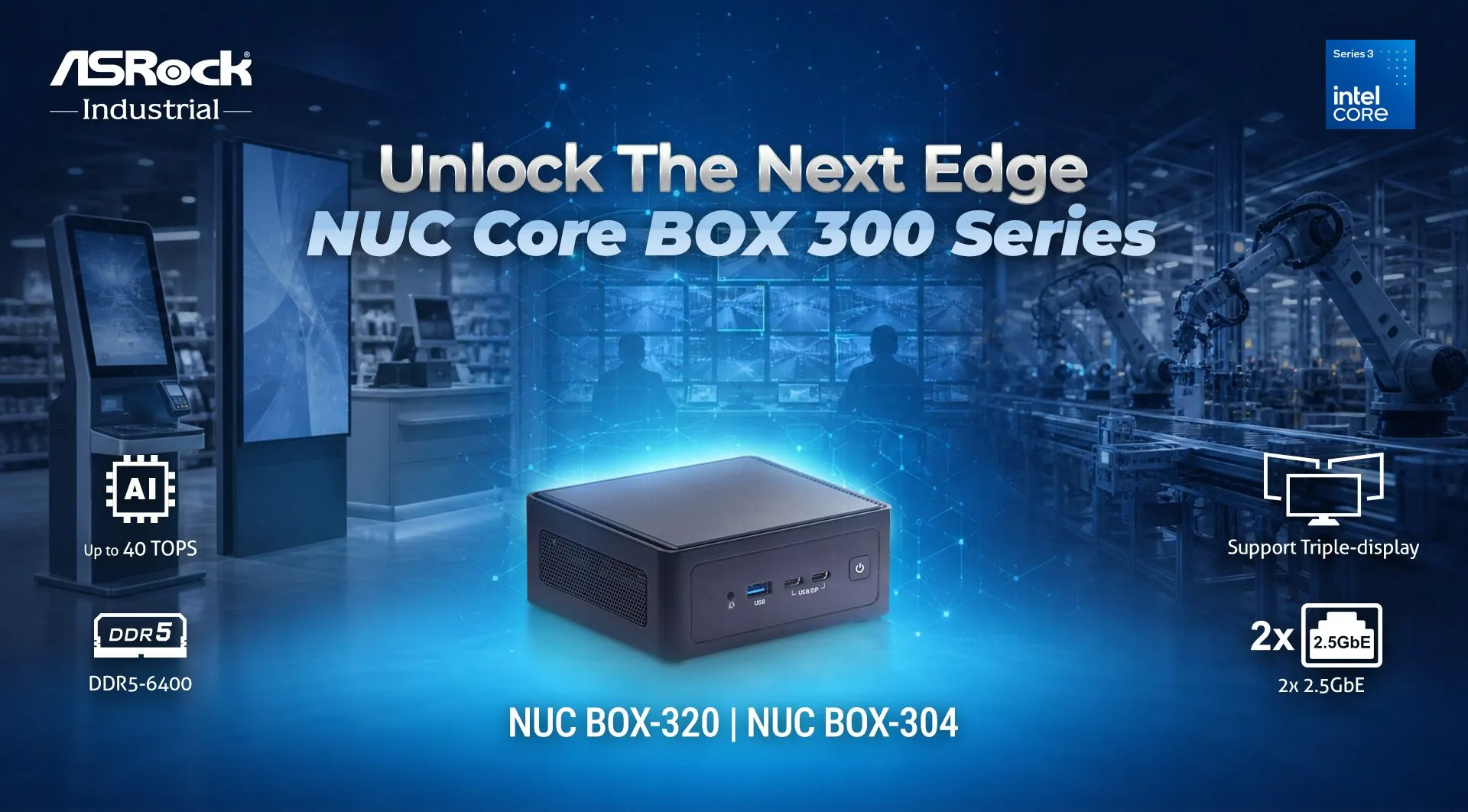
ASRock, a globally recognized leader in motherboard, graphics card, and small-form-factor computing solutions, has officially expanded its product portfolio with the release of the NUC BOX 300 Series. Representing the latest evolution in compact desktop computing, this new lineup features two primary models: the NUC BOX-320 and the NUC BOX-304. Both devices are driven by Intel’s newly introduced Core 300 processor family, which is built on the advanced Wildcat Lake architecture. Despite their remarkably diminutive physical footprints, these mini PCs are engineered to deliver high-performance computing, robust multitasking capabilities, and comprehensive connectivity, catering to a diverse range of enterprise, industrial, and consumer applications.
The introduction of the NUC BOX 300 Series arrives at a critical juncture in the personal computing market, where businesses and consumers alike increasingly demand space-saving hardware without sacrificing processing power. Traditional desktop towers are rapidly being phased out in professional environments in favor of ultra-compact form factor (UCFF) systems that reduce clutter, consume less energy, and simplify deployment across large office networks or digital signage installations. With Intel rolling out its Wildcat Lake architecture, hardware manufacturers like ASRock have found a reliable foundation to deliver higher energy efficiency and enhanced core configurations tailored specifically for compact computing solutions.
Detailed Specifications and Hardware Architecture
At the heart of the NUC BOX 300 Series are Intel’s latest Core 300 processors, designed to balance raw performance with thermal and power efficiency. The flagship model of the series, the NUC BOX-320, is powered by the Intel Core 5 320 processor. This CPU utilizes a hybrid architecture consisting of six total cores, divided into two Performance-cores (P-cores) for demanding computational tasks and four Efficient-cores (E-cores) for background processes and everyday workloads. This configuration ensures that users can execute intensive applications smoothly while maintaining optimal power consumption.
Meanwhile, the more budget-friendly variant, the NUC BOX-304, features the Intel Core 3 304 processor. This model scales back the core count slightly to a total of five cores, comprising one P-core and four E-cores. While positioned as an entry-level solution, the Core 3 304 remains fully capable of handling standard office productivity applications, web browsing, media streaming, and light data processing.
Memory and storage expansion are standout features of the NUC BOX 300 Series, dispelling the notion that mini PCs cannot be upgraded. Both models support high-speed DDR5-6400 memory through a single SODIMM slot, allowing users to configure their systems with up to 64GB of RAM. This high bandwidth is particularly beneficial for multitasking environments, virtual machines, and memory-intensive professional software.

For storage, ASRock has integrated a versatile array of options. The chassis accommodates both an M.2 2242 PCIe Gen 4 x1 slot and a larger M.2 2280 PCIe Gen 4 x2 slot, enabling users to install high-speed NVMe solid-state drives for operating systems and massive data storage. Additionally, a dedicated M.2 2230 key is reserved for wireless communication modules, pre-equipping the systems with Wi-Fi 6E and Bluetooth 5.3 capabilities for fast, low-latency wireless networking.
Comprehensive Connectivity in an Ultra-Compact Chassis
One of the primary challenges in designing mini PCs is maximizing connectivity options within a severely restricted physical space. ASRock has successfully addressed this engineering hurdle by outfitting the NUC BOX 300 Series with an impressive array of input and output (I/O) ports.
For display outputs, the devices feature two HDMI 2.1 ports alongside two USB Type-C ports that support DisplayPort 1.4a Alternate Mode. This multi-display configuration allows the mini PCs to drive up to four independent displays simultaneously at high resolutions, making them ideal for control rooms, financial trading desks, multi-monitor office workstations, and digital signage deployments.
Furthermore, the systems include three standard USB Type-A ports for legacy peripherals, a 3.5mm audio jack for headsets or speakers, and dual 2.5 Gigabit Ethernet (2.5GbE) ports. The inclusion of dual 2.5GbE network interfaces is a significant advantage for enterprise users, network administrators, and power users who require link aggregation, robust network redundancy, or the ability to function as a secure edge-routing appliance or small-scale server.
Physical Dimensions and Industrial Design
In terms of physical dimensions, the NUC BOX 300 Series exemplifies extreme miniaturization. The chassis measures a mere 117.5 x 110 x 49 millimeters, resulting in a total volume of approximately 0.63 liters. Tipping the scales at roughly 1 kilogram, the devices are lightweight yet structurally robust, featuring thermal engineering designed to dissipate heat efficiently despite the dense internal component layout.

To facilitate seamless integration into various physical environments, ASRock has designed the chassis with standard VESA mounting support. This allows the mini PCs to be securely attached to the rear of computer monitors, mounted underneath desks, or tucked away inside industrial enclosures, completely freeing up valuable desk space.
Market Implications and Industry Outlook
The release of the NUC BOX 300 Series highlights ASRock’s continued commitment to the small-form-factor market segment. By harnessing Intel’s Wildcat Lake processors, ASRock is targeting a wide spectrum of users, ranging from enterprise IT departments seeking reliable, energy-efficient office clients to digital signage operators, educational institutions, and home lab enthusiasts.
Mini PCs powered by modern hybrid architecture processors offer a compelling value proposition. They deliver performance levels that rival traditional desktop setups while consuming a fraction of the electricity, translating to lower long-term operational and cooling costs for businesses. The inclusion of high-speed DDR5 memory and dual 2.5GbE networking further future-proofs the hardware, ensuring it remains relevant as network infrastructure and software demands continue to evolve.
Pricing, Availability, and Global Launch Timeline
As of the official announcement, ASRock has not yet disclosed specific pricing details or regional market availability dates for the NUC BOX-320 and NUC BOX-304. Industry analysts anticipate that the company will release regional pricing structures closer to the actual shipping date, which is expected to occur later in the current quarter.
Given ASRock’s established distribution network, these mini PCs are projected to roll out across North America, Europe, and Asia-Pacific markets simultaneously. The key question for regional tech communities remains whether these entry-level to mid-range mini PCs will see aggressive local distribution in emerging markets such as Indonesia, where demand for cost-effective, space-saving enterprise and educational computing solutions continues to surge. Further updates regarding official retail prices and configuration options are expected to be announced by ASRock in the coming weeks.