Bambang Pamungkas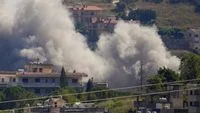
Jakarta, CNBC Indonesia – A recent attempt at de-escalation between Israel and the Iran-backed Hizbullah movement has tragically unraveled, with a freshly brokered ceasefire collapsing within 24 hours. Israeli airstrikes on southern Lebanon have reportedly claimed the lives of at least 11 individuals, casting a grave shadow over fragile diplomatic efforts to avert a wider regional conflict. The rapid deterioration underscores the volatile nature of the Israeli-Lebanese border, a long-standing flashpoint in the Middle East.
On Saturday, local time, reports from Lebanon’s official news agency indicated that Israeli fighter jets, drones, and artillery launched extensive attacks across more than a dozen locations. The areas around the city of Nabatieh bore the brunt of these assaults, with thick plumes of smoke observed rising from multiple sites across southern Lebanon, signaling a significant escalation. The Israeli military confirmed its involvement, stating that the operations targeted "Hizbullah terrorist objectives." This action, according to Israeli defense officials, was a direct response to Hizbullah having fired over 50 projectiles into Israeli-held territory in southern Lebanon earlier that day, further illustrating the perilous tit-for-tat dynamic that characterizes the conflict.
Escalation and Retaliation: A Vicious Cycle
The current surge in hostilities marks a dangerous phase in the perennial conflict between Israel and Hizbullah. The exchange of fire follows a pattern of provocation and response that has defined their relationship for decades. The Israeli military’s swift and forceful retaliation, citing Hizbullah’s projectile attacks, highlights its doctrine of overwhelming response to perceived threats. These strikes are not merely retaliatory; they are often intended to degrade Hizbullah’s military capabilities and infrastructure, which Israel views as a direct extension of Iranian influence on its northern border. The targeted areas in southern Lebanon, particularly around Nabatieh, are known strongholds for Hizbullah, making civilian casualties an unfortunately frequent consequence of these military operations. The precise nature of the 11 reported fatalities – whether they were combatants or civilians – remains a critical detail, often contested by both sides and a point of international concern.
From Hizbullah’s perspective, these actions are framed as legitimate resistance against Israeli aggression and occupation. Senior Hizbullah official Hassan Fadlallah unequivocally asserted the group’s "right to retaliate" against Israeli attacks. His statement, as quoted by Lebanon’s National News Agency (NNA) on Saturday, emphasized the group’s expectation that "the enemy fully and completely respects the ceasefire, and does not seek to attack our country and villages or attempt to occupy any new positions." This declaration underscores Hizbullah’s commitment to defending Lebanese territory and its refusal to be deterred by Israeli military might, setting the stage for potential further escalation should Israel maintain its current posture or expand its presence in southern Lebanon. The group’s capacity to launch sophisticated rockets and drones deep into Israeli territory remains a significant concern for Israeli security planners, complicating any prospects for a lasting ceasefire.
The Broader Regional Tapestry: Iran and the Axis of Resistance
The conflict between Israel and Hizbullah is inextricably linked to the broader geopolitical dynamics of the Middle East, with Iran playing a central, albeit indirect, role. Hizbullah, established in the early 1980s during the Lebanese Civil War, emerged with significant ideological and material support from revolutionary Iran. Over the decades, it has evolved into a powerful political party, social service provider, and formidable military force within Lebanon, often described as a state within a state. Its extensive arsenal, including an estimated 150,000 rockets and missiles, is largely supplied by Iran, making it a crucial component of what Tehran terms the "Axis of Resistance" – a network of allied groups aimed at countering Israeli and American influence in the region.
The 2006 Lebanon War offered a stark demonstration of Hizbullah’s military prowess and its strategic importance to Iran. During that 34-day conflict, Hizbullah’s sustained rocket attacks on northern Israel and its effective resistance against an Israeli ground invasion highlighted its capabilities and its deep entrenchment in Lebanese society. This history informs the current Israeli calculus, which views Hizbullah as an existential threat, capable of inflicting significant damage on its civilian population and critical infrastructure. For Iran, Hizbullah represents a forward defense line, a deterrent against potential Israeli or American military action against its nuclear program, and a crucial lever in regional power projection. The current clashes, therefore, are not merely local skirmishes but reverberations of a much larger, simmering regional rivalry. The extent of Iran’s direct involvement in orchestrating Hizbullah’s recent actions is a subject of intense scrutiny by intelligence agencies, but its influence and strategic guidance are undeniable.
A Fragile Timeline of Renewed Hostilities
The current wave of intense fighting represents a significant resurgence of hostilities that had somewhat abated but never truly ceased. The conflict reignited in earnest around early March, triggered by what Hizbullah and its allies described as an Israeli strike that killed a prominent Iranian leader, though specifics about the individual and the circumstances of their death remain debated. This alleged assassination served as a catalyst for Hizbullah’s subsequent actions, which included launching a barrage of rockets and sophisticated drones into Israeli territory. These attacks were framed as a direct response to perceived Israeli aggression against Iranian interests and personnel, signaling a willingness to escalate in defense of its patrons.
Israel’s response was immediate and overwhelming. It launched a large-scale bombing campaign across various regions of Lebanon, targeting what it identified as Hizbullah infrastructure, command centers, and rocket launch sites. This punitive campaign was followed by a significant ground incursion, leading to the occupation of approximately 5% of southern Lebanese territory. This occupation, a highly contentious move, has been met with fierce condemnation from Beirut and has further fueled Hizbullah’s resolve to resist, viewing it as a blatant violation of Lebanese sovereignty. The latest ceasefire, intended to halt this escalating cycle, proved to be critically fragile. Its collapse within 24 hours underscores the profound mistrust between the two sides and the deep-seated grievances that fuel the conflict. Each retaliatory strike, each projectile launched, pushes the region closer to a full-scale confrontation, mirroring the dangerous brinkmanship seen in previous conflicts.
Diplomatic Crossroads: US Efforts and Regional Stakes
The latest escalation has placed immense pressure on international diplomatic efforts, particularly those spearheaded by the United States. Washington has been actively engaged in trying to de-escalate tensions along the Israeli-Lebanese border, fearing that a wider conflict could engulf the entire region. The US administration had previously voiced strong criticism of Israel’s military operations in Lebanon, specifically warning that such actions risked undermining a broader, more comprehensive agreement with Iran. This potential deal, central to US foreign policy in the Middle East, aims to address a range of regional security concerns and includes commitments to halt fighting on multiple fronts, including Lebanon.
The US government’s concern extends beyond the immediate border clashes. It fears that a prolonged or intensified conflict in Lebanon could severely disrupt the implementation of any peace agreement with Tehran. Iran, for its part, has consistently maintained that the situation in Lebanon cannot be isolated and must be an integral component of any holistic resolution to the broader regional conflict. This stance complicates US diplomatic efforts, as it necessitates a comprehensive approach that considers the intertwined nature of various regional flashpoints. In a tangible demonstration of its commitment to these diplomatic tracks, US special envoy Steve Witkoff is reportedly slated to travel to Switzerland. There, he is expected to engage in preliminary discussions with Iranian representatives, with the primary objective of reinforcing the implementation of the prospective agreement and ensuring its integrity amidst the ongoing volatility. The success of Witkoff’s mission hinges on his ability to navigate complex political landscapes and bridge significant trust deficits between the various parties.
Domestic Pressures and International Reactions
Both Israeli Prime Minister Benjamin Netanyahu and Hizbullah leader Hassan Nasrallah operate under significant domestic pressures that influence their strategic decisions. In Israel, Prime Minister Netanyahu faces a powerful domestic constituency that demands decisive action against Hizbullah. The memory of past conflicts and the constant threat of rocket attacks on Israeli communities fuel public calls for a robust military response. Political rivals and segments of the Israeli public often criticize what they perceive as insufficient action, placing immense pressure on Netanyahu to demonstrate strength and commitment to national security, even if it risks further escalation. This internal dynamic makes any significant concessions or prolonged ceasefires politically challenging for the Israeli leadership.
Conversely, Hizbullah, while a formidable military force, also operates within the complex political landscape of Lebanon. Its actions are framed within its narrative of resistance against Israeli occupation and its role as a protector of Lebanon. The group has issued stern warnings, vowing to significantly increase its attacks if Israeli forces persist in their invasion or occupation of southern Lebanese territory. This warning serves as both a deterrent and a statement of intent, signaling Hizbullah’s readiness to escalate if its red lines are crossed. Domestically, the Lebanese government, already grappling with profound economic and political crises, finds itself caught between a powerful non-state actor and a determined regional adversary. While officially condemning Israeli incursions and calling for international protection of its sovereignty, Beirut’s capacity to influence Hizbullah’s actions is limited.
Internationally, the renewed fighting has drawn widespread concern. The United Nations and various international bodies have issued calls for immediate de-escalation, urging all parties to exercise restraint and adhere to international law. Humanitarian organizations are particularly alarmed by the escalating violence and its impact on civilians, reiterating appeals for unimpeded access to affected areas and protection for non-combatants. However, direct intervention or effective mediation remains elusive, highlighting the deep-seated nature of the conflict and the complex web of regional interests at play.
The Deepening Humanitarian Crisis and Economic Fallout
The prolonged and escalating conflict has precipitated a severe humanitarian crisis in Lebanon, exacerbating an already dire situation. According to recent estimates, approximately one million Lebanese citizens remain displaced from their homes, forced to flee the intense fighting in the southern regions. These internally displaced persons (IDPs) often face precarious living conditions, lacking adequate shelter, food, and medical care. The continuous bombardments and ground incursions have had a devastating impact on civilian infrastructure. Dozens of communities in southern Lebanon, once vibrant and bustling, have reportedly been reduced to rubble, completely destroyed by the sustained battles. Homes, businesses, schools, and essential services have been obliterated, making the prospect of return and reconstruction a distant and daunting challenge.
The economic fallout from this conflict is equally catastrophic for Lebanon, a nation already teetering on the brink of financial collapse. The country has been mired in one of the worst economic depressions in modern history, characterized by hyperinflation, widespread poverty, and a crumbling public sector. The ongoing hostilities further cripple vital sectors such as agriculture and tourism in the south, which are essential for local livelihoods. The destruction of infrastructure, coupled with the mass displacement, places an unbearable strain on the national budget and limited resources. International aid, while crucial, often struggles to keep pace with the scale of destruction and humanitarian needs. The long-term economic recovery of southern Lebanon, and indeed the entire country, hinges on a lasting cessation of hostilities and a concerted effort towards reconstruction and stabilization. Without peace, the humanitarian and economic crises are poised to deepen, trapping millions in a cycle of poverty and displacement.
Prospects for De-escalation: A Bleak Outlook?
The immediate prospects for a durable de-escalation appear bleak, given the rapid collapse of the recent ceasefire and the entrenched positions of both Israel and Hizbullah. The cyclical nature of the violence, driven by historical grievances, perceived provocations, and the broader regional power struggles, presents formidable obstacles to peace. Each side’s commitment to its strategic objectives, coupled with significant domestic pressures, makes compromise incredibly challenging.
For any lasting resolution to emerge, it would require sustained and robust diplomatic engagement from international actors, particularly the United States, to address not only the immediate border clashes but also the underlying causes of the conflict, including the role of Iran and the future status of disputed territories. A comprehensive agreement would likely need to include verifiable mechanisms for ceasefire monitoring, guarantees for the sovereignty and security of both nations, and a pathway for the withdrawal of all non-state armed groups from border areas. Without such a holistic approach, the region risks being perpetually caught in a cycle of violence, with devastating consequences for its people and profound implications for global stability. The recent events serve as a stark reminder of the urgent need for a renewed commitment to peace, however elusive it may seem.