Bambang Pamungkas
Jakarta, July 24, 2026 – A pivotal meeting took place at the Ministry of Migrant Worker Protection of Indonesia (P2MI) in Jakarta, marking a significant stride in strengthening bilateral relations between Indonesia and the Republic of Turkey. Mukhtarudin, the Indonesian Minister for Migrant Worker Protection, hosted a high-level delegation led by H.E. Mr. Vedat Işıkhan, the Turkish Minister of Labour and Social Security. The discussions centered on enhancing cooperation in labor affairs, safeguarding migrant workers, and fostering the development of professional workforces between the two nations. This encounter underscored a mutual commitment to building a framework for safe, orderly, and mutually beneficial international labor mobility, anchored in the principles of decent work and respect for workers’ rights.
A High-Level Dialogue for Enhanced Bilateral Cooperation
The Turkish delegation accompanying Minister Işıkhan included prominent officials such as Mr. Ali Aybey, Director General of Foreign Relations and European Union; Dr. İhsan Esen, Director General of Information Technologies and Chief of Cabinet; Mr. Yunus Öz, Director General of International Labour Force; Mr. Samet Güneş, Director General of the Turkish Employment Agency; Dr. Selim Dağlıoğlu, Deputy Director General of Foreign Relations and European Union; and Mr. Reşat Uğur Karacan, Deputy Chief of Mission and Counsellor at the Turkish Embassy in Jakarta. The presence of such a high-ranking and diverse delegation underscored Turkey’s serious intent to deepen its engagement with Indonesia on these critical issues.
Minister Mukhtarudin articulated that the Ministry of P2MI operates under a direct mandate from President Prabowo Subianto to comprehensively strengthen the governance of Indonesian migrant worker protection. He expressed profound appreciation for Minister Işıkhan’s visit, emphasizing its significance. "This visit serves as a recognition of the strategic existence and crucial role of the Ministry of P2MI in managing the placement, protection, and empowerment of Indonesian migrant workers," Mukhtarudin stated, highlighting the growing international acknowledgment of Indonesia’s efforts in this domain.
The Indonesian minister further noted the shared vision between Indonesia and Turkey regarding the establishment of secure, regulated, and mutually advantageous international labor mobility systems. Both nations, he observed, are committed to upholding the principles of decent work and ensuring the full respect of workers’ rights, a cornerstone of sustainable and ethical labor migration. "Indonesia welcomes the Turkish Government’s attention to the importance of strengthening cooperation in labor affairs, international professional labor mobility, and the protection of workers’ rights," Mukhtarudin affirmed, signaling Indonesia’s readiness for deeper collaboration.
A key agenda item during the meeting was the advancement of bilateral cooperation through the finalization of a Memorandum of Understanding (MoU) in the field of labor. This crucial agreement is intended to formalize and regulate future engagements between the Indonesian Ministry of Migrant Worker Protection and the Turkish Ministry of Labour and Social Security. "The draft MoU has already been submitted by our side. We are currently awaiting a response from the Turkish Ministry of Labour regarding the timeline for its signing," Mukhtarudin disclosed, indicating that significant progress has already been made in laying the groundwork for this accord. Beyond the MoU, Mukhtarudin expressed his hope that the meeting would foster stronger communication and coordination between the two ministries, facilitating the effective, safe, and sustainable management of international labor mobility. He conveyed his conviction that this meeting represents a strategic step to fortify Indonesia-Turkey relations in the labor sector and unlock broader opportunities for Indonesian migrant workers.
Turkey’s Affirmation: A Valued Partnership and Trustworthy Workforce
Minister Vedat Işıkhan conveyed his profound optimism for the future of labor cooperation between Indonesia and Turkey. Expressing his delight at being back in Indonesia, a nation he affectionately referred to as a "friend and brother country," Minister Işıkhan extended his gratitude for the warm hospitality received by his delegation. "I am very pleased to be in Indonesia, a friendly and brotherly country. I express my gratitude for the warm welcome and hospitality extended to me and our delegation," Vedat remarked, underscoring the deep cultural and historical bonds that transcend formal diplomatic ties.
He also extended his congratulations on the recent establishment of the Ministry of Migrant Worker Protection of Indonesia (KP2MI), expressing hope that this new ministry would significantly benefit the Indonesian populace, particularly its citizens working abroad. "I express my hope that this newly formed ministry will bring great benefits to the people of Indonesia, especially for Indonesian citizens residing abroad. I also congratulate Minister Mukhtarudin and wish him success in carrying out his mandate," Vedat stated, acknowledging the strategic importance of P2MI in safeguarding the welfare of its overseas workforce.
Minister Işıkhan highlighted 2026 as a landmark year, as Indonesia and Turkey commemorate 76 years of diplomatic relations. However, he emphasized that the historical ties between the two nations stretch back much further, spanning approximately four centuries, reflecting a rich tapestry of cultural exchange and mutual respect. He positioned Indonesia as a strategic partner for Turkey and a pivotal nation within the Islamic world, noting their robust collaboration across various international platforms, including the Organization of Islamic Cooperation (OIC), the G20, and MIKTA (Mexico, Indonesia, South Korea, Turkey, Australia).
Crucially, Minister Işıkhan underscored the excellent relationship between Turkish President Recep Tayyip Erdoğan and Indonesian President Prabowo Subianto, deeming it a vital guiding principle for strengthening future cooperation. "The very good relationship between President Recep Tayyip Erdoğan and President Prabowo Subianto serves as an important momentum and a guiding principle for us to continue strengthening cooperation in the future," he affirmed, highlighting the top-level political will driving this bilateral engagement.
From Turkey’s perspective, Indonesia holds a strategic position in the global landscape of international labor mobility. Minister Işıkhan particularly praised the reputation of Indonesian migrant workers, who are highly regarded by the Turkish government. "Indonesians are known as honest workers with a high commitment to their jobs. These two characteristics are always what we remember," Vedat declared, attributing the growing demand for Indonesian labor to these commendable qualities. He revealed a significant increase in work permit applications from Indonesian citizens seeking employment in Turkey in recent years. "In recent years, there has been a significant increase in the number of work permit applications submitted to our ministry on behalf of Indonesian citizens. The number continues to rise over time," he elaborated, indicating a clear and growing preference for Indonesian talent.
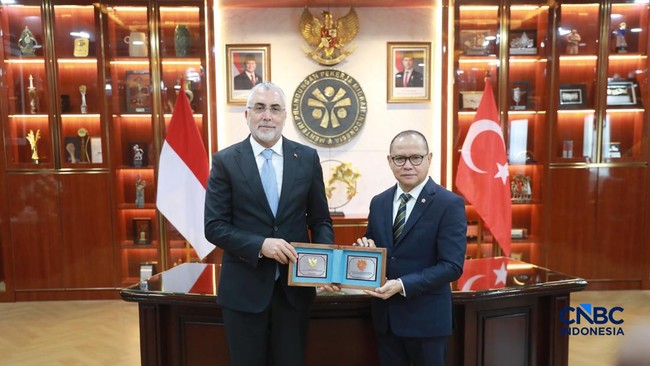
This upward trend, he concluded, is a strong indicator of increasing trust in the quality of the Indonesian workforce and opens doors for expanding mutually beneficial labor cooperation between the two countries. The meeting concluded with both ministers agreeing to sustain efforts to strengthen bilateral cooperation in labor and migrant worker protection through enhanced communication, coordination, and the expedited finalization of the Indonesia-Turkey MoU. They also pledged to promote safe, orderly, and mutually beneficial labor mobility, and to broaden opportunities for competent Indonesian workers across various sectors to meet the evolving demands of the Turkish labor market.
Historical Foundations and Economic Imperatives for Deeper Ties
The enduring relationship between Indonesia and Turkey is rooted in centuries of cultural, religious, and commercial exchanges, long preceding formal diplomatic recognition. The 76 years of official diplomatic relations, highlighted by Minister Işıkhan, represent a modern chapter built upon a historical narrative spanning over four centuries. This deep-seated connection provides a stable foundation for expanding cooperation, especially in sensitive areas like labor migration. Both nations, as prominent Muslim-majority countries and members of key international bodies, share a commitment to fostering South-South cooperation and advocating for a more equitable global order.
For Indonesia, the protection of its migrant workers is not merely a diplomatic priority but a fundamental human rights issue and an economic necessity. With an estimated 9-10 million Indonesian citizens working abroad, remittances constitute a significant portion of the national income, contributing billions of dollars annually to the economy. However, this vast diaspora also faces vulnerabilities, including exploitation, illegal recruitment, and lack of legal protection. The establishment of the Ministry of P2MI under President Prabowo Subianto signifies a renewed, dedicated commitment to formalizing and safeguarding this crucial workforce. The ministry’s mandate includes streamlining placement procedures, enhancing protection mechanisms, providing legal assistance, and empowering migrant workers through skills development and financial literacy programs. The collaboration with Turkey aligns perfectly with this broader strategy of ensuring safe, legal, and dignified pathways for Indonesian workers.
Turkey, on the other hand, presents an increasingly attractive destination for skilled and semi-skilled labor. As an emerging economic power with strategic geographical positioning bridging Europe and Asia, Turkey has experienced robust economic growth in recent decades. This growth, coupled with demographic shifts and specific sectoral demands, has created a need for foreign labor. Sectors such as construction, tourism, manufacturing, healthcare, and increasingly, technology and services, are experiencing labor shortages that Indonesian workers, known for their diligence and adaptability, could help address. The positive perception of Indonesian workers, as noted by Minister Işıkhan, further solidifies this potential synergy.
The Significance of the Memorandum of Understanding (MoU)
The proposed Memorandum of Understanding is a critical instrument in formalizing and regulating the flow of labor between Indonesia and Turkey. Such an agreement typically covers:
- Fair Recruitment Practices: Establishing transparent and ethical recruitment processes to prevent exploitation and illegal fees.
- Standard Employment Contracts: Ensuring clear terms and conditions of employment, wages, working hours, and social security benefits.
- Dispute Resolution Mechanisms: Providing avenues for migrant workers to address grievances and seek redress.
- Skills Matching and Certification: Facilitating the recognition of skills and qualifications to ensure workers are placed in appropriate jobs.
- Pre-Departure Orientation and Training: Equipping workers with necessary information about Turkish laws, culture, and workplace practices.
- Repatriation and Reintegration Support: Ensuring dignified return and reintegration for workers at the end of their contracts.
By codifying these aspects, the MoU will not only protect Indonesian workers but also provide Turkish employers with a reliable and regulated source of labor, fostering a stable and predictable environment for both sending and receiving countries. It transforms what might otherwise be an informal or unregulated migration into a structured, mutually beneficial process. The urgency expressed by Minister Mukhtarudin for a timely response on the MoU signing date reflects Indonesia’s commitment to swiftly establish this protective framework.
Broader Implications and Future Outlook
The strengthened labor cooperation between Indonesia and Turkey carries implications that extend beyond just migrant worker protection. It is a testament to a deepening strategic partnership that encompasses various sectors.
- Economic Diversification: For Indonesia, it opens a new, significant destination for its workforce, diversifying its traditional migrant worker corridors which have largely been concentrated in the Middle East and East Asia.
- Skill Transfer and Development: Exposure to the Turkish economy, particularly in its growing industrial and service sectors, can lead to valuable skill acquisition and knowledge transfer for Indonesian workers, contributing to national human capital development upon their return.
- Enhanced Bilateral Trade and Investment: A robust labor agreement can pave the way for increased trust and facilitate greater bilateral trade and investment. If both countries effectively manage labor mobility, it could lead to further economic integration and joint ventures.
- Diplomatic Influence: As active members of OKI and G20, stronger bilateral ties enable Indonesia and Turkey to exert greater collective influence on regional and global issues, from economic development to peace and security.
- Combating Irregular Migration: By providing legal and formal channels for employment, the MoU is expected to significantly reduce instances of irregular migration, which often exposes workers to severe risks and exploitation.
Minister Mukhtarudin’s announcement of a planned reciprocal visit by the P2MI Ministry to Turkey further underscores the commitment to fostering this strategic friendship and cooperation. Such visits facilitate direct engagement, deeper understanding of respective contexts, and collaborative problem-solving, ensuring that the partnership remains dynamic and responsive to evolving needs.
In conclusion, the meeting between the Indonesian and Turkish labor ministers on July 24, 2026, was more than a diplomatic courtesy; it was a substantive step towards solidifying a comprehensive framework for labor mobility. It reflects a shared vision for ethical migration, driven by economic necessity and guided by mutual respect and a long-standing historical bond. As both nations move towards finalizing their MoU, the prospects for a more integrated, protected, and prosperous future for Indonesian migrant workers in Turkey, and for the bilateral relationship as a whole, appear increasingly bright.