
 Bambang Pamungkas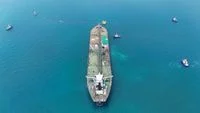
The economy of Iraq is teetering on the edge of unprecedented collapse, heavily ensnared in the widening geopolitical vortex and military escalations involving the United States, Israel, and Iran. The total paralysis of free-flowing maritime commerce through the vital Strait of Hormuz—which began in late February—has effectively placed a financial stranglehold on a sovereign nation that remains structurally and fundamentally reliant on foreign imports for its daily sustenance, industrial inputs, and commercial vitality.
According to reports citing high-level governmental briefings, Prime Minister Ali al-Zaidi has openly characterized the ongoing situation as an existential economic crisis. The disruption has inflicted staggering financial wounds upon Baghdad, culminating in an estimated loss of approximately $60 billion in oil export revenues. This catastrophic deficit stems from the country’s temporary yet prolonged inability to move roughly 90% of its petroleum products through the Persian Gulf corridor, a strategic waterway that has concurrently transformed into a high-stakes diplomatic and military theater between Washington and Tehran.
This financial bleeding serves as a devastating blow to the Iraqi state apparatus, given that hydrocarbons historically account for more than 90% of the federal budget. Beyond the direct loss of export revenue, the closure and active militarization of the Strait of Hormuz have critically fractured global supply chains. Consequently, transportation times have multiplied, shipping insurance premiums have skyrocketed, and the physical volume of imported goods clearing Iraqi customs has plummeted.
For ordinary citizens and business owners on the ground in Baghdad, the macroeconomic shock has swiftly translated into domestic hardship. Alaa-Eddin Sulaibi, a prominent supermarket owner in the Iraqi capital, noted that the proportion of imported consumer goods lining his shelves has drastically contracted from 90% to a mere 70%. Concurrently, retail prices for these remaining foreign goods have surged between 25% and 30%.
"We simply have no alternative but to pivot toward selling local products, even though the quality does not match what consumers have traditionally expected from imports," Sulaibi stated, highlighting the stark reality confronting domestic retailers and consumers alike.
The Chronology of Escalation and Supply Chain Paralysis
To fully comprehend the depth of Iraq’s current vulnerability, one must examine the cascading timeline of events that transformed a regional standoff into an economic catastrophe for Baghdad.
The immediate catalyst occurred in late February, when escalating naval tensions and security threats in the Persian Gulf effectively closed the Strait of Hormuz to commercial tanker traffic. As one of the world’s most critical chokepoints—through which a massive share of global petroleum passes—the shutdown instantly paralyzed Iraq’s primary maritime export routes from southern terminals like Basra.
Throughout March and April, as diplomatic efforts stalled and military postures hardened, Iraq’s national oil corporation found itself unable to clear tankers, forcing involuntary production cuts at major oilfields. Storage capacities quickly reached their thresholds, compounding the financial loss.
Simultaneously, the monetary front began to crumble. In April, mounting pressure from Washington regarding the alleged utilization of Iraqi financial channels by Iran-backed paramilitary networks prompted the administration of U.S. President Donald Trump to take drastic action. The U.S. federal authorities suspended the physical delivery of cash shipments derived from Iraq’s sovereign oil revenues held in U.S. accounts. Although these shipments were partially restored by July, the interlude created severe domestic liquidity strains and triggered severe friction between Washington and the monetary authorities in Baghdad.
By late August, foreign exchange reserves had hemorrhaged significantly, and by September, the cumulative impact of trade blockages, halted oil flows, and currency pressures drove the Iraqi economy into uncharted territory.
Monetary Turmoil: The Dinar, Foreign Reserves, and Dollar Shortages
The macroeconomic fallout has exerted immense downward pressure on the Iraqi dinar (IQD). In the parallel market, the exchange rate spiked dramatically, touching 1,600 dinars per U.S. dollar, a sharp divergence from the official government rate of 1,300 dinars and notably higher than the pre-war baseline of 1,540 dinars per dollar.
This currency depreciation has unfolded against a backdrop of acute physical dollar scarcity. The U.S. government’s mid-year allegations that several private Iraqi commercial banks were deeply enmeshed in large-scale clandestine operations to smuggle U.S. currency into Iran triggered rigorous compliance checks and restricted liquidity flows into the Iraqi banking system.
Official stances from Iraqi institutions have attempted to project stability. The Central Bank of Iraq (CBI) has aggressively pushed back against narratives of a systemic dollar shortage, attributing the wild fluctuations in the parallel market strictly to speculative behavior and psychological market panic driven by opportunistic traders.
However, insider disclosures from within the highest tiers of the Iraqi government paint a far more precarious picture. Mudher Mohammed Salih, the Financial Advisor to the Prime Minister, revealed alarming data regarding the nation’s sovereign buffers. According to Salih, the CBI’s foreign exchange reserves—the ultimate shield against external economic shocks—evaporated from approximately $106 billion prior to the outbreak of hostilities down to $80 billion by the conclusion of August. This depletion rate underscores the unsustainable pace at which Baghdad has had to burn through its financial reserves to defend the currency and service basic import bills.
Structural Vulnerabilities and Deep-Seated Economic Imbalances
International economists argue that the current crisis is not merely an exogenous shock, but rather the explosive convergence of decades of unaddressed structural flaws within the Iraqi economic model. Ziad al-Hashimi, a prominent researcher in international economics at Anglia Ruskin University, emphasized that the ongoing turmoil has mercilessly exposed the structural fragility of a rentier state.
"This crisis has exposed profound structural imbalances within the Iraqi economy, most notably the complete absence of institutional shock absorbers capable of insulating the domestic market during periods of severe geopolitical turbulence," al-Hashimi noted.
For generations, successive Iraqi administrations have failed to diversify the national economy away from its absolute reliance on crude oil extraction. Furthermore, the country’s failure to cultivate a robust domestic manufacturing or agricultural sector leaves it defenseless when international trade routes are compromised. Without local production lines capable of substituting basic foodstuffs, medical supplies, and manufactured goods, any disruption in the Strait of Hormuz instantly cascades into domestic inflation, scarcity, and social discontent.
When assessing the policy responses deployed by Baghdad thus far, al-Hashimi remains deeply skeptical of their long-term efficacy.
"Everything the Iraqi government has managed to implement thus far amounts to little more than short-term palliative measures," he explained. "These steps may marginally buffer the immediate impacts, but they rely heavily on emergency financing and borrowing mechanisms, which fundamentally fail to constitute a genuine, sustainable solution."
Implications and Broader Geopolitical Outlook
The plight of Iraq carries profound implications for regional stability and the global energy market. As long as the diplomatic gridlock persists between the United States and Iran—with Israel maintaining an aggressive posture across regional fronts—Iraq remains trapped in the crossfire.
The inability to safely export the vast majority of its petroleum not only deprives Baghdad of its fiscal lifeblood but also tightens global energy supplies, exerting upward pressure on international oil prices. For an import-dependent nation of over 45 million people, the compounding pressures of rising food prices, currency depreciation, eroding foreign reserves, and depleted cash supplies pose severe socio-political risks.
Policy experts warn that without an immediate de-escalation in the Persian Gulf, the resumption of free maritime traffic through the Strait of Hormuz, and a constructive diplomatic resolution regarding banking compliance between Washington and Baghdad, Iraq’s tentative steps toward economic recovery will give way to a systemic financial collapse. For now, the nation remains precariously suspended between the machinations of regional and global superpowers, with its civilian population bearing the brunt of a war fought far beyond its borders.








