
 Tyo Susilo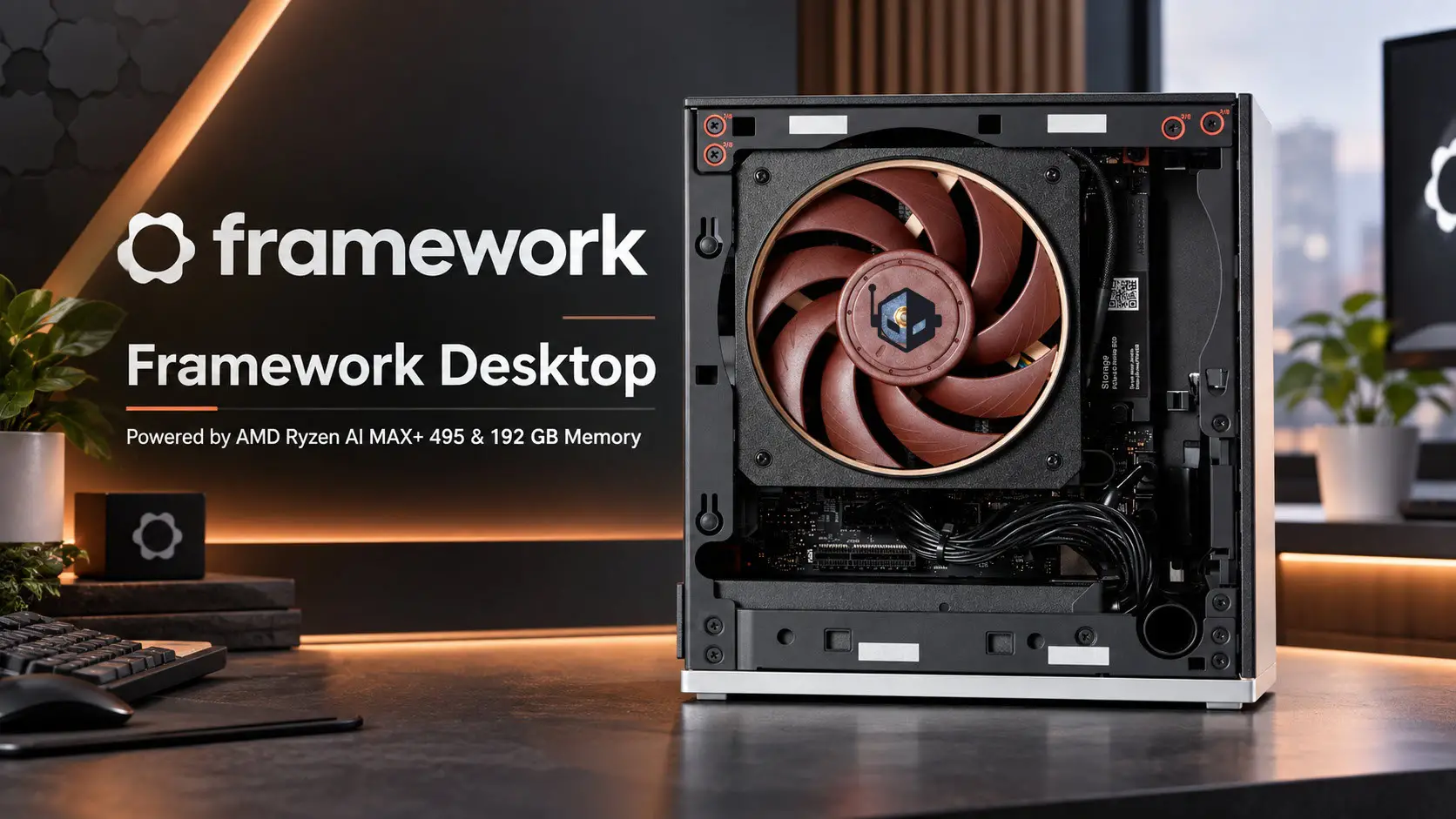
Framework, a company widely celebrated for pioneering repairable, highly modular laptops designed to combat electronic waste and the industry-standard right-to-repair barriers, has officially announced its expansion into the desktop personal computer market. Known previously for empowering consumers with easily swappable ports, upgradable motherboards, and user-serviceable components, the manufacturer is taking a massive leap forward. Instead of entering the desktop space with a standard, entry-level office machine or a conventional gaming tower, Framework is debuting with a heavy-duty, high-performance workstation aimed squarely at power users, artificial intelligence researchers, and software engineers who demand enterprise-grade computing power in a surprisingly compact form factor.
The newly revealed Framework Desktop arrives equipped with bleeding-edge hardware, headlined by the powerful AMD Ryzen AI Max+ 495 processor. This advanced system-on-chip (SoC) leverages a 16-core, 32-thread architecture based on AMD’s state-of-the-art Zen 5 microarchitecture, capable of achieving boost clock speeds of up to 5.2 GHz. On the graphical and parallel-processing front, the integrated SoC relies on the Radeon 8065S graphics engine, which incorporates 40 Compute Units based on the cutting-edge RDNA 3.5 architecture. This hardware configuration blurs the traditional line between discrete graphics cards and integrated processing units, offering immense computational bandwidth directly within the primary processor package.

Unprecedented Memory Configurations and Local AI Capabilities
Perhaps the most astonishing specification of the Framework Desktop is its memory architecture. Framework is offering configurations featuring up to an unprecedented 192 GB of LPDDR5X unified memory, operating at an impressive memory bandwidth of 273 GB/s. Because the central processing unit and the integrated graphics processing unit share this vast unified memory pool, up to 160 GB of memory can be dynamically allocated directly to the GPU. This capability is a game-changer for professionals working with massive datasets, real-time rendering, and complex local machine learning models.
In industry demonstrations, Framework showcased the desktop seamlessly executing large-scale local AI models without relying on cloud-based infrastructure. As data privacy concerns grow and organizations increasingly shift toward running localized artificial intelligence workloads to protect sensitive information, the demand for client hardware capable of processing massive parameter models locally has skyrocketed. By packing up to 192 GB of unified memory into a single desktop, Framework has positioned its new hardware as an accessible, high-performance local AI development node. Furthermore, for organizations or researchers requiring even higher capacity, the system architecture supports a unique daisy-chain or cluster configuration where two Framework Desktop units can be combined to achieve a staggering 384 GB of total unified memory.
Innovative Compact Design and Modular Expansion
Despite housing enterprise-level processing power and massive memory arrays, the Framework Desktop breaks convention by squeezing all of this hardware into a remarkably compact chassis with a volume of approximately 4.5 liters. Maintaining the company’s core philosophy of modularity and hardware longevity, the engineering team managed to design a miniature enclosure that does not completely sacrifice expandability. The system includes an open-ended PCIe x4 slot, allowing users to integrate additional high-speed expansion cards, storage controllers, or specialized networking hardware, even if the physical dimensions of the added PCIe device exceed the standard enclosed boundaries of the slot.

This design philosophy addresses a long-standing criticism of small form factor (SFF) desktop computers, which historically force users into rigid hardware ecosystems with zero post-purchase upgradability. By retaining an open expansion pathway and ensuring that the core components can be serviced or upgraded over time, Framework is extending its sustainable hardware ethos from portable laptops to stationary desktop computing environments. The inclusion of high-speed unified memory alongside physical expansion options demonstrates that miniaturization does not inherently require a closed, disposable ecosystem.
Background Context and Industry Evolution
The launch of the Framework Desktop represents a critical milestone in the broader evolution of the personal computing and semiconductor industries. Founded with the mission to reverse the trend of planned obsolescence in consumer electronics, Framework initially launched its flagship modular laptop in 2021. Over the subsequent years, the company steadily expanded its ecosystem by introducing modular mainboards that could be repurposed into standalone mini-PCs, external enclosures, and various DIY electronics projects.
However, the introduction of a dedicated, purpose-built desktop system powered by AMD’s Ryzen AI Max+ silicon marks a structural shift from a boutique laptop manufacturer to a comprehensive hardware provider. This strategic move coincides with a broader industry-wide transition toward AI-capable personal computers, commonly referred to as AI PCs. As semiconductor giants like AMD, Intel, and Qualcomm race to integrate dedicated Neural Processing Units (NPUs) and high-bandwidth unified memory architectures into consumer and professional silicon, hardware manufacturers must innovate rapidly to capture the emerging market of developers, data scientists, and creative professionals who require localized computational muscle.

Market Implications and Future Outlook
The entry of Framework into the desktop workstation market carries significant implications for both enterprise computing and the enthusiast community. Traditionally, high-capacity unified memory configurations exceeding 128 GB were restricted to expensive Apple Silicon Mac Studio systems or high-end enterprise server racks. By introducing an x86-based, highly serviceable desktop platform with up to 192 GB—and scalable to 384 GB via dual-unit deployment—Framework is democratizing access to massive memory pools for open-source developers and independent researchers.
Industry analysts note that while the form factor and specifications are undeniably impressive, the ultimate commercial success of the Framework Desktop will depend heavily on its pricing strategy and global availability. Pre-orders for the system are scheduled to open globally within the week, giving eager consumers and enterprise buyers their first opportunity to secure the hardware. As the technological landscape continues to pivot toward localized artificial intelligence processing, sustainable hardware design, and user-upgradable architectures, Framework’s latest offering establishes a formidable new benchmark for what compact desktop computers can achieve.








