Bambang Pamungkas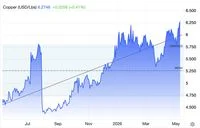
Jakarta, CNBC Indonesia – Global copper prices have once again surged, igniting concerns across industrial sectors and financial markets. On Monday, May 11, 2026, the vital industrial metal climbed to US$6.27 per pound, marking a 0.35% increase from the previous trading day, according to data from Trading Economics. This latest ascent is part of a broader upward trend that has seen copper futures soar by 4.94% over the past month and a staggering 36.75% compared to the same period last year. The commodity is now tantalizingly close to its all-time record high of US$6.58 per pound, a benchmark reached just four months prior in January 2026, with futures contracts already trading above the US$6.2 per pound threshold. This renewed fervor in the copper market underscores a complex interplay of burgeoning demand from transformative technologies and an increasingly fragile global supply chain.
A Historical Perspective
Copper, often dubbed "Dr. Copper" for its perceived ability to diagnose the health of the global economy, has a volatile yet consistently upward-trending history. Its price trajectory is deeply intertwined with industrial expansion and technological revolutions. Previous peaks, such as those seen during the commodity supercycle of the early 2000s and again in 2011, were primarily driven by rapid industrialization in emerging economies, particularly China. The 2011 peak, which briefly saw prices approach similar levels to today’s, was fueled by massive infrastructure projects and a housing boom. More recently, post-pandemic economic recovery and early signals of the green energy transition pushed prices to significant highs in 2021-2022. The current rally, however, is distinct. While echoing past demand surges, it is fundamentally shaped by a confluence of long-term structural shifts and acute geopolitical pressures, signaling a potentially sustained period of elevated prices. The January 2026 record of US$6.58 per pound itself was a harbinger of the current market tightening, driven by initial projections of accelerating demand for electrification and digital infrastructure.
The Electrification Era: Unprecedented Demand Drivers
The current surge in copper prices is not merely a cyclical phenomenon but rather a reflection of a profound structural shift in global industrial demand. The world is transitioning towards an electrified and digitally interconnected future, and copper is the irreplaceable lynchpin of this transformation.
Fuelling the AI Revolution
The rapid expansion of artificial intelligence (AI) is proving to be a colossal new demand driver for copper. AI data centers, the computational backbone of this revolution, are incredibly power-intensive and require vast amounts of copper for their internal wiring, cooling systems, and the immense grid infrastructure needed to power them. Each server rack in an AI data center is far more copper-intensive than conventional server racks due to higher power density and specialized cooling solutions. Industry estimates suggest that a single hyperscale AI data center can consume thousands of tons of copper for its electrical cabling, power distribution units, and cooling infrastructure. As AI models become more complex and widespread, the construction of these data centers is accelerating globally, with projections indicating a doubling of AI server deployment over the next five years, each requiring an intricate web of copper to function efficiently and reliably.
The Backbone of Electric Vehicles
The global push for electric vehicles (EVs) is another foundational pillar of copper demand. EVs utilize significantly more copper than their internal combustion engine (ICE) counterparts. A typical ICE vehicle contains approximately 18-22 kg of copper, primarily in wiring, starter motors, and alternators. In contrast, a battery electric vehicle (BEV) can contain 80-85 kg of copper, found in the motor, battery pack, inverters, and extensive wiring harnesses. Hybrid vehicles also use more copper, around 40 kg. Beyond the vehicles themselves, the burgeoning charging infrastructure—from home chargers to public fast-charging stations—is also highly copper-intensive, requiring robust cables and grid connections. With major automotive markets setting ambitious targets for EV adoption, the demand for copper from this sector is projected to grow exponentially through the next decade, with some forecasts predicting a fivefold increase by 2030.
Powering the Green Transition
Beyond AI and EVs, the broader global transition to clean energy sources and modernized electrical grids is creating unprecedented demand for copper. Renewable energy installations, such as solar photovoltaic (PV) farms and wind turbines, are copper-heavy. A typical onshore wind turbine uses several tons of copper for its generator, transformers, and cabling, while offshore turbines require even more. Solar panels and their associated wiring, inverters, and grid connections also contribute substantially. Crucially, the modernization and expansion of the global electricity grid to accommodate these new energy sources and manage increased demand is perhaps the most significant long-term driver. Smart grids, high-voltage direct current (HVDC) transmission lines, and upgraded distribution networks all require vast quantities of copper due to its superior conductivity and durability. S&P Global’s comprehensive study in January 2026 projected that global copper demand is set to reach an astounding 42 million metric tons by 2040, an increase of approximately 50% from current levels. This figure highlights the immense scale of the demand challenge, pushing the market far beyond conventional cyclical patterns.
A Constrained Supply Landscape
While demand spirals, the supply side of the copper equation faces escalating and multifaceted pressures, creating a structural deficit that is becoming increasingly difficult to bridge. The market is beginning to recognize that these are not transient issues but rather systemic challenges that threaten to undermine the ambitious targets of global decarbonization and technological advancement.
Mining Challenges and Declining Ore Grades
The primary constraint lies in mine production. The discovery of large, high-grade copper deposits has become increasingly rare. Existing mines globally are experiencing declining ore grades, meaning more rock must be processed to yield the same amount of copper, which in turn increases energy consumption, water usage, and operational costs. Major producing regions, particularly in South America like Chile, are facing a combination of mature assets, water scarcity issues exacerbated by climate change, and community opposition to new projects or expansions. For instance, Chile, the world’s largest copper producer, saw its production decline by approximately 6% in the first quarter of 2026 compared to the same period last year, a trend indicative of broader industry struggles. Permitting processes for new mines are also becoming protracted and complex, often taking over a decade from discovery to full production, making it exceedingly difficult for supply to respond quickly to sudden demand spikes.

Smelter Bottlenecks and China’s Sulfuric Acid Ban
Even if raw ore can be extracted, processing it into usable metal presents another bottleneck. Smelting and refining capacity has not kept pace with mine production, partly due to stringent environmental regulations and high energy costs. China currently dominates global smelting capacity, controlling an estimated 40% of the world’s processing infrastructure. This concentration creates a critical vulnerability in the global supply chain. The latest pressure point emerged from China’s decision to halt exports of sulfuric acid from May until at least December 2026. Sulfuric acid is an indispensable reagent in the hydrometallurgical process of copper refining, particularly for leachable oxide ores. This policy is expected to remove approximately 3 million tons of global seaborne sulfuric acid supply, with significant repercussions for copper producers in countries like Chile, Indonesia, and India, which rely on these imports for their refining operations. Goldman Sachs estimates that this ban alone could trim Chile’s copper production by around 200,000 tons, equivalent to 1% of the global annual supply, further tightening an already stretched market.
Geopolitical Flashpoints and Logistics Woes
Geopolitical instability is adding another layer of complexity and cost to copper supply. The ongoing conflict in the Middle East, specifically the heightened tensions around critical energy and shipping routes like the Strait of Hormuz, has directly impacted the cost of producing and transporting industrial metals. Disruptions in these vital maritime chokepoints lead to soaring shipping insurance premiums, longer transit times, and crucially, higher energy costs. Mining operations are heavily reliant on diesel fuel for their massive fleets of heavy equipment, ore transportation, and logistical chains. When diesel prices surge due to global energy market volatility and supply chain disruptions, the operational costs for mines escalate significantly, directly influencing the final price of copper. These external shocks make long-term planning and investment in the mining sector even more challenging.
Copper as a Critical National Security Material
The strategic importance of copper has been increasingly recognized by major global powers. In a landmark move, the United States designated copper as a critical material for national security in February 2025. This designation underscores a fundamental shift in how governments perceive the metal, moving beyond its purely economic value to its role in underpinning national defense, economic prosperity, and technological leadership.
Concentration Risks and Supply Chain Vulnerabilities
The White House’s rationale for labeling copper as critical stemmed from concerns over an excessive reliance on foreign supply, which opens doors to market manipulation and severe supply chain disruptions. The global copper supply chain is highly concentrated: approximately two-thirds of the world’s copper mine production is controlled by just six countries, predominantly in South America. Furthermore, China’s substantial control over smelting and refining capacity means that any significant disruption in these key regions or processing hubs can have immediate and far-reaching global repercussions. This structure creates inherent vulnerabilities, raising fears that copper supply could be weaponized or become a leverage point in geopolitical rivalries, similar to concerns around rare earth elements. Phil Ehr, a former US military commander and current advisor to NovaRed Mining, highlighted the profound implications of copper scarcity, stating that approximately three-quarters of global copper demand is linked to electrical applications. He warned that tightening supply rapidly impacts critical national systems, including power grids, communication networks, transportation infrastructure, and defense capabilities, elevating it to a matter of strategic national interest.
Global Market Reactions and Strategic Shifts
The synchronized price increases across major commodity exchanges—the COMEX in New York, the London Metal Exchange (LME), and the Shanghai Futures Exchange (SHFE)—are clear indicators that the pressures on copper are global rather than regional. This universality suggests that the market is collectively bracing for a prolonged period of constrained supply relative to surging demand.
Investor Sentiment and Exchange Dynamics
Investor sentiment in the copper market is overwhelmingly bullish. Major financial institutions and commodity traders are increasing their long positions, betting on sustained price appreciation. The premiums observed in spot markets, particularly in regions like the United States where buyers are reportedly paying more than in other areas to secure immediate supplies, further illustrate the tightness in the physical market. This signals a willingness to pay above standard rates to ensure continuity of operations, reflecting deep-seated anxieties about future availability. Analytical firms like Goldman Sachs and S&P Global continue to issue forecasts that highlight the deepening supply deficit, reinforcing investor confidence in the long-term upward trajectory of copper prices.
The Paradigm Shift Towards Supply Resilience
In response to these escalating challenges, governments and corporations are fundamentally re-evaluating their strategies for securing critical resources. The traditional focus on achieving the lowest possible cost for raw materials is rapidly being superseded by an imperative for supply reliability and resilience. This paradigm shift is driven by the recurring specter of geopolitical conflicts, trade wars, and energy crises that expose the fragility of highly optimized, just-in-time global supply chains. Countries are now exploring diversified sourcing strategies, investing in domestic mining and processing capabilities where feasible, and prioritizing long-term supply agreements with geopolitically stable partners. There is also a renewed emphasis on circular economy principles, with significant investments in copper recycling initiatives to maximize the utilization of existing materials and reduce reliance on virgin mine production.
Outlook and Long-Term Implications
The current market dynamics for copper suggest that the era of cheap and abundant supply may be drawing to a close. The confluence of insatiable demand from the AI, EV, and green energy revolutions with severe, structural supply constraints points towards a future of sustained high prices. This has several profound implications. For one, it could accelerate innovation in material science, spurring research into alternative conductors or more efficient uses of copper, though its unique properties make widespread substitution difficult in many critical applications. Secondly, it will inevitably raise the costs associated with the global energy transition, potentially impacting the timelines and economic viability of green projects if copper remains a significant bottleneck. Thirdly, the geopolitical significance of copper will only intensify, making access to and control over reserves and processing capacity a central pillar of national economic and security policy. The market’s current trajectory signals a challenging but transformative period ahead, where copper’s role as the indispensable metal for the future will be solidified, albeit at a significantly higher cost.
CNBC Indonesia Research