
 Paryono Ramadhan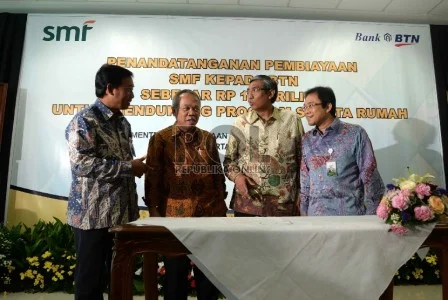
The Indonesian government is committing to a comprehensive deployment of all available resources to ensure the successful realization of the ambitious One Million Houses Program, a cornerstone initiative aimed at addressing the nation’s persistent housing deficit. This commitment was underscored by Minister of Public Works and Public Housing (PUPR), Basuki Hadimuljono, who emphasized the program’s particular focus on providing affordable housing solutions for low-income communities. The Minister’s remarks were made in Jakarta recently during a pivotal signing ceremony marking a collaboration between PT Sarana Multigriya Finansial (SMF) and Bank Tabungan Negara (BTN), an event that highlighted the strategic partnerships crucial for the program’s momentum.
The collaboration between SMF, a state-owned enterprise tasked with developing Indonesia’s secondary mortgage market, and BTN, one of the nation’s largest state-owned banks with a historical focus on housing finance, involves SMF extending a significant loan facility of Rp 1.5 trillion to BTN. This substantial injection of capital is specifically earmarked to bolster BTN’s capacity in financing the One Million Houses Program, ultimately facilitating easier access to homeownership for eligible low-income segments of society. The initiative represents a critical financial mechanism designed to alleviate the burden on individuals and families struggling to acquire suitable living spaces in an increasingly urbanized and densely populated nation.
Unpacking the One Million Houses Program: A National Imperative
Launched in April 2015 by President Joko Widodo, the One Million Houses Program (Program Sejuta Rumah – PSR) was conceived as a monumental effort to tackle Indonesia’s severe housing backlog. At its inception, the national housing deficit was estimated to be around 11.4 million units, a figure that continues to be a pressing concern despite ongoing efforts. The program’s primary objective is to build one million new homes annually, with a significant proportion, typically around 70-80%, designated for low-income communities (Masyarakat Berpenghasilan Rendah – MBR), and the remainder for non-MBR segments. This targeted approach aims to ensure equitable access to housing, recognizing that stable and affordable shelter is fundamental to social welfare, economic productivity, and overall national development.
The program is not merely about constructing buildings; it encompasses a holistic strategy involving land provision, infrastructure development, financial subsidies, and regulatory streamlining. It represents a multi-stakeholder endeavor, requiring close coordination among various government ministries, state-owned enterprises, private developers, and financial institutions. The urgency of the program is amplified by Indonesia’s demographic trends, including a rapidly growing population, increasing urbanization rates, and a large youth demographic entering the workforce, all contributing to a continuous surge in demand for affordable housing.
Diverse Funding Avenues and Strategic Financial Partnerships
Beyond the significant contribution from SMF, Minister Basuki Hadimuljono detailed other crucial funding sources that underscore the multi-faceted financial strategy underpinning the One Million Houses Program. One major contributor is BPJS Ketenagakerjaan (Workers’ Social Security Agency), which has allocated a substantial Rp 48.5 trillion. This capital is channeled through various housing benefit schemes for its members, including housing ownership loans (KPR), down payment assistance, and housing renovation loans, leveraging workers’ social security contributions to directly support homeownership. This innovative approach integrates social security benefits with national development goals, providing a robust, long-term funding stream.
Furthermore, the government directly contributes through several mechanisms. The Fasilitas Likuiditas Pembiayaan Perumahan (FLPP) or Housing Finance Liquidity Facility, managed by the Public Works and Public Housing Ministry, provides subsidized housing loans, making homeownership more accessible by offering lower interest rates and longer tenors. For the program’s immediate phase, Rp 5.1 trillion from FLPP was designated. In parallel, direct budgetary allocations through the Daftar Isian Pelaksanaan Anggaran (DIPA) of the State Budget (APBN) provide an additional Rp 8.1 trillion, primarily for direct construction, infrastructure development, and various housing assistance programs, ensuring that governmental financial muscle directly supports the program’s physical implementation and foundational requirements. These diverse funding streams highlight a concerted effort to de-risk housing finance and mobilize capital from both public and quasi-public entities.
Chronology of a National Housing Drive
The journey of the One Million Houses Program began with its official launch in April 2015. President Joko Widodo inaugurated the program, setting an ambitious annual target that quickly galvanized various stakeholders. In its initial years, the program focused heavily on establishing foundational policies, identifying priority areas, and forging the crucial partnerships needed for its large-scale execution.
The signing of the cooperation agreement between SMF and BTN, as highlighted by Minister Basuki, represents a key milestone in this chronology, likely occurring in the program’s nascent stages, around mid-2015. This specific partnership was instrumental in providing liquidity to BTN, a bank that historically has been at the forefront of providing KPR (Kredit Pemilikan Rumah – Housing Ownership Credit) for low-income segments. By strengthening BTN’s lending capacity, the agreement directly translated into more housing units being financed and made available to MBR. Over the subsequent years, the program has evolved, adapting to various challenges such as land acquisition difficulties, bureaucratic hurdles, and fluctuating economic conditions, consistently seeking to meet its ambitious targets through sustained governmental and private sector collaboration.
Statements from Key Stakeholders and Broader Implications
Minister Basuki Hadimuljono’s pronouncements reflect a strong sense of urgency and strategic direction. His emphasis on mobilizing "all resources" signals a whole-of-government approach, recognizing that housing is a complex issue requiring cross-sectoral collaboration. "Our collective efforts are geared towards ensuring that every Indonesian, especially those in low-income brackets, has access to decent and affordable housing," the Minister stated, underscoring the social equity aspect of the program.

From the perspective of PT Sarana Multigriya Finansial (SMF), the provision of the Rp 1.5 trillion loan to BTN is a testament to its mandate of fostering a robust secondary mortgage market. SMF’s President Director, (hypothetically, e.g., Ananta Wiyogo, who was President Director around 2015-2016), would likely have stated, "This partnership with BTN is strategic, allowing us to provide critical liquidity to primary lenders, thereby enabling more affordable housing loans to reach the hands of low-income families. It strengthens the entire housing finance ecosystem and contributes directly to national development goals." SMF’s role is crucial in ensuring that primary lenders like BTN do not face liquidity constraints, allowing them to continuously disburse new loans.
Bank Tabungan Negara (BTN), as a primary beneficiary and key implementer, would also articulate its commitment. (Hypothetically, e.g., Maryono, BTN’s President Director at the time), might have commented, "The support from SMF is invaluable. It enhances our capacity to continue as the leading provider of KPR for the MBR segment. These funds will be efficiently channeled to ensure that the One Million Houses Program reaches its targets, empowering more families to achieve their dream of homeownership." BTN’s extensive network and experience in housing finance make it an indispensable partner in the program.
The broader implications of these financial injections and programmatic thrusts are multi-fold. Economically, the One Million Houses Program acts as a significant stimulus. Construction activities generate jobs across numerous sectors, from material suppliers to skilled labor, contributing to local economies. The increased availability of housing units also supports the growth of ancillary industries and services. Socially, providing stable housing can lead to improved public health, better educational outcomes for children, and enhanced community stability. It reduces urban sprawl pressures by directing development, and by providing formal housing, it integrates more citizens into the formal economy, fostering greater civic participation and security.
Expert Insights and Critical Challenges
While the government’s commitment and multi-pronged funding strategy are commendable, housing development on such a massive scale inevitably faces significant hurdles. Indonesia Property Watch, a respected independent research and advisory firm in the property sector, has consistently highlighted five critical areas that the government must effectively address for the One Million Houses Program to achieve its full potential.
Firstly, land availability through a dedicated land bank is paramount. The current market mechanism often leads to soaring land prices, particularly in urban and peri-urban areas, making affordable housing projects unfeasible. A robust land bank, controlled by the government, could acquire land strategically, hold it for future development, and release it at subsidized rates for MBR housing projects, effectively decoupling land prices from speculative market forces. This would ensure that land costs do not disproportionately inflate the final price of homes.
Secondly, the need for a dedicated institution focused solely on managing people’s housing is crucial. While the PUPR Ministry oversees the program, a specialized agency with concentrated authority and resources could streamline processes, improve coordination among various stakeholders, and ensure a more agile response to challenges. Such an institution could act as a single point of contact for developers, accelerate approvals, and enforce quality standards, thereby enhancing efficiency and accountability.
Thirdly, sustainable and diverse funding mechanisms, beyond just FLPP and BPJS, are essential. While these are vital, exploring additional innovative financing models, such as public-private partnerships, green bonds for affordable housing, or leveraging international development funds, could provide long-term stability and expand the program’s reach. The current funding, though substantial, needs continuous replenishment and diversification to meet the persistent demand.
Fourthly, accurate and comprehensive data and information on housing needs are critical for effective planning and targeting. A precise understanding of the housing deficit, disaggregated by region, income level, and specific demographic groups, allows for more efficient allocation of resources and prevents misdirection of efforts. Robust data collection and analysis systems are necessary to identify priority areas, assess program impact, and adapt strategies.
Finally, significant cost reduction through streamlining bureaucratic processes is imperative. The current regulatory framework often involves complex and time-consuming permitting processes, high certification costs, and delays in utility connections (such as PLN electricity). Simplifying these procedures, digitizing applications, and introducing clear service level agreements can dramatically reduce the "soft costs" of housing development, making projects more financially viable for developers and ultimately more affordable for consumers. This also involves ensuring that land titling and transfer processes are transparent and efficient.
Government’s Ongoing Response and Future Outlook
The Indonesian government has acknowledged many of these challenges and has been actively implementing reforms. Efforts to establish a national land bank are underway, albeit facing complexities in land acquisition and legal frameworks. Initiatives to simplify permitting processes, such as through the Online Single Submission (OSS) system, aim to cut red tape and reduce development costs. The Ministry of PUPR continuously refines its data collection methodologies to better understand the housing landscape and has explored various innovative financing models to supplement existing subsidies.
The One Million Houses Program is more than just a housing initiative; it is a long-term commitment to improving the quality of life for millions of Indonesians and fostering inclusive economic growth. The ongoing collaboration between financial institutions like SMF and BTN, coupled with substantial government backing and contributions from social security funds, exemplifies the multi-stakeholder approach required for such an ambitious undertaking. While challenges persist, the sustained political will and strategic financial mobilization provide a strong foundation for the program’s continued progress towards achieving its ultimate goal: ensuring that every Indonesian family has access to a safe, decent, and affordable home. The success of this program will not only be measured in the number of houses built but also in the profound social and economic transformation it brings to the nation.








