
 Paryono Ramadhan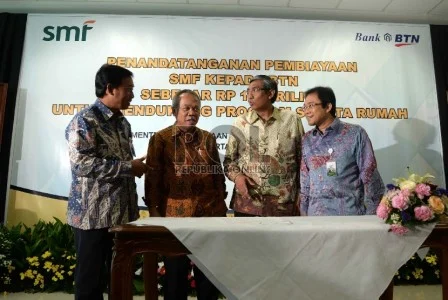
The Indonesian government is committing all available resources to ensure the successful implementation of the ambitious One Million Houses Program, a cornerstone initiative aimed at addressing the nation’s significant housing backlog, particularly for low-income communities. This national strategic effort received a substantial boost through a crucial financial collaboration, as PT Sarana Multigriya Finansial (SMF), a state-owned enterprise operating in the secondary mortgage market, extended a significant loan facility of Rp 1.5 trillion to Bank Tabungan Negara (BTN). The partnership, formalized recently in Jakarta, is designed to bolster BTN’s capacity to disburse housing loans and make homeownership more accessible for Masyarakat Berpenghasilan Rendah (MBR), or low-income earners, across the archipelago.
Minister of Public Works and Public Housing (PUPR), Basuki Hadimuljono, underscored the government’s unwavering resolve during the signing ceremony, emphasizing that every available resource would be marshaled to achieve the program’s objectives. "We are mobilizing all our resources in the context of the One Million Houses Program, especially for low-income communities," Minister Hadimuljono stated, highlighting the cross-sectoral commitment required to tackle such a monumental task. The initiative is not merely about constructing physical units; it embodies a broader vision of enhancing social welfare, fostering economic growth, and ensuring equitable access to decent and affordable housing for all Indonesian citizens. The housing sector, with its extensive value chain, plays a pivotal role in stimulating economic activity, from raw material suppliers to construction workers and financial services.
Strategic Financial Partnership: Bolstering Affordable Housing Access
The collaboration between SMF and BTN represents a critical financial artery for the One Million Houses Program. SMF, established with the mandate to develop and deepen Indonesia’s secondary mortgage market, plays a crucial role in providing liquidity to primary mortgage lenders like BTN. By securitizing mortgage loans or providing direct financing, SMF enables banks to free up capital, which can then be recycled to fund new housing loans, thereby sustaining the flow of credit to homebuyers. This Rp 1.5 trillion loan facility specifically targets the expansion of housing finance for MBR, allowing BTN, traditionally a leading state-owned bank specializing in housing finance, to significantly increase its lending capacity for subsidized housing programs.
BTN, as a key executor of government housing policies, is at the forefront of distributing affordable mortgages, including those under the Fasilitas Likuiditas Pembiayaan Perumahan (FLPP), or Housing Finance Liquidity Facility. This partnership with SMF is instrumental in fortifying BTN’s ability to reach a wider segment of the MBR population, particularly those who might otherwise struggle to access conventional mortgage financing due to stringent eligibility criteria or high-interest rates. The synergy between a secondary market facilitator and a primary lender is crucial for creating a robust and sustainable housing finance ecosystem that can effectively support large-scale programs like the One Million Houses initiative.
Diverse Funding Avenues for National Housing Ambitions
Beyond the SMF-BTN collaboration, Minister Basuki Hadimuljono outlined several other significant funding sources earmarked for the One Million Houses Program, demonstrating a multi-pronged financial strategy. These diverse streams of capital are essential to meet the substantial financial requirements of building one million houses annually, a target set to address an estimated housing backlog that has historically hovered around 11-12 million units nationwide.
One of the largest potential funding sources identified is BPJS Ketenagakerjaan, the national social security agency for employment, which possesses a substantial investment portfolio. An estimated Rp 48.5 trillion from BPJS Ketenagakerjaan’s funds could be channeled into housing finance. This typically occurs through specific housing benefit programs for its members, such as subsidized mortgage interest rates, down payment assistance, or home renovation loans, leveraging the agency’s long-term investment capabilities to support social housing objectives. This mechanism allows workers, who are BPJS Ketenagakerjaan members, to access more affordable housing options, linking social security benefits directly to tangible assets.
Furthermore, direct government support plays a vital role through the FLPP program, with an allocation of Rp 5.1 trillion. FLPP is a government-subsidized mortgage scheme that provides low-interest rates and fixed installments over long tenures, making homeownership attainable for MBR. The government collaborates with participating banks, like BTN, to disburse these subsidized loans, effectively reducing the financial burden on eligible homebuyers. This facility is a cornerstone of Indonesia’s affordable housing strategy, directly addressing the affordability gap faced by a large segment of the population.
Additionally, the state budget, via the Daftar Isian Pelaksanaan Anggaran (DIPA) APBN, allocates Rp 8.1 trillion. DIPA funds are typically used for direct infrastructure development and specific housing projects undertaken by the Ministry of Public Works and Public Housing or other related government agencies. This allocation supports the construction of public housing, basic infrastructure in new housing developments, and other supporting facilities crucial for creating livable communities. The combination of these varied funding sources—capital market liquidity, social security funds, and direct government subsidies and allocations—underscores the comprehensive financial architecture being built to sustain the One Million Houses Program.
Addressing Systemic Challenges: Insights for Sustainable Housing Development
While the government’s commitment and financial mobilization are significant, experts emphasize that several systemic challenges must be overcome for the One Million Houses Program to achieve its full potential. Indonesia Property Watch, a prominent independent research and consultancy firm specializing in the property sector, has consistently highlighted five critical areas requiring government intervention to ensure the program’s success. These recommendations provide a pragmatic roadmap for policy refinement and operational efficiency.
The first critical challenge is land availability and the establishment of a robust land bank. The escalating price of land, often driven by speculative market mechanisms rather than intrinsic value, remains a major impediment to affordable housing development. Without a dedicated national land bank—a government-controlled repository of land parcels designated for public purposes, including affordable housing—developers face immense difficulties in acquiring land at reasonable costs. This issue is compounded by rapid urbanization, which pushes land prices higher in strategic locations, and complex land acquisition processes that can be protracted and costly. A functioning land bank would enable the government to procure and hold land for future housing projects, shielding it from market speculation and ensuring that affordable housing units can be built on appropriately priced land.

Secondly, the experts stress the need for a dedicated institution focused solely on managing people’s housing. While the Ministry of Public Works and Public Housing has a broad mandate, a more specialized agency, perhaps a national housing authority with comprehensive powers for planning, regulation, and execution, could streamline efforts. Such an institution could centralize data, coordinate various stakeholders (local governments, developers, financial institutions), and ensure consistent policy implementation across different regions, thereby enhancing efficiency and accountability in the housing sector. This dedicated focus would allow for more agile responses to regional housing needs and better long-term strategic planning.
Thirdly, sustainable funding mechanisms are paramount. While the current sources like FLPP, BPJS, and SMF are vital, the sheer scale of the housing backlog demands continuous and diversified funding. This includes exploring innovative financing models, encouraging greater private sector participation through incentives, and potentially tapping into international development funds. Ensuring the long-term viability and expansion of these funding avenues is critical to avoid bottlenecks and maintain the momentum of housing construction.
The fourth crucial aspect is the availability of accurate data and information regarding housing shortages. Effective planning and targeted interventions require precise, up-to-date data on the housing backlog, demand patterns, demographic shifts, and the socio-economic profiles of MBR. A comprehensive national housing database would enable policymakers to identify priority areas, allocate resources efficiently, and tailor housing solutions to specific community needs. Without reliable data, programs risk misallocation of resources or failure to address the most pressing housing gaps.
Finally, streamlining bureaucratic processes and reducing associated costs is indispensable. The current regulatory environment often involves multiple layers of permits, lengthy approval times, and high administrative fees, all of which add significantly to the cost of housing development. Simplifying land certification processes, rationalizing building permits, and reducing utility connection fees (such as those from PLN for electricity) would directly lower construction costs. These savings can then be passed on to homebuyers, making housing more affordable. Government efforts to cut red tape and enhance transparency in these processes are vital to improving the efficiency of housing delivery.
Chronology and Historical Context of Indonesia’s Housing Policies
The One Million Houses Program, officially launched by President Joko Widodo in April 2015, marked a significant escalation in Indonesia’s commitment to addressing its housing challenges. Prior to this, government involvement in housing dated back decades, with the establishment of Perum Perumnas (National Urban Development Corporation) in 1974 as a state-owned developer tasked with providing affordable housing. Early housing programs often focused on direct construction and subsidized financing, but the scale of the challenge continued to grow with rapid population expansion and urbanization.
The "Sejuta Rumah" initiative was conceptualized as a more comprehensive and ambitious approach, aiming to synchronize efforts across ministries, state-owned enterprises, and the private sector. Its launch in 2015 was a direct response to the persistent housing backlog and the recognition that previous programs, while beneficial, had not been sufficient to keep pace with demand. The program set an annual target of building one million units—80% for low-income communities and 20% for the non-MBR segment—to systematically reduce the housing deficit over time. This marked a shift from piecemeal projects to a more integrated, large-scale national movement. The initial years of the program saw significant progress, with millions of units completed, albeit facing fluctuating economic conditions and the aforementioned structural challenges.
Broader Economic and Social Implications
The successful implementation of the One Million Houses Program carries profound implications for Indonesia’s economic development and social stability. Economically, the program acts as a powerful stimulus, directly boosting the construction sector, which is a significant employer. The demand for building materials, construction services, and associated industries (e.g., logistics, manufacturing of home appliances) creates a ripple effect throughout the economy, generating jobs and fostering growth. Investments in housing also contribute to local economic development, especially in areas where new settlements are established.
Socially, providing decent and affordable housing directly improves the quality of life for millions of Indonesians. Homeownership offers security, stability, and a sense of belonging, which are fundamental to social well-being. It reduces urban slum growth, improves public health conditions, and can lead to better educational outcomes for children. For low-income families, owning a home can be a critical step out of poverty, providing an asset that can appreciate in value and serve as collateral for future investments. The program aligns directly with the United Nations Sustainable Development Goals (SDGs), particularly Goal 11: Sustainable Cities and Communities, by ensuring access to adequate, safe, and affordable housing and basic services.
Future Outlook and Remaining Hurdles
While the government’s renewed vigor and the strategic financial partnerships signal a strong commitment, the long-term sustainability and effectiveness of the One Million Houses Program depend on continuous adaptation and innovation. Key future challenges include ensuring the sustained availability of funding, especially from private sector participation, and effectively implementing the land bank concept to control land prices. The dynamics of urbanization, particularly the rapid growth of secondary cities, necessitate flexible and adaptable housing policies that can cater to diverse regional needs.
Technological advancements in construction, such as modular housing and prefabrication, offer potential solutions for faster and more cost-effective housing delivery, and their adoption should be encouraged. Furthermore, robust monitoring and evaluation mechanisms are essential to track progress, identify bottlenecks, and make necessary policy adjustments. The collaborative spirit demonstrated by the SMF-BTN partnership, coupled with the government’s determination to address systemic issues identified by experts, will be crucial in steering Indonesia towards a future where affordable and decent housing is a reality for all its citizens. The journey is complex, but the ongoing mobilization of resources and strategic partnerships underscore the nation’s resolve to close its housing gap.








