Azin Asro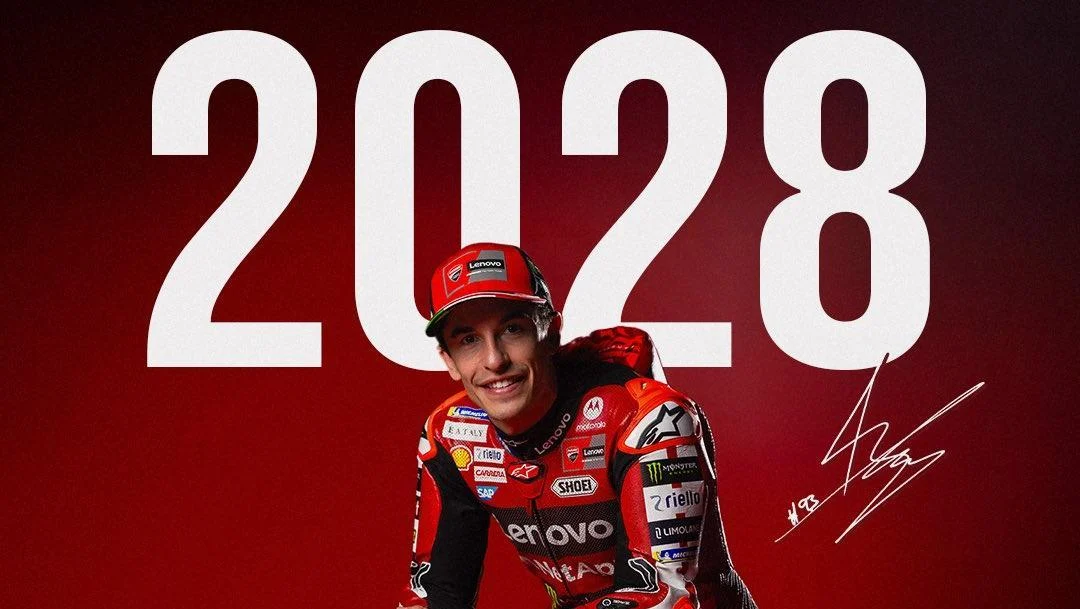
The landscape of modern motorcycle racing shifted fundamentally with the announcement that Marc Marquez, the six-time MotoGP premier class champion, has officially signed a two-year contract to join the Ducati Lenovo Team starting in 2025. This move, which pairs the most successful rider of the current era with the most dominant machinery on the grid, has ignited discussions regarding the potential for Marquez to shatter the most prestigious records in the sport. However, amidst the fervor of statistical projections and historical comparisons, the 31-year-old Spaniard has introduced a surprising narrative for the final chapter of his illustrious career: a pursuit of joy over the pursuit of history.
Statistically, the path to immortality is well within Marquez’s reach. With six premier-class titles already to his name, he requires just one more to equal the seven achieved by Valentino Rossi in the modern era, and two more to surpass the legendary Giacomo Agostini’s record of eight top-flight championships. Furthermore, with 60 premier-class victories currently on his resume, the milestone of 89 wins held by Rossi remains a mathematical possibility during his upcoming tenure with the Ducati factory squad. Yet, in a candid reflection on his journey, Marquez has signaled that his primary motivation is no longer the accumulation of silverware, but the preservation of his passion for the sport.
A Shift in Philosophy: Passion Over Precedence
Speaking to the media following the confirmation of his promotion to the factory Ducati seat, Marquez articulated a perspective forged by years of physical hardship and professional uncertainty. He emphasized that his "greatest ambition" is to enjoy the twilight of his career rather than becoming obsessed with the numerical legacy he leaves behind. This sentiment marks a significant departure from the "win at all costs" mentality that defined his decade of dominance with Repsol Honda.
"My biggest ambition is to enjoy my passion in the final years of my career," Marquez stated, as reported by industry outlets. His reasoning is rooted in the harsh reality faced by many elite athletes. Marquez observed that many of his peers conclude their professional journeys with a sense of bitterness, driven away by the cumulative toll of injuries, the relentless pressure of expectations, and the frustration of declining results.
"Sometimes athletes end their careers hating their sport or their passion because, usually, in the final years, you can suffer from injuries, pressure, and poor results," he explained. "What I want to do is simply try to enjoy the final years of my career, and this will be the main target."
This psychological pivot is not merely a defensive posture against potential failure but a strategic recalibration. By prioritizing "fun" and "feeling," Marquez aims to maintain the mental longevity required to compete at the highest level. However, he was quick to clarify that a desire for enjoyment does not equate to a lack of competitiveness. "Clearly, I always like to compete and strive for 100 percent," he added, noting that specific performance targets for the 2025 season would be formalized during the upcoming winter testing period.
The Road to the Red Garage: A Chronology of Resilience
To understand why Marquez is prioritizing enjoyment, one must examine the grueling four-year period that preceded his move to Ducati. His journey from the pinnacle of the sport to the brink of retirement—and back again—is one of the most compelling narratives in sporting history.
- The Peak (2013–2019): Marquez entered the premier class in 2013, winning the title in his rookie year. Over the next six seasons, he redefined the limits of the motorcycle, winning five more titles and displaying a level of dominance rarely seen in grand prix racing.
- The Jerez Crash (July 2020): At the season opener in Jerez, a violent high-side crash resulted in a fractured right humerus. A premature return to the bike just days later caused the internal fixation plate to fail, leading to a series of complications, infections, and four major surgeries over the next three years.
- The Honda Decline (2021–2023): As Marquez struggled to regain fitness, his longtime employer, Honda, fell behind in the technical development race. The RC213V became notoriously difficult to ride, leading to frequent crashes and a lack of competitive results.
- The Gresini Gamble (2024): In a historic move, Marquez terminated his lucrative Honda contract a year early to join Gresini Racing, a satellite Ducati team. Riding a year-old GP23, he sought to prove to himself—and the world—that he was still capable of competing at the front.
- The Factory Promotion (June 2024): After a series of podium finishes and a demonstration of his undiminished speed, Ducati Corse management, led by Gigi Dall’Igna, chose Marquez over younger talents like Jorge Martin and Enea Bastianini to lead their factory effort alongside Francesco Bagnaia.
Statistical Context: Chasing Agostini and Rossi
While Marquez downplays the importance of records, the motorcycling world remains fixated on them. The move to the factory Ducati team provides him with the most potent tool to challenge the "Greatest of All Time" (GOAT) hierarchy.
In the premier class (500cc/MotoGP), Giacomo Agostini holds the record with eight world titles. Valentino Rossi follows with seven. Marquez, currently sitting on six, is the only active rider with a realistic chance of surpassing these icons. A single title in either 2025 or 2026 would see him equal Rossi’s premier-class tally and tie Agostini’s record of eight titles across all classes (Marquez has eight total, including 125cc and Moto2; Agostini has 15 total).
The win count is another area of intense scrutiny. Valentino Rossi’s 89 premier-class victories were once thought to be untouchable. While Marquez’s win rate slowed significantly during his injury-plagued years, the transition to Ducati has revitalized his statistics. Entering the latter half of the 2024 season, Marquez has shown he can fight for wins even on satellite equipment. With the full technical support of the Bologna factory, the 29-win gap to Rossi’s record, while daunting, is no longer viewed as impossible.
The Ducati Dynamic: Marquez and Bagnaia
The implications of Marquez’s signing extend beyond his personal records; they fundamentally alter the internal dynamics of Ducati. By placing Marquez alongside the reigning double-world champion Francesco "Pecco" Bagnaia, Ducati has created what many are calling a "Super Team," reminiscent of the Senna-Prost era in Formula 1.
Ducati’s decision was not without controversy. It led to the departure of Jorge Martin, the current championship leader, who signed with Aprilia after realizing the factory Ducati seat was no longer available to him. Similarly, Enea Bastianini opted to move to the KTM project.
Industry analysts suggest that Ducati’s choice was driven by a combination of Marquez’s transcendent talent and his global marketing appeal. Despite being in his early 30s, Marquez remains the most recognizable face in MotoGP. For Ducati, having the "Baby Alien" win on a Desmosedici is a marketing goldmine that outweighs the potential risks of intra-team friction.
Technical Analysis: The GP25 Advantage
Marquez’s current success on the GP23—a bike that lacks the ride-height device refinements and aerodynamic efficiency of the 2024 model—suggests that his adaptation to the Ducati platform is nearly complete. When he steps onto the GP25 next season, he will benefit from:
- Latest Aerodynamic Packages: Ducati’s "Aero" department is currently the gold standard in the paddock, providing stability under braking and better turning.
- Engine Performance: The factory spec engines typically offer a marginal but crucial advantage in top-end power and delivery.
- Data Access: As a factory rider, Marquez will have a dedicated crew of engineers and direct influence over the development direction of the motorcycle.
This technical superiority is the primary reason why oddsmakers have already installed Marquez as a favorite for the 2025 world title, regardless of his stated goal of simply "enjoying" himself.
The Broader Impact on MotoGP
The "Marquez to Ducati" era promises to be a boon for MotoGP’s viewership and commercial health. After the retirement of Valentino Rossi, the sport entered a period of transition, searching for a central rivalry to captivate a global audience. The prospect of Marquez battling the young vanguard—Bagnaia, Martin, and the sensational rookie Pedro Acosta—provides the high-stakes drama that the series thrives upon.
Furthermore, Marquez’s shift in focus toward "enjoying the sport" serves as a powerful message for the next generation of riders. In an era where the physical and mental demands of the 22-round calendar (including Sprint races) are higher than ever, Marquez’s emphasis on mental well-being and passion highlights a necessary evolution in athlete management.
Conclusion: A Legend in His Own Terms
As the MotoGP paddock prepares for the upcoming rounds, including the highly anticipated German Grand Prix at the Sachsenring—a track where Marquez has historically been invincible—the narrative around the Spaniard has changed. He is no longer the desperate champion trying to fix a broken arm or a broken bike. He is a veteran who has regained his smile, armed with the fastest bike in the world.
Whether he equals Agostini or surpasses Rossi may ultimately be secondary to the fact that Marc Marquez has found a way to remain relevant and competitive into his second decade of racing. By rejecting the pressure of historical records in favor of the "joy of the ride," he may have ironically found the exact mindset needed to become the greatest the sport has ever seen. The next two years will not just be about trophies; they will be a testament to the resilience of a rider who refused to let his passion be extinguished by the very sport that made him a legend.