 Azin Asro
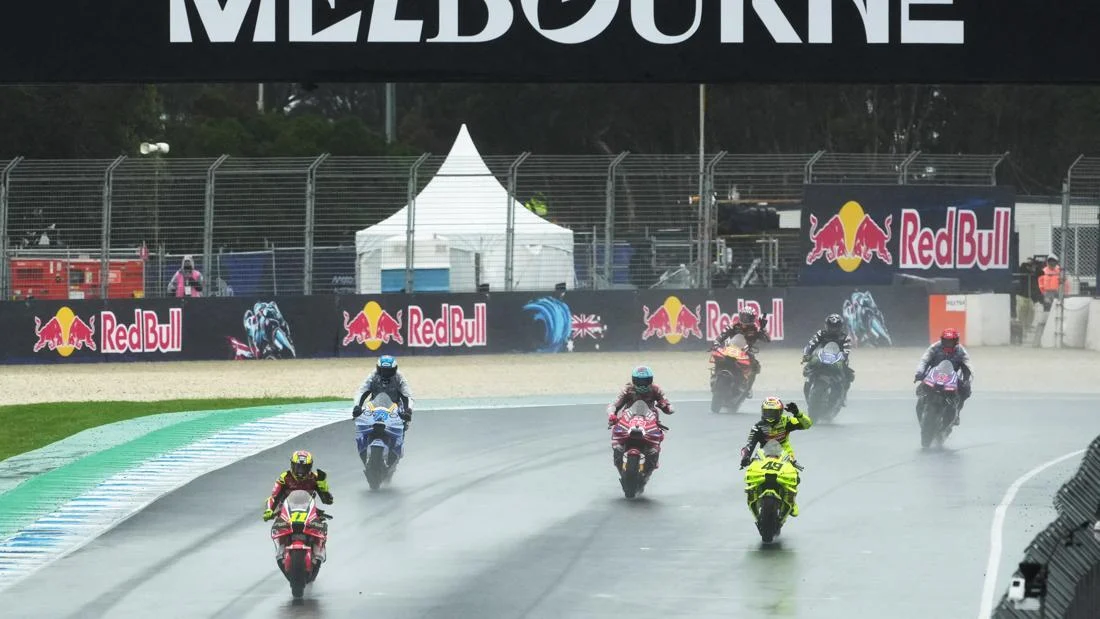
The 2026 MotoGP Australian Grand Prix at the historic Phillip Island Circuit was officially cancelled following severe weather conditions that rendered medical helicopters entirely non-operational. The unexpected heavy fog and poor visibility rolling in from Melbourne disrupted the rigorous safety protocols mandated by the Fédération Internationale de Motocyclisme (FIM), forcing race direction to pull the plug on the main Grand Prix event. Davide Tardozzi, the seasoned team manager of the factory Ducati Lenovo Team, stepped forward to fully endorse the decision, emphasizing that human life and rider safety must always supersede the championship ambitions of any team or manufacturer.
The cancellation marks a deeply bittersweet chapter for the Phillip Island Grand Prix Circuit, a venue that has captured the hearts of motorsport enthusiasts for decades. Under the current schedule, the 2026 season was slated to be the final time the premier class of motorcycle Grand Prix racing graced the sweeping coastal corners of Victoria before the Australian round officially relocates to a brand-new circuit in Adelaide starting in the 2027 season. Instead of a triumphant farewell celebration filled with high-speed duels and roaring crowds, the iconic track bid a subdued adieu, overshadowed by the unpredictable forces of nature.
Chronology of Events and the Escalating Weather Crisis
The sequence of events leading up to the unprecedented cancellation began in the early morning hours of race day. While initial meteorological forecasts suggested acceptable racing conditions with intermittent cloud cover, an unforeseen weather anomaly developed rapidly over the region. A dense, persistent bank of fog, rolling inland from Melbourne toward the Bass Strait coastline, enveloped the Phillip Island circuit and surrounding areas.
As race officials monitored the situation, it became glaringly apparent that the visibility levels had fallen well below the strict safety thresholds required for aviation. Under FIM regulations, a Grand Prix event cannot commence or continue unless air ambulance services are fully functional. This ensures that in the catastrophic event of a high-speed crash, an injured rider can be airlifted rapidly to a major trauma center. Because the medical helicopters were completely grounded at their departure points and unable to navigate the thick fog to reach the circuit, race control was left with no regulatory alternative. Delayed start attempts proved futile as the weather system refused to clear within the allocated scheduling window, leading to the ultimate announcement of cancellation.
The Uncompromising Stance of Ducati’s Davide Tardozzi
Speaking to the media in the paddock, Ducati Team Manager Davide Tardozzi cut a pragmatic and resolute figure. Despite the championship implications and the potential points left on the table for Ducati contenders, Tardozzi made it unequivocally clear that the team fully supported the governing body’s decision.
"Keselamatan pebalap adalah yang utama, itu selalu menjadi syarat pertama," Tardozzi stated, translating his unwavering philosophy to the international press. "It is true that today, logically speaking, we might have lost an opportunity to add to our points tally, but for Ducati, the safety of the rider is the absolute most important thing."
Tardozzi elaborated that the debate surrounding the cancellation should not be framed as a matter of personal opinion or team politics. The absence of operational medical aviation introduced an unacceptable level of risk that no professional sporting organization could ethically justify.
"This is not a matter of agreeing or disagreeing," Tardozzi continued. "The decision was made because the helicopter could not arrive. If a serious accident occurs, it is impossible to evacuate the rider safely. Therefore, we cannot talk about opinions: if safety conditions are not met, we must adapt to the decision that has been made."
Echoes of the Past: The Carl Fogarty Tragedy at Phillip Island
To understand the profound gravity with which Tardozzi approaches rider safety, one must examine the dark history shared between the veteran Italian manager and the Phillip Island Circuit. During his extensive career in motorsport management, Tardozzi has witnessed firsthand how a split-second tragedy on an unforgiving track can alter the trajectory of human lives forever.
Tardozzi invoked the haunting memory of Carl Fogarty, the legendary British motorcycle racer who achieved immortal status in the World Superbike Championship (WorldSBK). Fogarty, affectionately known as "King Carl," dominated the championship during the 1990s, securing four World Superbike titles in 1994, 1995, 1998, and 1999 while riding for Ducati. His fierce competitive spirit and charismatic persona made him a global icon of motorcycle racing.
However, the year 2000 brought a sudden and brutal end to Fogarty’s illustrious career. During a WorldSBK race weekend at Phillip Island, Fogarty suffered a devastating high-speed crash between the circuit’s notoriously fast Turn 3 and Turn 4 sections. The accident resulted in severe, career-ending trauma to his shoulder, forcing the reigning champion into an abrupt and permanent retirement from professional racing.
The psychological scar left by the Fogarty incident remains deeply embedded in Tardozzi’s leadership style. He noted that the harrowing memory of losing one of his greatest riders to the unforgiving tarmac of Phillip Island dictates his zero-tolerance attitude toward compromised safety measures.
"I have already said this to the riders: here at this track, I have already lost a rider, because Fogarty’s career ended right between turns 3 and 4 after that crash," Tardozzi reflected somberly. "At Phillip Island, I have already experienced a serious incident, and I never want to see that happen again to any of our riders or to any rider in the paddock."
Anomalous Weather and Logistical Realities
Delving deeper into the mechanics of the cancellation, Tardozzi offered a balanced perspective on how standard meteorological forecasting failed to capture the localized microclimate that crippled race day operations. Modern motorsport is heavily reliant on advanced weather modeling, radar tracking, and real-time atmospheric data. Yet, nature occasionally presents variables that outsmart even the most sophisticated technology.
According to Tardozzi, the overarching weather conditions at the track itself were not inherently unsuitable for motorcycle racing. Had the logistical lifeline of the medical helicopter not been compromised, the race could have proceeded under normal protocols. The catastrophic variable was the dense fog originating specifically from the greater Melbourne metropolitan area, which blocked the flight path of the emergency aircraft long before it could approach the coastal circuit.
"It was a hypothesis that had been considered," Tardozzi explained regarding the meteorological assessments. "Obviously, the authorities responsible for making the decision assessed that the conditions and forecasts were not overly poor, because they genuinely weren’t. The possibility of fog rolling in from Melbourne was simply not factored in, which prevented the helicopter from arriving. This was a situation that went well beyond normal weather forecasting. In my view, if the helicopter had been present, the track conditions would have truly allowed us to race."
Broader Implications for MotoGP and the Phillip Island Legacy
The cancellation of the 2026 Australian Grand Prix sends ripples across the entire MotoGP ecosystem, impacting championship standings, commercial stakeholders, and the rich legacy of the Phillip Island venue.
From a sporting perspective, the sudden elimination of a full-points Grand Prix forces teams and riders to recalculate their strategies for the remainder of the championship calendar. In a fiercely competitive era where every single point dictates the championship trophy, losing an entire round alters the mathematical probabilities for title contenders. However, the unanimous backing of race direction by major manufacturers like Ducati underscores a unified paddock culture that prioritizes athlete welfare above corporate or sporting gains.
Economically and culturally, the premature conclusion to MotoGP’s tenure at Phillip Island is a bittersweet pill for Australian motorsport fans. Since its inclusion in the premier class calendar, Phillip Island has earned a reputation among riders and fans alike as one of the most breathtaking, challenging, and picturesque tracks in the world. Its sweeping layout, coupled with the unpredictable coastal winds and dramatic ocean backdrops, has produced some of the most memorable duels in Grand Prix history.
As the series prepares to transition its Australian home to Adelaide in 2027, the 2026 cancellation leaves an unwritten final chapter on the Phillip Island asphalt. Rather than a checkered flag under sunny skies, the circuit’s penultimate chapter—and its ultimate farewell as a MotoGP host—will be remembered as a weekend where the elements triumphed, and the racing community chose preservation over peril.
Ultimately, the events at Phillip Island serve as a stark reminder of the inherent dangers of motorcycle racing. While modern engineering, protective gear, and medical advancements have exponentially increased safety standards over the decades, the fundamental law of motorsport remains unaltered: when the forces of nature compromise the safety net, wisdom must prevail over speed. Davide Tardozzi and the MotoGP paddock ensured that on this foggy Australian afternoon, the most important victory was the safe return of every rider to the pit lane.