 Tyo Susilo
NVIDIA Corporation has officially rolled out a massive performance and optimization update for its flagship Deep Learning Super Sampling 5 (DLSS 5) technology, addressing long-standing concerns regarding the heavy hardware footprints associated with real-time neural rendering. When NVIDIA initially unveiled DLSS 5, the industry responded with cautious optimism paired with valid skepticism. While the technology delivered unprecedented levels of visual fidelity, bringing computer-generated graphics closer to photorealism than ever before, it came with a staggering cost: immense VRAM consumption and high computational overhead that severely stressed even high-end graphics cards during intense gaming sessions.
In a decisive move to mitigate these hardware bottlenecks, NVIDIA’s latest October 2026 update directly targets the underlying architecture of DLSS 5. By simultaneously accelerating processing pipelines and drastically shrinking the memory footprint, the semiconductor giant aims to make advanced neural rendering accessible, efficient, and practical for a broader range of gamers. This update represents a watershed moment for AI-driven graphics acceleration, proving that visual realism no longer needs to come at the absolute expense of hardware efficiency or frame stability.
The Architectural Evolution of DLSS 5: Shrinking Models and Speeding Up Pipelines
At the heart of the October 2026 update is a sweeping overhaul of the 3D-Guided Neural Rendering model utilized by DLSS 5. According to technical documentation released by NVIDIA, the revamped model now operates at speeds twice as fast as the previous iteration deployed in September. This dramatic acceleration was achieved through sophisticated pipeline optimizations and a leaner, more efficient neural network design.
Most notably, the physical size of the AI model has been reduced by approximately 24%, bringing its parameter count down to roughly 118 million. In the realm of deep learning and computer graphics, trimming parameters without sacrificing output quality is a monumental engineering feat. By streamlining the network, NVIDIA has successfully driven down VRAM consumption at ultra-high 4K resolutions by up to 20%.
The combined effect of these architectural refinements is staggering. The overall processing burden placed on the GPU has been cut in half compared to previous versions of the software. Because DLSS 5 heavily relies on artificial intelligence to dynamically construct lighting, shadows, and material interactions in real-time, the computational overhead was traditionally a massive drain on resources. A smaller, faster model significantly reduces this computational tax, leaving vital VRAM headroom open for high-resolution textures, complex geometry, and other memory-intensive game assets.

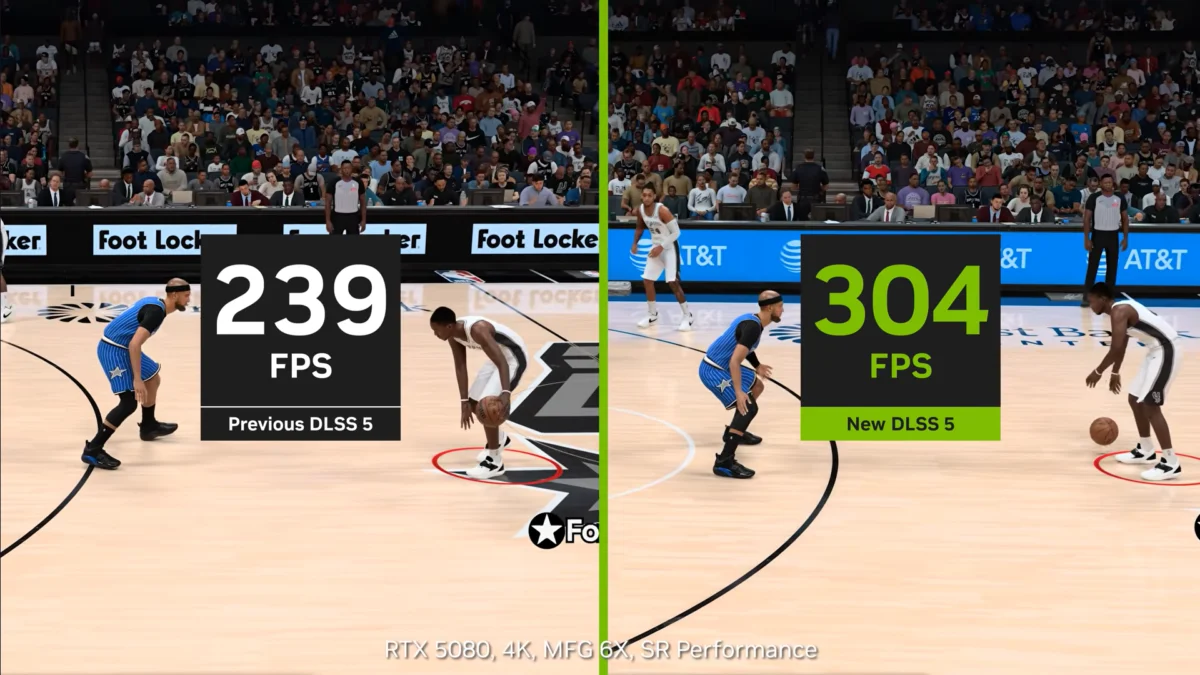
Furthermore, NVIDIA’s internal benchmarking indicates that these optimizations can unlock performance gains translating to up to a 1.4x increase in frame rates under specific, optimized conditions. However, the company remains transparent, noting that real-world results will naturally fluctuate based on the specific title being played, the underlying GPU architecture, and the user’s custom graphical settings.
Rollout Timeline and Early Implementation: NBA 2K27 Leading the Charge
The deployment of this highly anticipated update follows a carefully structured timeline designed to ensure stability and seamless integration for developers and players alike. NVIDIA has confirmed that the updated DLSS 5 neural model will officially launch on October 16, 2026.
The vanguard title for this technological milestone is 2K Games’ sports simulation blockbuster, NBA 2K27. To demonstrate the tangible benefits of the patch, NVIDIA released an extensive side-by-side comparison video showcasing how the game maintains immaculate visual fidelity while running with significantly reduced VRAM overhead and drastically improved frame pacing.
Following the rollout in NBA 2K27, the optimization pipeline will not rest. NVIDIA has confirmed that engineering teams are actively working on integrating the updated DLSS 5 framework into other major upcoming releases over the next several weeks. Among the confirmed titles are Avalanche Software’s critically acclaimed Hogwarts Legacy ecosystem and NetEase Games’ ambitious open-world title, Where Winds Meet. This rapid deployment schedule underscores NVIDIA’s commitment to ensuring that current-generation games can leverage neural rendering without forcing players into hardware upgrades.
Expanding Efficiency: The Introduction of Preset C for Frame Generation
While the enhancements to DLSS 5’s Neural Rendering model represent the flagship feature of the October update, NVIDIA has also introduced a vital expansion to its Frame Generation technology. Designated as a new performance mode called "Preset C," this update fundamentally alters how the software handles auxiliary visual elements.
Previously, computing optical flow across complex UI elements, heads-up displays (HUDs), and intricate ray-traced reflections demanded dedicated AI calculations that added to the system’s overall latency and resource consumption. Preset C replaces the legacy optical flow AI model with a streamlined, lightweight algorithm specifically engineered to handle these elements efficiently.

The implementation of Preset C yields immediate dividends. NVIDIA reports a massive 35% boost in processing speed on mid-range hardware such as the GeForce RTX 5060. Crucially, this new preset is engineered to seamlessly support the entire ecosystem of frame generation technologies, including standard Frame Generation, Multi Frame Generation, and Dynamic Multi Frame Generation.
By rolling out Preset C across both the GeForce RTX 40 and RTX 50 Series of graphics cards, NVIDIA has ensured that the benefits of this performance update extend far beyond the high-end enthusiasts using the absolute newest hardware. This broad compatibility strategy guarantees that a massive installed base of gamers will experience immediate improvements in fluidity and responsiveness.
Broader Industry Implications and Market Analysis
The release of NVIDIA’s October 2026 update arrives at a critical juncture for the PC gaming hardware market. As developers increasingly rely on software-based solutions like upscaling and neural rendering to achieve photorealistic graphics—often at the expense of native rendering optimization—hardware requirements have skyrocketed. For years, consumers have voiced growing frustration over escalating VRAM demands, with many feeling pressured to upgrade their GPUs prematurely simply to accommodate newer rendering techniques.
By directly addressing these concerns through algorithmic efficiency rather than brute-force hardware power, NVIDIA is signaling a shift in its software engineering philosophy. Reducing the VRAM footprint by 20% and shrinking model parameters by nearly a quarter demonstrates that AI models can be pruned and refined to coexist harmoniously with existing hardware constraints.
For consumers, the implications are profoundly positive. Gamers running mid-tier systems equipped with RTX 40-series or newer RTX 50-series cards can now harness advanced rendering and frame-generation technologies without constantly monitoring memory usage limits or experiencing stuttering caused by VRAM saturation. For developers, the optimized pipeline provides greater creative freedom, allowing them to push the boundaries of in-game lighting and geometry knowing that NVIDIA’s middleware can efficiently handle the heavy lifting.
As the industry moves toward an increasingly AI-centric future in game development, the success of updates like DLSS 5’s October patch will serve as a benchmark. It proves that technological advancement does not inherently require inflated hardware requirements, setting a new standard for efficiency and performance in modern PC gaming.