Tyo Susilo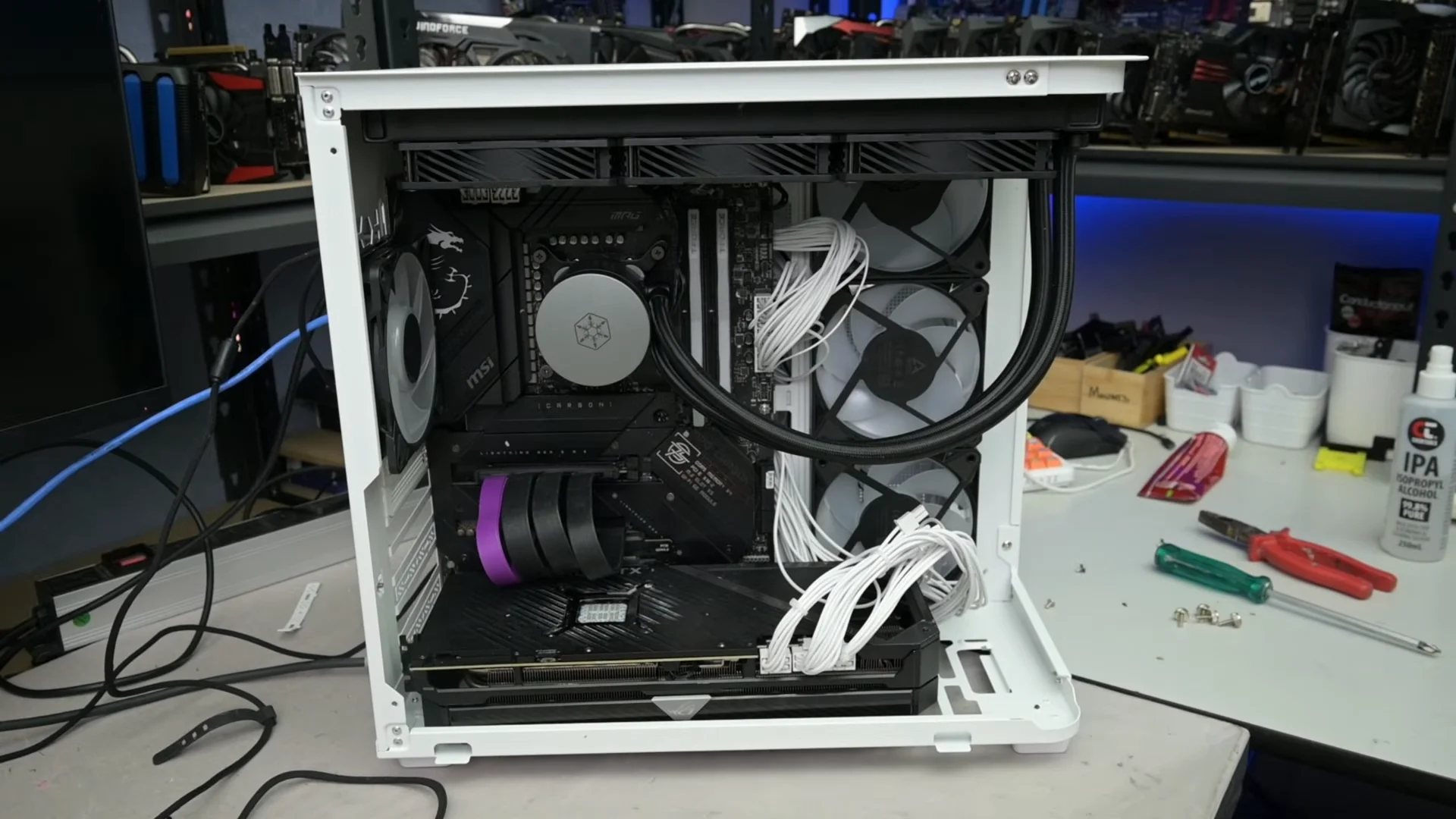
Thermal management remains one of the most critical challenges in modern PC building, especially as hardware power consumption continues to rise significantly. Recently, a hardware modification enthusiast known online as TrashBench conducted an unorthodox thermal experiment that challenges conventional PC building wisdom. By mounting a graphics processing unit (GPU) in an unconventional location utilizing PCIe riser cables, the modder managed to slash the GPU hotspot temperature by an impressive 19 degrees Celsius. While the initial results seemed like a revolutionary breakthrough for passive thermal optimization, the experiment quickly revealed a complex domino effect on overall system cooling, highlighting the delicate balance of internal chassis airflow dynamics.
The Genesis of the Experiment: Rethinking PCIe Layouts
Standard PC assembly guidelines dictate that a dedicated graphics card, or VGA card, should be slotted directly into the primary PCIe x16 slot affixed horizontally to the motherboard. This established layout has dominated desktop computing for decades, optimized for structural integrity, signal integrity, and predictable airflow paths. However, modern graphics cards such as the NVIDIA GeForce RTX 3080 utilized in TrashBench’s experiment produce substantial amounts of thermal energy under load. These high-end GPUs frequently push thermal thresholds, requiring massive heatsinks, complex vapor chambers, and triple-fan arrays to maintain safe operating parameters.
Seeking to bypass the physical constraints of traditional horizontal mounting—which often traps heat between the graphics card shroud and the bottom of the chassis or other motherboard components—TrashBench explored alternative positioning. By leveraging flexible PCIe extension cables, the modder separated the GPU from its native motherboard slot, relocating the hardware into unconventional zones within the PC case.
Chronology of the Thermal Tests
The experimental phase began with the relocation of the NVIDIA GeForce RTX 3080 to the bottom section of the chassis, directly adjacent to the side intake fans. In this non-standard orientation, the graphics card was positioned to receive a direct, unobstructed stream of cool ambient air drawn straight from the exterior of the case.

When put under stress tests, the initial results were striking. The GPU hotspot temperature plummeted by a remarkable 19 degrees Celsius compared to the baseline horizontal configuration. For hardware enthusiasts, a delta of nearly 20 degrees Celsius without upgrading to liquid cooling blocks, changing thermal paste, or modifying fan curves represents a monumental thermal gain. It appeared to offer a simple yet highly effective structural remedy for heat-soaked systems.
However, advanced PC cooling is rarely a closed-loop system operating in isolation. Upon analyzing the broader system metrics, TrashBench uncovered a significant drawback: while the GPU experienced a dramatic cooling effect, the CPU temperature spiked noticeably. The repositioned graphics card had effectively disrupted the established thermal plumes and intake-exhaust pathways inside the chassis. By blocking specific airflow vectors and altering internal pressure zones, the misplaced GPU diverted crucial cooling air away from the processor, creating a localized heat trap around the CPU socket.
Iterative Optimization and Achieving Thermal Balance
Recognizing that optimizing one component at the expense of another fails to deliver a viable long-term solution, TrashBench initiated a second phase of experimentation. The objective shifted toward finding a harmonious layout that could capitalize on improved GPU airflow without starving the processor of necessary thermal dissipation.
Through rigorous trial and error, the modder arrived at a revised configuration. In this final setup, the CPU was repositioned vertically closer to the side intake fans, while a 360mm All-in-One (AIO) liquid cooling radiator remained mounted in its conventional orientation. This meticulous spatial rearrangement successfully resolved the airflow bottlenecks.
The final performance data validated the iterative approach: the GPU hotspot temperature still registered a significant reduction of 14 degrees Celsius, while the CPU temperature dropped by approximately 3.3 degrees Celsius relative to the original factory configuration. This refined setup proved that spatial reconfiguration could indeed yield net-positive thermal improvements across multiple core components, provided the internal aerodynamics were carefully managed.
Broader Implications for PC Case Design and Hardware Modders

TrashBench’s experiment offers valuable insights for the broader enthusiast community, thermal engineers, and PC case manufacturers. Modern graphics cards have grown exponentially in physical dimensions, often spanning three or four expansion slots and measuring over 30 centimeters in length. These massive components act as physical walls inside mid-tower and even full-tower chassis, fundamentally altering how air moves from intake to exhaust.
Traditional ATX layouts, while standardized, may no longer be universally optimal for ultra-high-end components that generate extreme localized heat loads. The experiment demonstrates that rethinking component placement via riser cables can unlock untapped thermal headroom. However, it also underscores the reality that PC cases function as holistic ecosystems. Any alteration to internal geometry directly impacts static pressure, turbulence, and thermal transfer efficiency across neighboring hardware.
Expert Analysis and Practical Recommendations
Industry analysts and thermal engineers note that while experiments like TrashBench’s highlight the flexibility of custom builds, replicating these results in a consumer setting requires careful consideration. The success of unconventional mounting heavily depends on specific variables, including the chassis’s volumetric capacity, fan static pressure ratings, ambient room temperature, and the specific thermal design power (TDP) of the hardware involved.
Furthermore, utilizing low-quality or excessively long PCIe riser cables can introduce signal degradation, potentially forcing the PCIe lane to down-throttle from Gen 4 or Gen 5 speeds to older standards, thereby impacting system performance despite cooler temperatures. Modders attempting similar spatial reconfigurations must balance thermal gains against potential drops in data transfer bandwidth and structural stability.
Ultimately, TrashBench’s unorthodox setup serves as both an intriguing technical showcase and a cautionary tale. While repositioning a GPU can yield dramatic temperature drops, builders are advised to conduct thorough thermal and performance benchmarking rather than hastily dismantling their systems based on isolated experimental results. As hardware continues to demand more power and produce more heat, innovative layout experiments will undoubtedly continue to shape the future of custom PC building.