Nila Kartika Wati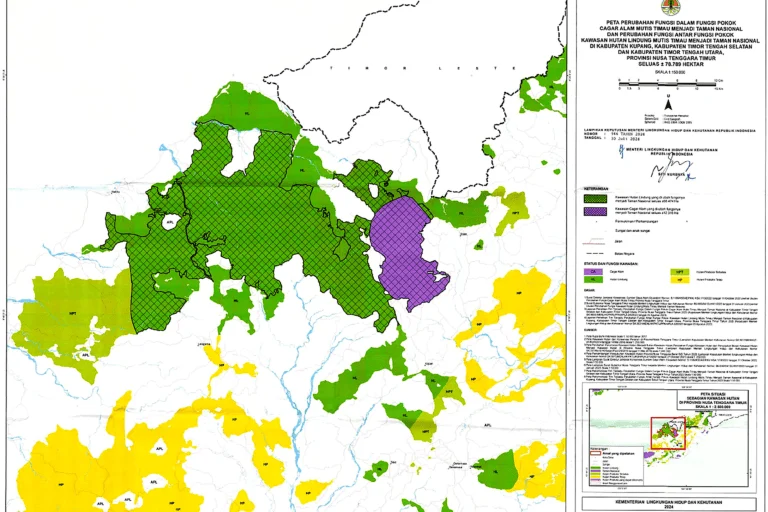
Under the scorching sun, Krisensia Naben carefully treads the narrow paths between rice paddies flanking the Noel Besi River in Timor Tengah Utara, Nusa Tenggara Timur. Beside her, her husband, Remigius, works the damp, nutrient-rich soil, planting rice seeds one by one. Their 15-are plot of land serves as the lifeline for a family deeply tethered to the majestic Mount Mutis. For generations, the mountain has been more than a geographical landmark; it has been the cradle of their culture, a source of water, and the guarantor of their food security. However, the 2024 transition of the Mount Mutis-Timau area from a strict Nature Reserve to a National Park has cast a shadow of uncertainty over the future of the Atoni Pah Meto people who call these slopes home.
The reality of climate change and environmental instability is not abstract for Krisensia. She vividly remembers the devastation wrought by Tropical Cyclone Seroja in 2020. The ensuing floods and landslides buried six ares of their original 21-are farm, leaving them with only a fraction of their former productive land. Today, the family manages a delicate cycle of subsistence farming, cultivating long beans, onions, tomatoes, carrots, and bok choy alongside their annual rice crop. The yields are modest, often netting only Rp1–2 million per harvest, and the rice is reserved almost exclusively for home consumption. For families like hers, the water flowing from the forested heights of Mount Mutis is the only reason they can continue to cultivate the land. Without the forest’s sponge-like ability to store and release water, their agricultural existence would cease to be viable.
The Sacred Geography of the Atoni Pah Meto
For the Atoni Pah Meto people, the landscape is defined by a sophisticated system of traditional knowledge. They practice a belief system that categorizes the environment into three distinct, living entities: oe kanaf (named water), hau kanaf (named wood), and fatu kanaf (named stone). These are not merely resources; they are ancestral legacies that demand stewardship.

Lukas Tefa, the head of the Noepesu Traditional Council, emphasizes that the forest is a divine mandate. "Mount Mutis is a legacy from Uis Neno (The Creator) and our ancestors that we must guard," Tefa stated. According to local lore, the forest and its water sources have sustained not just the people of Timor, but have nourished communities across the border in Timor Leste. There is a deep-seated fear that if "outsiders" with exploitative intentions enter the forest, the spiritual balance will be disrupted, leading to ecological retribution and the destruction of the community’s way of life.
Chronology of a Conservation Shift
The legal status of the Mount Mutis-Timau region has undergone significant transformation over the decades, culminating in a decision by the Ministry of Environment and Forestry (KLHK) on September 8, 2024. The area was officially declared the 56th National Park in Indonesia, covering a massive 78,789 hectares across three regencies: Kupang (52,199 hectares), Timor Tengah Selatan (22,313 hectares), and Timor Tengah Utara (4,277 hectares).
This declaration is not merely a change in nomenclature. It brings with it a complex system of zoning regulations that directly overlaps with the ancestral territories of villages including Kuannoel, Fatumnasi, Nenas, Nuapin, Tutem, Tune, Bonleu, Noepesu, Fatuneno, and Tasinifu. Historically, these areas were managed as Nature Reserves, which theoretically prohibited human activity. However, the de facto management by local communities—including grazing, water usage, and ritual practices—continued uninterrupted for generations.
The transition to a National Park, while intended to provide a more holistic landscape management approach, has triggered alarm among residents. They question whether the government’s new zoning maps align with the historical, traditional zoning that the Atoni Pah Meto have practiced for centuries.

The Conflict Between State Policy and Customary Rights
The core of the tension lies in the clash between "fortress conservation"—an approach that prioritizes state-led territorial control—and the rights of indigenous communities. Agung Wibowo, Executive Coordinator of the HuMa Association, argues that the change in status poses significant risks if the state fails to recognize existing customary rights.
"When the state designates or changes the status of a forest into a conservation area, it must not ignore the existence of ancestral rights, customary territory, and the management systems of indigenous peoples that have existed long before," Wibowo asserted. He highlights that many conservation areas in Indonesia are, in fact, vibrant, managed landscapes where local communities have acted as the primary guardians of biodiversity.
There is a growing concern that the implementation of a National Park management model will prioritize tourism and commercial interests, potentially leading to the marginalization of local farmers. The requirement for Free, Prior and Informed Consent (FPIC) is frequently cited by advocates as a missing link in this transition. Participation, they argue, cannot be limited to formal "consultations" after decisions have already been made; it must be an ongoing process where the community holds the power to influence the management of their own ancestral lands.
Official Stance: A Promise of Collaboration
In response to the growing anxiety, Adhi Nurul Hadi, Head of the Natural Resources Conservation Agency (BKSDA) of East Nusa Tenggara, has sought to reassure the public. He argues that the status change is not intended to displace people but to provide a legal framework for activities that were previously technically illegal under the strict Cagar Alam (Nature Reserve) regulations.

"As long as the activities align with natural resource conservation and the sustainability of ecological, social, and economic functions, we will not reduce the community’s access," Hadi stated. He noted that the region serves a critical hydrological role for the island of Timor, particularly for the Benanain-Noelmina watershed, and is a vital habitat for endangered species such as the Timor deer, the Timor monitor lizard, and the Mutis finch.
According to the BKSDA, the National Park status allows for a "zoning" approach that can accommodate sustainable human activity, such as the harvesting of non-timber forest products like wild honey or moss. The government plans to involve the community in patrols and biodiversity monitoring, framing the new status as an opportunity to legitimize traditional practices that were previously in a legal "gray area."
Broader Implications and Future Outlook
The case of Mount Mutis-Timau is a microcosm of a larger national struggle in Indonesia. As the government aggressively pursues its goal of expanding conservation areas to meet international climate commitments, it often finds itself on a collision course with indigenous populations.
The legal precedent set by the Constitutional Court Ruling No. 35/PUU-X/2012, which declared that customary forests are no longer categorized as state forests, serves as a beacon for these communities. Yet, the gap between legal recognition and local implementation remains wide. If the management of the new National Park continues to rely on top-down directives, it risks alienating the very people who have the greatest stake in the forest’s survival.

For Maria Magdalena Nale, a resident of Noepesu, the scientific terminology of "conservation" and "zoning" means little compared to the daily reality of survival. "If food is scarce here, we go to the Mutis forest. We pray and ask the ancestors politely to take what we need. We rarely buy food from outside. The forest loves us, and it gives us food," she said.
As the government moves forward with its 2024 management plan, the success of the Mount Mutis-Timau National Park will not be measured solely by the number of hectares protected or the number of species saved. It will be measured by its ability to integrate the Atoni Pah Meto people into the management structure as subjects—not objects—of conservation. The history of the region suggests that the forest has remained intact precisely because of the community’s traditional wisdom; ignoring that wisdom now, in favor of centralized control, may be the greatest threat to the ecosystem the government aims to preserve.
The coming years will be a test of whether the Indonesian state can evolve its conservation model to move beyond the legacy of exclusionary practices. For the people of Noepesu, the hope is that the National Park will become a bridge for collaboration rather than a barrier to their survival. Whether the state chooses to listen to the voices of the Atoni Pah Meto or proceeds with a technocratic implementation will determine the fate of one of Timor’s most vital natural assets.