Nila Kartika Wati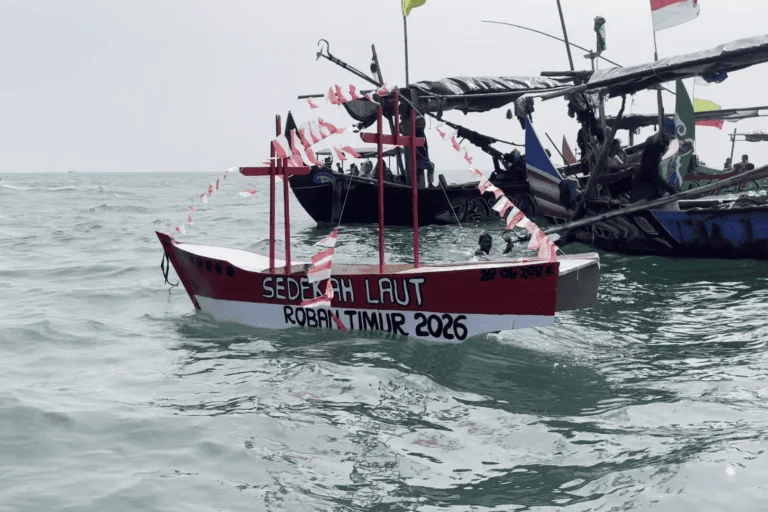
The scorching midday sun did not deter the residents of Roban Timur Village in the Batang Regency of Central Java from gathering on the coast on Sunday, June 28, 2026. Seated in a wide circle, the community surrounded a spread of traditional food, their eyes fixed on the offerings that would soon be the center of a spirited communal scramble. A middle-aged man led the congregation in a solemn prayer, his voice carrying over the sound of the crashing waves. Hands were raised in supplication as the villagers offered thanks to the Almighty for the bounty of the sea—the primary source of life and livelihood for this coastal enclave.
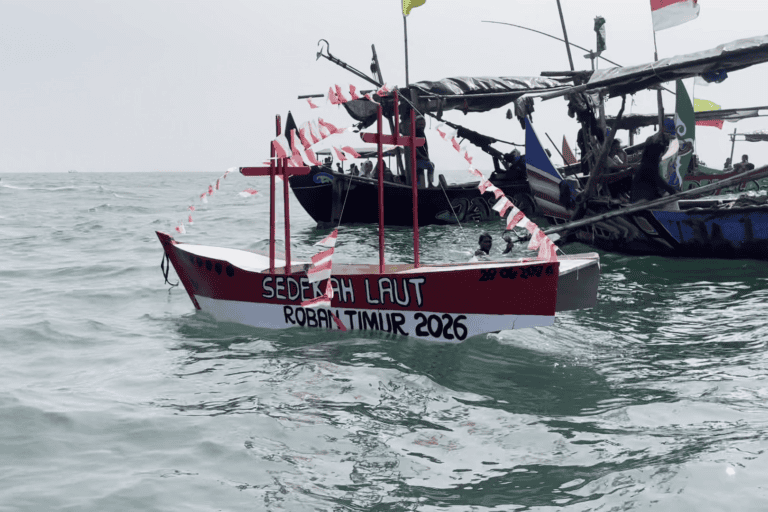
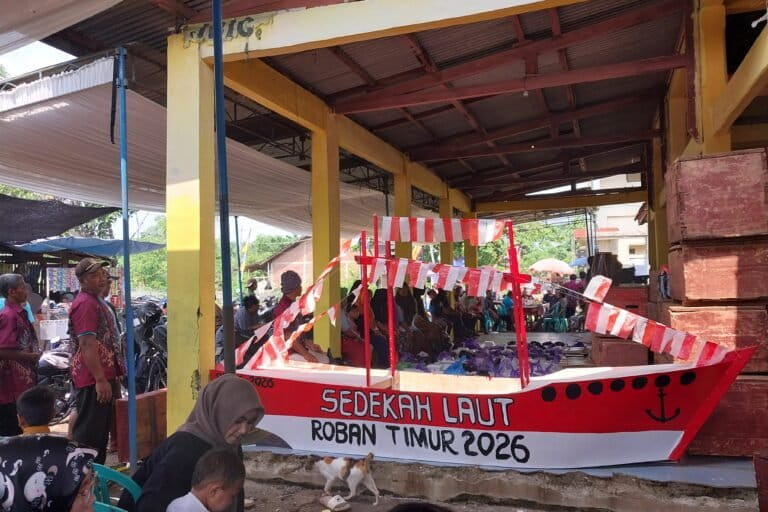
As the final "Amen" was whispered, the atmosphere shifted from quiet reverence to energetic celebration. Villagers surged forward to partake in the food, which is locally believed to carry divine blessings. Simultaneously, a small replica of a ship, painted in the national colors of red and white and laden with various sea products, was carried toward the water. This vessel, a symbolic gift back to the ocean, was placed onto a larger fishing boat to be escorted into the deep. This ritual, known as Sedekah Laut or "Sea Alms," is a cornerstone of Batang’s cultural identity, yet this year, the prayers for prosperity were underscored by a palpable sense of anxiety regarding the rapidly changing environment.
The Ritual and the Reality of the Sea
The procession of boats moved in a rhythmic line, heading out to the open sea to release the offerings. For the fishermen of Roban Timur, this is more than just a colorful ceremony; it is a plea for safety and survival. Hariyono, a local fisherman who has spent decades navigating these waters, expressed the collective hope of his peers. He noted that the primary wish is for a livelihood free from interference—whether from the massive coal barges that now frequent the area or from the increasingly unpredictable natural conditions. "We hope that we, as fishermen, can make a living at sea without any disturbances," Hariyono said. "We must continue to guard the sea and the coast here in Roban Timur."
Vina, a female fisherman whose life has been directly impacted by the nearby Batang Coal-Fired Power Plant (PLTU), shared similar sentiments. For women in the fishing industry, the stakes are equally high. "I hope the sea continues to provide a living for us coastal residents," she remarked. "We pray for abundant fish and a better life for our families." However, the optimism of the ritual is increasingly tempered by the reality of a degrading ecosystem. Tono, another resident, recalled a time when the sea was more generous. "We remain grateful and continue the Sedekah Laut, even though the sea is not like it was when I was a child. Back then, fish were abundant near the shore. Now, we have to go much further out to catch anything," he explained.
A Historical Anchor in a Changing World
The tradition of Sedekah Laut is deeply rooted in the history of the Javanese northern coast (Pantura). According to Silvero Raden Lilik Aji Sampurno, a historian from Sanata Dharma University in Yogyakarta, the formalization of this tradition can be traced back to the Dutch colonial era. Historical records indicate that in 1875, the third Regent of Cilacap, Raden Tumenggung Tjakrawerdaya III, ordered the first officially recorded "larung sesaji" (offering float) to be held on a Friday Kliwon during the month of Suro, the first month of the Javanese calendar.
While the 1875 date marks its formal administrative recognition, Silvero believes the practice existed long before then as an indigenous animistic tradition that later harmonized with Islamic teachings as the religion spread across the archipelago. Today, the ritual is characterized by Islamic prayers but retains its ancient Javanese essence. "Tradition acts as a binding force for these communities," Silvero explained. "There is a deep-seated belief that if they do not perform these rituals, they may face misfortune. This spiritual connection ensures that they will continue to protect their environment to the best of their ability, even when they are forced to ‘battle’ against the interests of industrial development."
The Ecological Toll: Abrasion and Industrial Expansion
Despite the cultural resilience of the Roban Timur community, the physical landscape they call home is literally disappearing. Environmental activists and researchers have pointed to a worrying trend of coastal erosion and ecological damage in the Batang Regency. Zalya Tilaar, an activist with the Indonesian Forum for the Environment (Walhi) in Central Java, views the Sedekah Laut as a poignant reminder of the threats facing coastal residents. She argues that the provincial and regional governments have prioritized industrialization over ecological preservation and the rights of traditional fishermen.
"In the current politics of spatial planning, coastal areas are being steered toward becoming industrial zones," Tilaar stated. "As a result, the ecological function of the coast is ignored, and the living space for fishermen is increasingly marginalized." The northern coast of Batang is home to vital coral reef ecosystems that serve as nurseries for marine life. These ecosystems are now under siege from "dirty energy" projects, including the operational PLTU Batang and plans for a new gas-fired power plant (PLTGU).
The impact of these projects is not merely theoretical. According to a study on shoreline changes in Batang from 2017 to 2021, the region has experienced significant abrasion that far outweighs any natural land accretion. Using Digital Shoreline Analysis System (DSAS) methodology and Landsat 8 satellite imagery, researchers found that approximately 17.79 hectares of land were lost to the sea in that four-year window alone. Tilaar noted that since the PLTU began operations, the community has recorded an average abrasion rate of 2.2 meters per year due to changes in sea current dynamics caused by industrial infrastructure.
The Government’s Dilemma: Growth vs. Sustainability
The local government is not unaware of these challenges. M. Faiz Kurniawan, the Regent of Batang, has publicly acknowledged that coastal abrasion is a growing crisis, with some areas experiencing a retreat of the shoreline by up to four meters annually. He admitted that while industrialization has boosted the local economy, it has also created a complex spatial planning dilemma. "Every year, our land area decreases," he stated via the Batang Regency Government’s official communication channels, emphasizing the need for better sea-space management.
However, for organizations like Walhi, the government’s response has been insufficient. Tilaar argues that the protection of small-scale fishermen should be a primary national agenda, especially within the context of food security. "When the state talks about food sovereignty, the fishermen are the key actors who maintain the supply of protein from the sea," she said. "But what we see today is fishermen facing shrinking catch areas, damaged ecosystems, and a lack of legal protection. It is impossible to build national food security if the living spaces of those who provide the food are continuously sacrificed for industrial interests."
The Shrinking Horizon of Roban Timur
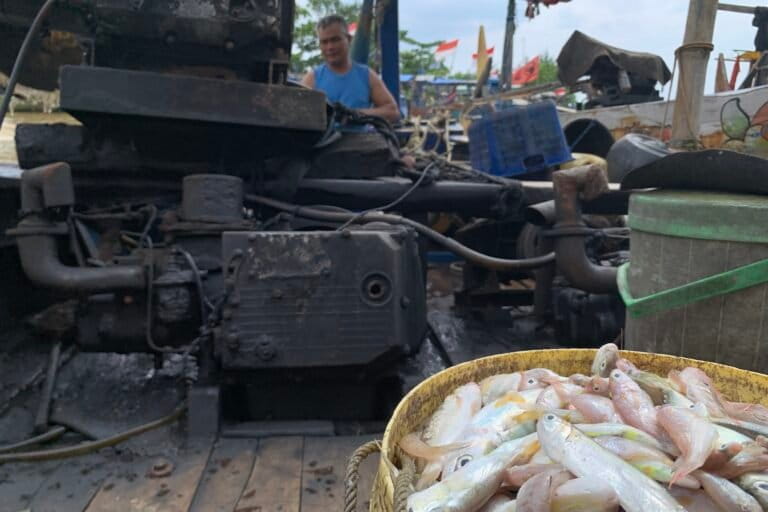
The visual evidence of this decline is stark. Photographs from the region show a noticeable decrease in the size of the catch brought in by Roban Timur fishermen. The narrowing of the fishing grounds is a direct consequence of the security perimeters established around the PLTU Batang and the destruction of coral reefs during construction and operation. These reefs once acted as a natural barrier against waves and a home for various fish species; without them, the coast is defenseless, and the sea is increasingly barren.
Abdul, a village elder in Roban Timur, summarized the community’s resolve. "This tradition existed before we were born. It is our way of saying thank you to God. We will continue to offer our prayers, hoping that the people of Roban Timur can remain prosperous even though the conditions have become very difficult."
As the Sedekah Laut of 2026 concluded, the replica ship disappeared into the horizon, carrying the hopes of a village that refuses to let its heritage sink beneath the waves. Yet, the question remains: how much longer can tradition sustain a community when the very land and sea they honor are being consumed by the relentless march of industrial progress? The battle for the soul of Batang’s coast is far from over, and the outcome will determine whether rituals like the Sedekah Laut remain a vibrant living practice or become a memorial to a lost way of life.