Azin Asro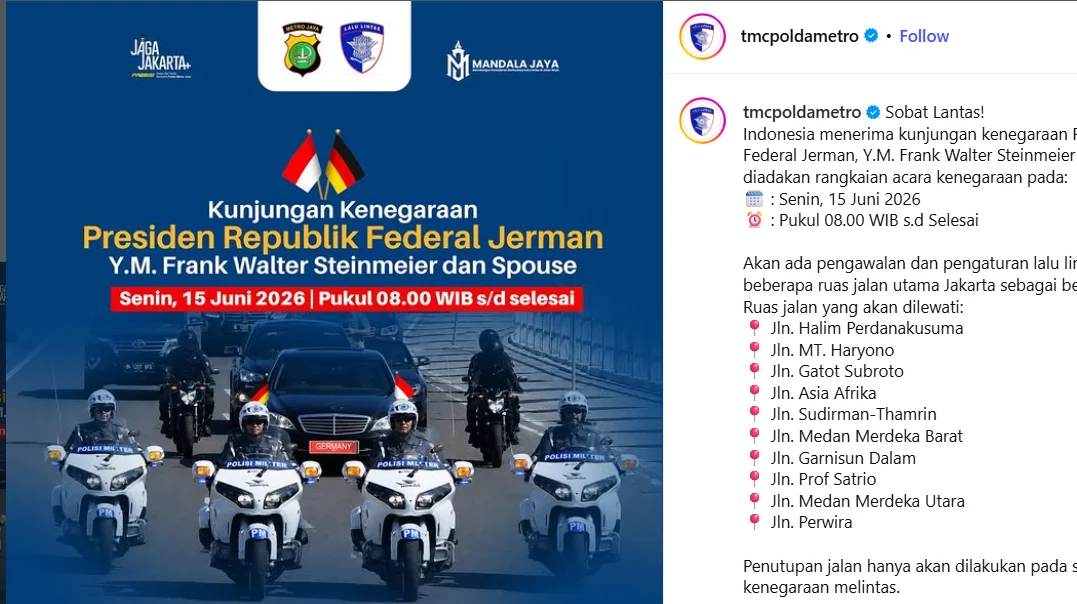
The Indonesian capital of Jakarta is preparing for a significant diplomatic event as German President Frank-Walter Steinmeier arrives for a high-profile state visit on Monday, June 15, 2026. This visit, which underscores the deepening ties between Southeast Asia’s largest economy and the European Union’s industrial powerhouse, has prompted the Jakarta Metropolitan Regional Police (Polda Metro Jaya) to implement extensive traffic management strategies across the city’s primary corridors. The visit is not merely ceremonial; it carries a heavy economic and strategic agenda, with President Steinmeier accompanied by a high-level business delegation representing the core sectors of Germany’s industrial and digital economy.
The Directorate of Traffic of Polda Metro Jaya has officially announced that ten major thoroughfares in Jakarta will be subject to temporary closures and diversions to facilitate the movement of the German presidential motorcade. These measures are designed to ensure the safety and punctuality of the state guests while minimizing the inevitable disruption to the city’s morning and evening commutes. According to official communications from the @tmcpoldametro social media channels, the security and escort operations are scheduled to commence at 08:00 WIB and will remain active until the conclusion of the day’s diplomatic activities.
Comprehensive List of Impacted Thoroughfares
The traffic engineering plan identifies ten critical arteries that serve as the backbone of Jakarta’s transportation network. These roads connect the eastern gateway of the city to the central administrative district and the southern business hubs. The affected routes are as follows:
- Jalan Halim Perdanakusuma: Serving as the primary access point for the Halim Perdanakusuma International Airport, where the German delegation is expected to land.
- Jalan MT Haryono: A major arterial road facilitating movement from East Jakarta toward the city center.
- Jalan Gatot Subroto: One of Jakarta’s busiest roads, traversing the city’s main business districts and providing access to several government ministries.
- Jalan Asia Afrika: Located in the Senayan area, this road is a key link for diplomatic and sporting venues.
- Jalan Sudirman-Thamrin: The "Golden Triangle" corridor, which represents the financial and commercial heart of the capital.
- Jalan Medan Merdeka Barat: A vital link leading directly to the Presidential Palace complex.
- Jalan Garnisun Dalam: A strategic connection point near the Semanggi interchange.
- Jalan Prof. Satrio: An essential east-west link connecting the Sudirman area to the Kuningan business district.
- Jalan Medan Merdeka Utara: The road directly fronting the Merdeka Palace, the site of the formal state reception.
- Jalan Perwira: A critical access road within the administrative "Ring 1" zone.
Director of Traffic for Polda Metro Jaya, Kombes Pol Komarudin, emphasized that these closures are not permanent throughout the day. Instead, the police will employ a "situational" approach, where traffic is halted only moments before and during the passage of the diplomatic convoy. "The closure will only be carried out when the state guest’s motorcade is passing through," Komarudin stated. This method is intended to balance the high-security requirements of a visiting head of state with the logistical needs of Jakarta’s millions of daily commuters.
Chronology of the State Visit
The schedule for President Steinmeier’s visit is tightly packed, reflecting the urgency of the bilateral discussions. The delegation is expected to arrive at Halim Perdanakusuma International Airport at approximately 08:00 WIB. Following a formal welcoming ceremony, the motorcade will proceed through the aforementioned routes toward the Merdeka Palace.
Between 10:00 WIB and 13:00 WIB, President Steinmeier is scheduled to hold a private Tête-à-tête with Indonesian President Prabowo Subianto, followed by a bilateral meeting involving senior cabinet ministers from both nations. The afternoon is reserved for a business forum where German industry leaders will engage with Indonesian counterparts and government officials. The German delegation is scheduled to depart from Jakarta at approximately 17:00 WIB, coinciding with the city’s evening rush hour, which has prompted additional warnings for commuters to seek alternative routes or adjust their travel times.
Strengthening the Economic Bridge: Key Sectors of Cooperation
The presence of a significant business delegation alongside President Steinmeier highlights the shift in Indonesia-Germany relations toward a more pragmatic, economy-focused partnership. Germany remains Indonesia’s largest trading partner within the European Union, and this visit aims to capitalize on Indonesia’s growing role in global supply chains.
Four primary sectors have been identified as the pillars of this visit’s agenda:
1. Logistics and Infrastructure
As Indonesia continues its massive infrastructure push under the administration of President Prabowo Subianto, German expertise in logistics technology and port management is highly sought after. Discussions are expected to focus on the modernization of Indonesian ports and the integration of smart logistics systems to reduce the "high-cost economy" that has historically hindered Indonesian competitiveness.
2. Labor Mobility and Vocational Training
Germany is currently facing a significant labor shortage in technical fields, while Indonesia possesses a vast "demographic bonus" of young workers. A key component of the talks will involve the "Fachkräfteeinwanderungsgesetz" (Skilled Immigration Act) and how Indonesia can provide skilled technicians, particularly in the healthcare and engineering sectors, to Germany. In exchange, Germany is expected to increase its investment in Indonesian vocational schools (SMK) to align local training with international industrial standards.
3. Digitalization and Industry 4.0
Germany’s "Industry 4.0" initiative serves as a blueprint for Indonesia’s own "Making Indonesia 4.0" roadmap. The delegation includes leaders from the digital and tech sectors who are looking to collaborate on cybersecurity, cloud computing, and the digital transformation of small and medium enterprises (SMEs). With Indonesia’s digital economy projected to reach unprecedented heights by 2030, German firms are keen to provide the foundational technology required for this growth.
4. Manufacturing and Green Energy
The manufacturing sector remains the bedrock of German-Indonesian trade. Beyond traditional automotive and machinery exports, there is a burgeoning interest in the "Green Economy." Germany has been a vocal supporter of Indonesia’s Just Energy Transition Partnership (JETP). The visit is expected to yield new agreements regarding the transfer of technology for renewable energy components, specifically in solar and wind power manufacturing within Indonesia.
Official Responses and Public Safety
Kombes Pol Komarudin has urged the public to exercise patience and cooperation during the temporary disruptions. "We ask the community to remain orderly and follow the directions of officers in the field for the sake of mutual smooth flow," he noted. Over 500 personnel from the Traffic Directorate, supported by the Indonesian National Armed Forces (TNI) and the Presidential Security Force (Paspampres), have been deployed to secure the routes.
Observers of Indonesian diplomacy note that this visit is a crucial touchstone for President Prabowo’s foreign policy, which seeks to maintain "active and independent" relations while aggressively pursuing foreign direct investment. The German embassy in Jakarta has expressed optimism that this visit will elevate the "Comprehensive Partnership" established between the two nations over a decade ago to a new level of strategic integration.
Analysis of Broader Implications
The timing of President Steinmeier’s visit is significant. As the global geopolitical landscape shifts, Germany is increasingly looking toward the ASEAN region to diversify its supply chains and reduce over-reliance on single-market dependencies. Indonesia, with its stable economic growth and strategic location along major maritime trade routes, presents an ideal partner.
From a domestic perspective, the successful management of such a high-profile visit serves as a litmus test for Jakarta’s ability to host international events. The use of sophisticated traffic engineering and the coordination between various security apparatuses demonstrate the city’s evolving urban management capabilities.
Furthermore, the focus on labor mobility marks a transition in how Indonesia views its workforce—not just as domestic labor, but as a global commodity capable of competing in the most advanced economies. If the agreements discussed during this visit reach fruition, it could provide a template for similar arrangements with other European nations.
As the sun sets on Monday and the German delegation departs, the impact of this visit will likely be felt far beyond the temporary traffic jams on Jalan Sudirman. The frameworks established for digitalization, green energy, and industrial cooperation are poised to define the next decade of Indonesia-Germany relations, positioning both nations to better navigate the complexities of the 21st-century global economy. Residents of Jakarta are advised to monitor real-time traffic applications and official police social media accounts for the latest updates on road conditions throughout the day.