Nila Kartika Wati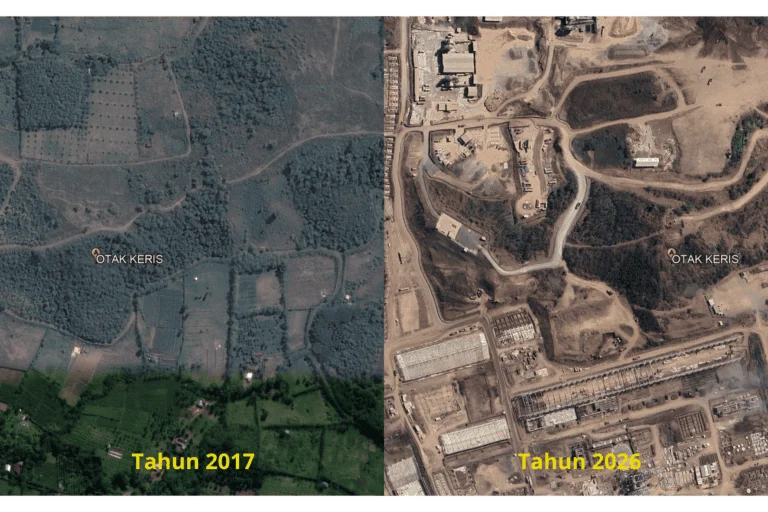
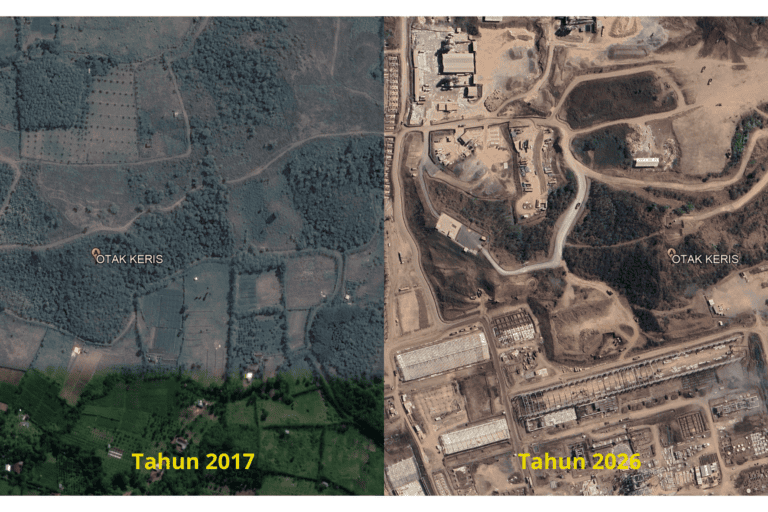
The roar of heavy machinery now serves as a constant backdrop to the evening call to prayer in the remnants of what was once Dusun Otak Keris, located in Maluk Village, West Sumbawa Regency, West Nusa Tenggara. For Jumari, a former resident of the hamlet, the sound is a painful reminder of a life forcibly left behind. His eyes well with tears as he recounts the transformation of his ancestral lands into a sprawling industrial complex dedicated to the smelting of copper and gold. "We are humans, not animals," he told investigative journalists, his voice trembling with the weight of seven years of displacement. "We hoped for a fair process, but instead, Otak Keris was taken by force."
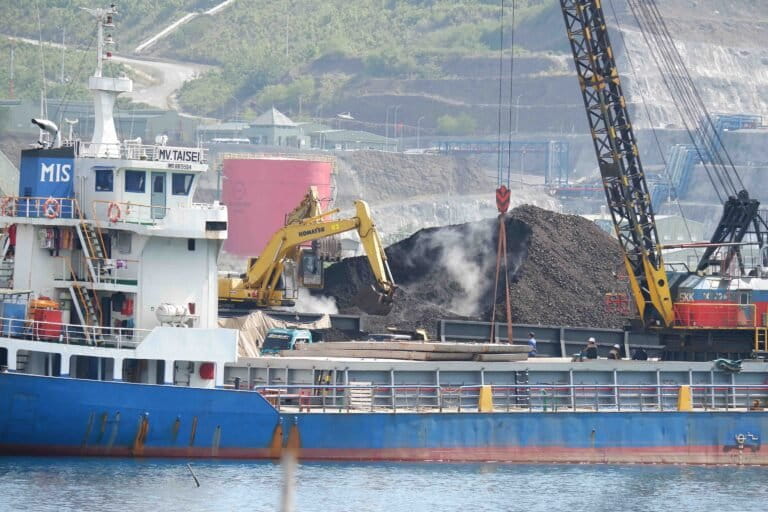
The story of Otak Keris is a microcosm of the broader tensions surrounding Indonesia’s aggressive push for mineral downstreaming—a national policy known as hilirisasi. While the central government in Jakarta views the construction of massive smelters as a path toward developed-nation status, for the residents of West Sumbawa, the reality is one of fractured communities, lost livelihoods, and environmental degradation. The displacement of Otak Keris began approximately seven years ago to make way for the copper and gold smelting facility owned by PT Amman Mineral Nusa Tenggara (AMNT). What was once a thriving agricultural community has been replaced by 272 hectares of industrial infrastructure designed to process 900,000 tons of copper concentrate annually.
A Broken Promise and the Arrival of Industrialization
The chronology of the displacement reveals a pattern of administrative pressure followed by corporate encroachment. According to Jumari and other residents, the process began with a visit from the local Regent (Bupati). The official spoke to the villagers about the strategic importance of the smelter project, urging them to support the mine for the sake of national development. The Regent reportedly promised that in exchange for their land and homes, the residents would be provided with a "decent life" and better opportunities.
However, as the project progressed, the promised administrative support vanished. Residents claim the Regent never returned to address their concerns. Instead, they were met with private security forces and "enforcers" who used intimidating tactics to ensure the land clearing proceeded. Access roads were blocked with bamboo fences, and despite the community’s efforts to protest—including the hanging of banners throughout the village—the pressure became insurmountable. Without legal recourse or political backing, the residents of Otak Keris eventually surrendered their property.
The scale of the displacement was significant. Mahmudi, a former head of a neighborhood unit (RT), estimated that at least two neighborhood units, comprising roughly 90 families, were forced to leave. The area spanned 200 hectares of residential land and fertile gardens. Before the smelter, approximately 176 residents relied entirely on this land for their survival, growing vegetables and raising livestock. The loss of this land did not just mean the loss of a home; it meant the total erasure of their economic foundation.
The Economic Reality of Displacement
The financial compensation provided to the residents of Otak Keris has proven insufficient to replicate their former quality of life. Records indicate that land was compensated at a rate of Rp 5 million per are (100 square meters), while houses—many measuring 25 square meters—were bought for Rp 60 million. For the farmers of Maluk, who previously earned a steady income of Rp 3 million to Rp 4 million per month from their crops and cattle, this one-time payment was a poor substitute for a lifetime of food security.
"The compensation money wasn’t enough to build a new house elsewhere," Mahmudi explained. "We had to take out loans and go into debt just to find a place to live." Today, the former residents of Otak Keris are scattered. Some have moved to other hamlets within Maluk Village, while others have returned to their ancestral homes on the neighboring island of Lombok. The transition from independent landowners to landless laborers has been stark. Many now work as day laborers, construction workers, or in low-level positions within the very mine that displaced them. For those past working age, like the now-retired Mahmudi, the future is increasingly precarious.
Tongo Village: Life in the ‘Red Zone’
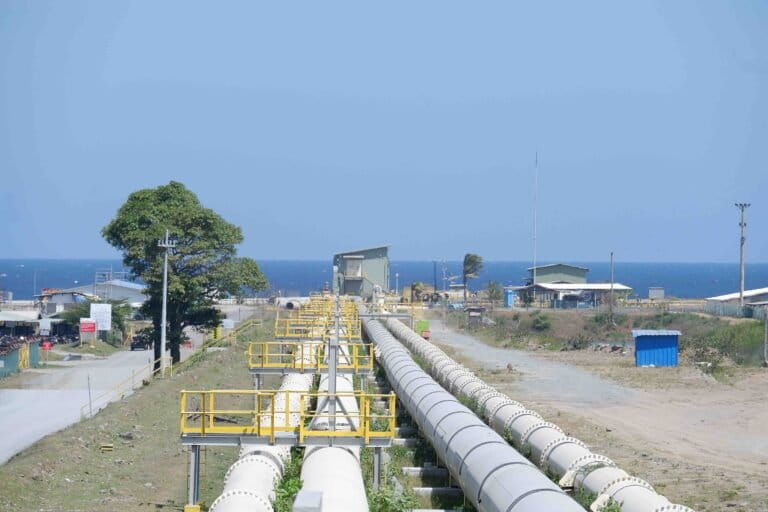
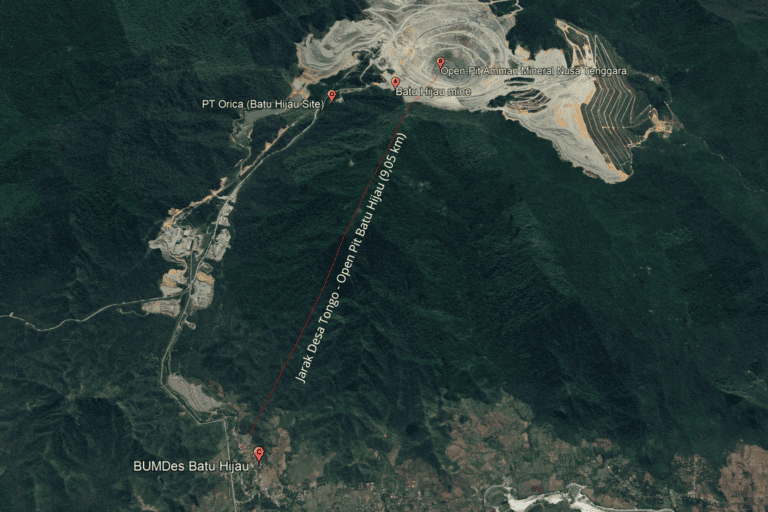
The impact of PT AMNT’s operations extends far beyond the footprint of the smelter. Roughly 9.5 kilometers from the "Batu Hijau" open-pit mine lies Desa Tongo. Situated downstream from the mining highlands, Tongo is often referred to by locals as the "Red Zone." The village is physically hemmed in by industrial infrastructure; four massive pipelines stretch across the landscape, two of which pump toxic tailings into the sea, while the others draw seawater for a desalination plant used in mineral processing.
For the 470 families in Tongo, the arrival of large-scale mining has fundamentally altered their relationship with the environment. Historically, the ancestors of Tongo lived off the forest, harvesting wild honey, producing palm sugar from nira palms, and grazing vast herds of cattle and buffalo in the highlands. Today, those forests have been absorbed into the mining concession.
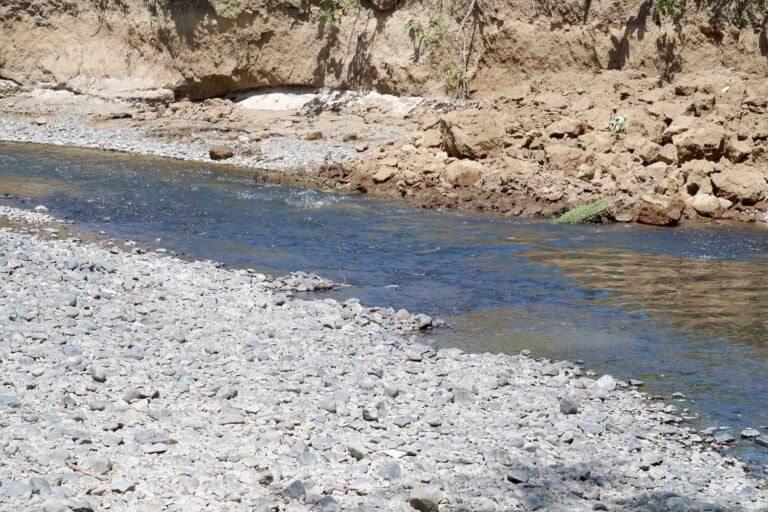
The most critical issue facing Tongo is the loss of water. Residents report that the Sejorong River, once a rushing source of fresh water for irrigation and domestic use, has been reduced to a murky trickle. During the dry season, the water level barely reaches the ankles of an adult. More concerning is the fear of contamination. In 2017, the community witnessed a massive fish kill in the Sejorong River, which was attributed to acid mine drainage. This trauma persists, leaving residents afraid to use the remaining river water for bathing or cooking, fearing heavy metal poisoning.
The water crisis has also crippled the village’s cultural identity. In Tongo, cattle and buffalo are not merely assets; they are central to the community’s social fabric. These animals are required for traditional ceremonies, including Sorong Serah (wedding rituals), Besesudak (funeral rites), and circumcisions. With the loss of grazing land and water, most villagers can no longer maintain herds. They are now forced to buy expensive livestock from outside the region to fulfill their traditional obligations, further straining their limited finances.
The Push for Social Forestry
In a desperate bid to regain some form of land security, the displaced communities have turned to the Indonesian government’s Social Forestry program. This national initiative is designed to grant local communities legal rights to manage forest areas, balancing conservation with economic necessity.
In Desa Tongo, the Ai Ayan Farmers Group has applied for a social forestry permit covering 200 hectares of land that their ancestors once managed. Similarly, the former residents of Otak Keris, organized under the Sinar Batu Hijau Farmers Group, submitted a proposal in August 2025 for 300 hectares. They hope to provide 260 displaced farmers with a place to return to their agricultural roots.
"If we don’t farm, how do we live?" Jumari asked. "We don’t have other skills. We are too old to be hired by the mine. In Maluk, the price of basic goods is skyrocketing because of the mining presence, but we have no land to grow our own food."
However, the path to legal land rights is fraught with bureaucratic hurdles. Ristianto Pribadi, a spokesperson for the Ministry of Forestry, confirmed that while the applications are being processed, there are significant conflicts of interest. The land requested by the Ai Ayan Farmers Group in Tongo overlaps with an active Forest Area Utilization Permit (PPKH) held by PT AMNT for mining exploration until 2030. Under Indonesian law, social forestry permits cannot be granted on land that is already "encumbered" by existing mining licenses.
For the Sinar Batu Hijau group, the outlook is slightly more optimistic. Their application has passed the administrative phase and is scheduled for technical verification by the Denpasar Social Forestry Office. If successful, it could provide a rare legal victory for a community that has lost nearly everything to the industrialization of their home.
Broader Implications and the Resource Curse
The situation in West Sumbawa highlights the complex challenges of Indonesia’s mineral-led economic strategy. PT AMNT is a vital player in the national economy; its facility produces 220,000 tons of copper cathodes and 18 tons of gold annually. These materials are essential for the global transition to green energy, particularly for electric vehicle batteries and renewable energy infrastructure.
However, the "resource curse"—whereby regions rich in minerals suffer from poor economic growth and environmental degradation—remains a looming threat for the people of Maluk and Sekongkang. The disparity between the billions of dollars in mineral wealth extracted from the Batu Hijau pit and the struggling farmers who can no longer afford to Akikah (celebrate a birth) because they have no cows is a stark reminder of the social costs of extraction.
As of mid-2026, PT Amman Mineral Nusa Tenggara has not provided a formal response to inquiries regarding the socio-economic impacts on the Otak Keris and Tongo communities. While the company maintains that it operates within the legal framework provided by the Indonesian government, the residents on the ground tell a story of a "decent life" promised but never delivered.
The struggle for land rights in West Sumbawa is far from over. Whether through social forestry or continued local advocacy, the people of Otak Keris and Tongo are fighting to ensure that their identity is not completely buried under the weight of the nation’s industrial ambitions. For Jumari and his neighbors, the goal is simple: the right to work the land and live with the dignity they feel was stripped away seven years ago.