Bambang Pamungkas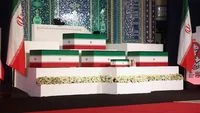
The mortal remains of Iran’s Supreme Leader, Ayatollah Ali Khamenei, were laid to rest at the Grand Mosalla Mosque in Tehran on Friday, marking the solemn commencement of a multi-day funeral procession expected to transform into a colossal demonstration of Iran’s enduring resistance against perceived Western adversaries. This unprecedented national mourning comes in the wake of a cataclysmic event four months prior, when the Supreme Leader, alongside several members of his family, including his one-year-old granddaughter, was reportedly killed in the initial wave of Israeli and United States air strikes on Tehran. The authorities in Iran have projected an attendance exceeding 20 million people for the series of ceremonies scheduled to unfold over the next six days, signaling a profound moment for national introspection and a powerful projection of collective will on the international stage.
The Fallen Leader and the Cataclysmic Attack
The sudden and tragic demise of Ayatollah Ali Khamenei, reported to have occurred during an aerial bombardment, sent shockwaves across the Islamic Republic and the wider Middle East. According to official Iranian accounts, the Supreme Leader was among the casualties of what was described as the "first wave of Israeli and United States air strikes" targeting Tehran. This pivotal event, which reportedly also claimed the lives of his wife and other relatives, including a one-year-old granddaughter whose small casket was among the five draped in the Iranian flag displayed at the Mosalla, ignited a fierce escalation in regional tensions that had been simmering for months. The strikes occurred amidst a period of intense, albeit undeclared, conflict between Iran and its regional rivals, primarily Israel, with the United States often caught in the diplomatic and military crossfire. The subsequent "fragile ceasefire" with the United States, mentioned by Iranian authorities, underscores the precarious geopolitical landscape in which the nation now finds itself, navigating the aftermath of profound loss and sustained external pressure. Details surrounding the exact timing and nature of these "first wave" attacks remain intensely guarded, but their impact on the Iranian psyche and state policy is undeniable, shaping the narrative of the Supreme Leader’s death as a martyrdom in the face of foreign aggression.
A Legacy Forged in Revolution and Resistance
Ayatollah Ali Khamenei’s leadership spanned over three decades, succeeding the founder of the Islamic Republic, Ayatollah Ruhollah Khomeini, in 1989. His tenure was defined by unwavering commitment to the principles of the 1979 Islamic Revolution, which fundamentally reshaped Iran’s political, social, and international identity. The revolution itself was deeply rooted in anti-Western sentiment, seeking to liberate Iran from perceived foreign domination and establish an independent Islamic state. Khamenei, as the Supreme Leader, became the ultimate arbiter of state policy, guiding Iran through numerous domestic and international challenges, including sanctions, nuclear negotiations, and proxy conflicts across the Middle East. His ideology emphasized self-reliance, national sovereignty, and resistance against what he frequently termed the "Global Arrogance" (referring primarily to the United States and its allies). This stance was further solidified by the brutal eight-year war with Iraq in the 1980s, which, despite its devastating human and economic cost, served to entrench the regime’s power and foster a strong narrative of national resilience against external threats. Under Khamenei, Iran significantly developed its military capabilities, particularly in missile technology and drone warfare, which are now frequently cited by conservative factions as key achievements in safeguarding national security.
A Nation Gathers: The Funeral Procession Begins
The initial ceremonies in Tehran were marked by a confluence of national grief and international diplomatic presence. Among the high-profile foreign officials who arrived to pay their respects were Dmitry Medvedev, Deputy Chairman of Russia’s Security Council, and He Wei, Deputy Chairman of China’s highest legislative body. Their presence, alongside representatives from Pakistan, Iraq, India, Turkey, and other nations, highlighted Iran’s strategic alliances and its role in a multi-polar world order, particularly in defiance of Western influence. The somber display of five simple caskets, each draped in the Iranian flag, inside the Grand Mosalla Mosque, was a poignant visual. The inclusion of the small casket belonging to Khamenei’s one-year-old granddaughter served as a stark reminder of the human cost attributed to the recent attacks, amplifying the narrative of martyrdom and national sacrifice. State media broadcasted these images widely, underscoring the profound sense of loss and the unified front presented by the nation’s leadership.
The Pilgrimage of Grief and Defiance: Chronology of Ceremonies
The multi-day funeral procession is not merely a series of rites but a carefully orchestrated national pilgrimage, designed to galvanize public sentiment and project an image of unwavering resolve. Following the initial three days of ceremonies in Tehran, during which portions of the capital’s airspace were temporarily closed as a security measure, the Supreme Leader’s remains are scheduled for a profound journey. On Tuesday, the procession will move to Qom, a city of immense religious significance as the spiritual heart of Shia Islam in Iran, home to numerous seminaries and the shrine of Fatimah Masumeh. This stop is expected to draw an enormous gathering of religious scholars and devotees.
From Qom, the journey will extend beyond Iran’s borders to Iraq on Wednesday, visiting the revered Shia holy cities of Najaf and Karbala. Najaf is the site of the Shrine of Imam Ali, the first Shia Imam, and a center of Shia scholarship, while Karbala houses the Shrine of Imam Hussein, a grandson of Prophet Muhammad and a central figure in Shia Islam, whose martyrdom is commemorated annually during Ashura. These stops underscore the deep spiritual and historical ties between Iran and the Shia communities in Iraq, reinforcing Iran’s regional influence and its identity as the protector of Shia Islam. The culmination of this extensive journey is scheduled for Thursday, July 9, when Ayatollah Khamenei will be interred in his birthplace, Mashhad, in eastern Iran. Mashhad is home to the Shrine of Imam Reza, the eighth Shia Imam, making it another profoundly sacred site and a fitting final resting place for a leader who embodied the religious and political aspirations of the Islamic Republic. Each stage of this elaborate procession is meticulously planned not only as an act of mourning but also as a public spectacle of national unity and a reaffirmation of the revolutionary ideals.
Mobilizing Millions: A Message to the World
The Iranian government is strategically leveraging the sheer scale of this funeral mobilization to reinforce public support, particularly against the backdrop of the fragile ceasefire with the United States and the extensive damage inflicted across various regions of Iran during the preceding months of conflict. The anticipated turnout of over 20 million people, a figure that would significantly surpass the estimated 10 million mourners at the 1989 funeral of Ayatollah Ruhollah Khomeini, speaks volumes about the regime’s capacity for mobilization and its desire to send an unequivocal message to both domestic and international audiences. Hossein Ansari, a translator planning to attend the final burial in Mashhad, articulated this sentiment, stating that such a massive crowd would convey a clear message to the world. He observed that the presence of millions demonstrated continued respect for Khamenei among many Iranians, even those who might not be overtly religious.
The memory of Khomeini’s funeral, which saw chaotic scenes as security forces struggled to control the immense crowds, serves as a powerful precedent. The current administration aims to channel this fervent public display into a renewed sense of national purpose and solidarity. Preparations were extensive, with many shops in Tehran closing and shopping mall parking lots filling with vehicles as citizens from across the country converged on the capital to participate in the ceremonies. Mohammad Bagher Ghalibaf, a senior Iranian official and the current chief negotiator, echoed the government’s narrative, describing the funeral as a "renewal of the nation’s oath to the path of the martyrs" and a potent reminder of the "values of the Islamic Revolution" that form the bedrock of the state.
Divided Nation, Unifying Narrative?
Despite the outward display of national unity, Ayatollah Khamenei leaves behind an Iran marked by decades of sharp internal divisions. A significant portion of the younger generation has grown up amidst political repression and severe economic hardships, leading to widespread discontent and a critical view of the leadership. However, the recent conflict and the reported attacks have, according to some analyses, subtly shifted perceptions among certain segments of the populace. Narges Bajoghli, an Associate Professor at Johns Hopkins School of Advanced International Studies, suggested that Iran’s ability to withstand the attacks and exert pressure on its adversaries has, for some citizens, validated the hardline strategies pursued under Khamenei. She noted that his death could transform his image from a repressive figure into an architect of a strategy perceived as successfully preserving Iran’s integrity against the greatest modern threats. Yet, Bajoghli cautioned that the domestic record of Khamenei’s administration, characterized by economic struggles and human rights concerns, cannot be overlooked. A 23-year-old student in Tehran speculated that history might ultimately judge Khamenei more favorably than contemporary opinion, citing a tendency among Iranians to admire leaders who expand the nation’s international influence.
Indeed, while Khamenei’s popularity may have waned in recent years, millions of Iranians, predominantly from conservative factions, remain staunch supporters of the clerical and military leadership. This demographic largely views Iran’s enhanced military capabilities—including its advanced missile arsenal and drone program, frequently highlighted in anti-Israel and anti-United States speeches by conservative figures and military commanders in recent days—as one of the greatest achievements of his era.
Geopolitical Chessboard: International Presence and Reactions
The attendance of high-ranking officials from Russia and China at Khamenei’s funeral carries significant geopolitical weight. Their presence symbolizes a strengthened alliance with Iran, a shared interest in challenging the unipolar global order, and a coordinated response to perceived Western hegemony. For Moscow and Beijing, expressing solidarity with Tehran during this critical period reinforces their strategic partnerships in the Middle East and Central Asia. Other nations, such as Pakistan, Iraq, India, and Turkey, also sent representatives, reflecting their complex diplomatic ties with Iran, which often balance regional rivalries with economic and security interests.
Conversely, Western nations, particularly the United States and European powers, likely view the funeral with a mixture of apprehension and watchful pragmatism. The "fragile ceasefire" mentioned in the article implies ongoing, albeit indirect, engagement with Iran on critical issues such as nuclear proliferation, regional stability, and sanctions. The mass mobilization and anti-Western rhetoric emanating from the funeral will undoubtedly be interpreted by Western capitals as a clear signal of Iran’s continued defiance and its determination to maintain its current trajectory. The question for these powers is whether the post-Khamenei era will bring any opportunities for de-escalation or if the hardline stance will become even more entrenched.
Succession and the Path Forward
The question of succession looms large over the funeral ceremonies. Mojtaba Khamenei, the Supreme Leader’s son and a widely speculated successor, reportedly sustained injuries in the attack that claimed his father, wife, and other relatives, and has not been seen in public since. His absence from the funeral procession fuels speculation about his health and his potential role in the leadership transition. The process of selecting a new Supreme Leader rests with the Assembly of Experts, a body of 88 religious scholars. While the selection process is traditionally opaque, the current geopolitical climate and the narrative of martyrdom surrounding Khamenei’s death could influence the choice towards a candidate who embodies continuity and unwavering resistance. The stability of the regime, particularly in the face of such a profound loss and ongoing external pressures, will depend heavily on a smooth and unified transition of power.
Navigating the Future: Domestic Challenges and Foreign Policy
The post-Khamenei era presents immediate challenges for President Masoud Pezeshkian, who faces pressure from more moderate factions to pursue the unfreezing of Iranian assets through negotiations with the United States. However, recent indirect talks in Doha failed to yield a breakthrough on sanctions relief or the release of new funds. This failure was reportedly linked to Iran’s refusal to relinquish control over the strategically vital Strait of Hormuz, a crucial global energy trade route largely influenced by the Islamic Revolutionary Guard Corps (IRGC), an entity often at odds with the civilian government’s more pragmatic approaches.
Sanam Vakil, Director of the Middle East and North Africa Programme at Chatham House, offered a critical perspective, suggesting that Khamenei’s hardline policies may have ultimately contributed to him becoming a target. She argued that Iran’s regional policies, often perceived as destabilizing, could have provoked military actions against the country. Vakil emphasized that while the Iranian regime must honor Khamenei’s legacy during the mourning period, a crucial question remains: will the government merely uphold Khamenei’s long-standing ideologies, or will it seize this moment to pivot and reorient Iran’s future policy direction? The funeral, while serving as a powerful reaffirmation of past principles, also stands at a crossroads, potentially signaling either a continuation of the established hardline path or the nascent seeds of a strategic recalibration in response to a profoundly altered landscape.
In conclusion, the funeral of Ayatollah Ali Khamenei transcends a mere religious rite; it is a meticulously choreographed national spectacle of profound grief, defiant resolve, and a potent assertion of Iran’s sovereignty. Amidst the solemnity, the event serves as a powerful reminder of the nation’s revolutionary roots, its ongoing struggles against external pressures, and the complex internal dynamics that will shape its path forward in a post-Khamenei world. The sheer scale of public participation, framed by the narrative of martyrdom, aims to unite a divided nation and project an image of formidable strength to a world watching closely.