Bambang Pamungkas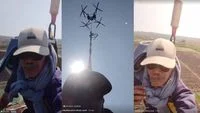
The serene landscape of Jombang, East Java, recently became the unexpected backdrop for an extraordinary display of personal ingenuity that has captivated millions online and ignited a global discussion on drone technology, safety, and regulation. A middle-aged farmer, known only by his TikTok handle @mbahkaruhon.tiktok.com1, achieved instant viral fame after sharing a video of himself using an oversized drone to commute home from his banana plantation. The footage, depicting the farmer suspended beneath a large multi-rotor drone as it traversed the agricultural terrain, quickly garnered over 3.1 million views on TikTok, drawing a mix of awe, admiration, and significant safety concerns from a wide audience.
The Viral Flight: A Daring Commute
The incident, which unfolded in a remote area of Jombang, saw the farmer employing what appeared to be a custom-built or heavily modified heavy-lift drone to airlift himself over a distance estimated at 1.5 kilometers. The viral video clip shows the farmer gripping onto a harness or frame attached to the drone, his body dangling several meters above the banana trees, as the unmanned aerial vehicle (UAV) steadily carried him towards his home. The drone maintained a stable flight path, navigating the agricultural landscape with apparent ease, presenting a surreal image that blurred the lines between agricultural innovation and audacious personal transport.
The decision by the farmer to adopt such an unconventional method of transportation stems, presumably, from practical challenges inherent to his daily routine. Accessing remote banana plantations in rural Indonesia can often involve navigating challenging terrain, including unpaved roads, dense vegetation, or even small waterways, making conventional commutes arduous and time-consuming. While the exact motivations for this specific act remain unstated by the farmer, the visual narrative suggests a desire for efficiency and overcoming geographical obstacles, albeit through a highly unorthodox and potentially perilous means. The simplicity of the act, contrasted with the advanced technology involved, resonated deeply with internet users, many of whom lauded the farmer’s ingenuity while simultaneously expressing profound worries about the inherent risks.
Unpacking the Technology: Heavy-Lift Drones and the DJI FlyCart 100
While the precise model of the drone used by the Jombang farmer remains unidentified, the incident has brought the capabilities of heavy-lift drones into sharp focus. The original report alludes to drones manufactured by DJI, specifically mentioning the DJI FlyCart 100 (FC100), as a device capable of transporting substantial payloads, potentially up to 100 kilograms. This reference provides a crucial technological benchmark against which the farmer’s viral flight can be contextualized, highlighting the significant advancements in drone engineering.
The DJI FlyCart 100 (FC100) represents a pinnacle in commercial heavy-lift drone technology, building upon the success of its predecessor, the FlyCart 30. Developed by DJI, a global leader in drone manufacturing, the FC100 is engineered for robust logistical operations in challenging environments, a testament to the evolving role of drones beyond aerial photography and surveillance. Its design philosophy prioritizes high payload capacity, operational efficiency, and advanced safety features, making it suitable for demanding tasks such as delivering supplies to remote mountainous regions, transporting goods across difficult terrains, or even facilitating emergency aid delivery.
The FC100 boasts an impressive payload capacity of up to 100 kg, a critical specification that enables it to perform heavy-duty logistical tasks. This capacity is achieved through a meticulously engineered multi-rotor coaxial four-axis, eight-blade configuration, which enhances lift and stability. The drone’s optimized wing design, coupled with 62-inch carbon fiber propellers and more powerful motors delivering higher torque, collectively contribute to its exceptional lifting capabilities and efficient flight performance. For instance, with a dual-battery configuration, the FC100 can carry a 65 kg payload over a distance of 12 kilometers, a significant improvement over previous models. In an emergency single-battery configuration, it can still manage an 80 kg payload for 6 kilometers. These specifications underscore the drone’s utility in scenarios where traditional ground transport is impractical or impossible.
Beyond its lifting power, the FC100 is equipped with a suite of sophisticated safety systems crucial for its intended operations. These include LiDAR (Light Detection and Ranging) technology for precise environmental mapping and obstacle detection, multi-sensor obstacle avoidance systems to prevent collisions, and an integrated parachute system for emergency landings. Such features are indispensable for ensuring safe operation, especially when navigating complex and unpredictable environments like mountain ranges, forests, or over water bodies. The drone also features faster charging capabilities, minimizing downtime and maximizing operational efficiency.
The economic implications of such advanced technology are substantial. The DJI FC100, for example, carries a price tag of approximately Rp 500 million in Indonesia, which translates to roughly $30,800 USD (as of early June 2024, assuming 1 USD = ~16,200 IDR). This considerable investment reflects the sophisticated engineering, advanced materials, and comprehensive safety features integrated into the device, positioning it as a high-value asset for specialized commercial and industrial applications. It is highly improbable that the farmer in Jombang utilized an FC100, given its cost and specialized nature; more likely, his drone was a modified, less sophisticated, and significantly less expensive alternative, potentially assembled from various components. This distinction is crucial when assessing the safety implications of his actions.
Safety, Regulation, and the Perils of Unsanctioned Human Transport
The viral video of the Jombang farmer has inevitably sparked a global debate on the safety and regulatory frameworks surrounding drone technology, particularly concerning human transport. While heavy-lift drones like the FC100 are designed for cargo, their use for carrying humans, especially without certified equipment or regulatory oversight, presents grave risks.
From a safety perspective, the farmer’s actions are fraught with peril. Uncertified drone systems designed for cargo delivery lack the redundant safety mechanisms, flight stability, and emergency protocols essential for human carriage. Key risks include:
- Mechanical Failure: The structural integrity of a non-certified drone, especially one possibly modified for human transport, is highly questionable. Component failures (motors, propellers, frame) could lead to catastrophic accidents.
- Power System Failure: Sudden battery depletion or motor malfunction mid-flight could result in an uncontrolled descent, posing an immediate threat to life.
- Environmental Factors: Unpredictable wind gusts, sudden changes in weather, or even bird strikes could destabilize the drone, leading to a loss of control.
- Lack of Redundancy: Commercial passenger-carrying aircraft and future eVTOL (electric Vertical Take-Off and Landing) vehicles are designed with multiple layers of redundancy for critical systems. Improvised drones typically lack these vital safeguards.
- Pilot Skill and Certification: Operating a heavy-lift drone, let alone one carrying a human, requires highly specialized piloting skills and official certification. The farmer’s level of training for such an endeavor is unknown, but it is highly unlikely to meet aviation standards.
Inferred reactions from aviation authorities, such as Indonesia’s Directorate General of Civil Aviation (DGCA), would almost certainly emphasize the extreme dangers of such acts. They would likely issue strong warnings against using drones for unapproved human transport, citing violations of aviation safety regulations and the potential for severe accidents. Drone manufacturers like DJI, while proud of their products’ capabilities, would undoubtedly disavow any endorsement of their drones being used for unauthorized human flight, highlighting that their cargo drones are not designed or certified for carrying people. Safety experts globally would echo these concerns, stressing that the development of human-carrying drones (often referred to as ‘air taxis’ or ‘eVTOLs’) is a complex field requiring years of rigorous testing, certification, and regulatory approval by international bodies like the FAA (Federal Aviation Administration) and EASA (European Union Aviation Safety Agency). These legitimate human-carrying solutions are still years away from widespread commercial deployment, precisely because of the stringent safety requirements.
Indonesia, like many nations, has regulations governing drone use, primarily for recreational, commercial, and governmental purposes. These regulations typically cover flight altitudes, restricted zones, operator licensing, and drone registration. However, specific regulations for personal human transport via drone are largely non-existent, precisely because the technology is not yet deemed safe or mature enough for such applications. The farmer’s act thus operates in a legal grey area of an uncertified "aircraft" and an uncertified "pilot" carrying a human, potentially exposing him to significant legal penalties in addition to the inherent physical risks.
Public Perception and the Allure of Innovation
The viral spread of the Jombang farmer’s drone commute speaks volumes about public fascination with technological innovation, especially when it manifests in unexpected ways. The video tapped into a universal human desire for efficiency, overcoming obstacles, and the sheer novelty of flight. Comments from viewers ranged from expressions of amazement ("This man is living in 2050!") and admiration for his ingenuity ("Indonesian innovation is unmatched!") to serious warnings about the dangers ("This is incredibly dangerous, please don’t try this at home!").
This dichotomy in public reaction highlights a common challenge in the age of rapid technological advancement and social media. On one hand, there’s an appreciation for the pioneering spirit and problem-solving. On the other, there’s a critical need for education and awareness regarding the responsible and safe application of new technologies. The viral nature of the content ensures broad dissemination, but without accompanying expert commentary or regulatory guidance, it risks inspiring unsafe imitation. The incident serves as a stark reminder of social media’s power to amplify both inspiring innovation and perilous practices.
Beyond the Buzz: Economic Implications and Future Potential
While the Jombang farmer’s actions were likely a one-off, improvised solution, the broader context points to the immense potential of drone technology in various sectors, particularly in developing economies like Indonesia. For agriculture, drones are already revolutionizing practices through precision farming, crop monitoring, pesticide spraying, and even seeding. In logistics, heavy-lift drones are being explored for last-mile delivery in remote areas, disaster relief, and transporting specialized equipment where ground infrastructure is lacking.
The economic implications of drones in these fields are significant, promising increased efficiency, reduced labor costs, and improved access to remote regions. However, this potential is predicated on safe, regulated, and commercially viable operations. The high cost of advanced drones like the DJI FC100 (approximately $30,800 USD) means that such sophisticated solutions are currently out of reach for individual farmers. Instead, these drones serve larger agricultural enterprises, logistics companies, or government agencies. The farmer’s drone, if homemade or heavily modified, represents a much more rudimentary and economically accessible, though far less safe, approach to leveraging drone power.
The incident underscores a crucial gap: the aspiration for advanced personal air mobility versus the current reality of technology and regulation. While companies globally are investing billions in developing certified eVTOLs for urban air mobility, these projects are years away from widespread commercialization, primarily due to the stringent safety and regulatory hurdles that must be cleared. The Jombang farmer’s viral flight, while visually striking, is a stark contrast to these rigorously engineered and regulated future solutions.
Conclusion: A Symbol of Innovation and Caution
The story of the Jombang farmer and his drone commute is more than just a viral sensation; it is a powerful symbol of human ingenuity at the intersection of technological aspiration and practical necessity. It highlights the profound impact of drone technology, not just in sophisticated commercial applications but also in the lives of ordinary individuals seeking solutions to everyday challenges. However, it also serves as a critical cautionary tale, underscoring the paramount importance of safety, rigorous engineering, and robust regulatory frameworks when integrating advanced technologies into human activities, especially those involving human transport.
As drone technology continues to evolve at a rapid pace, incidents like this will undoubtedly prompt further discussions among policymakers, manufacturers, and the public about the responsible deployment of UAVs. While the vision of personal air mobility is exciting and increasingly within technological reach, the journey from cargo drone to certified human transport is long and paved with stringent safety requirements. The Jombang farmer’s daring flight, though inspiring to some, ultimately serves as a vivid reminder that while innovation knows no bounds, human safety must always remain the highest priority.