Tyo Susilo
The escalating cost of Graphics Processing Units (GPUs) has become a pervasive issue for consumers and enthusiasts alike, pushing many to humorously fantasize about building their own. However, for hardware hacker Matthias Balwierz, known online as "Bitluni," this notion transcended mere jest, culminating in a remarkable feat of engineering: the construction of a functional graphics processing unit utilizing a staggering 8,192 RISC-V microcontrollers. This ambitious project not only challenges conventional GPU architecture but also sheds light on the burgeoning potential of open-source hardware.
The Genesis of a RISC-V GPU
The inspiration for Bitluni’s groundbreaking project stems directly from the frustratingly high prices of commercially available GPUs. In a market often dominated by a few major players, the cost of entry for high-performance graphics has become prohibitive for many. This economic pressure, coupled with a growing fascination for alternative computing architectures, likely fueled Bitluni’s desire to explore a radically different approach. The RISC-V architecture, an open-source instruction set architecture (ISA), has gained significant traction in recent years due to its flexibility, cost-effectiveness, and freedom from proprietary licensing. This makes it an attractive platform for independent developers and researchers looking to innovate outside the traditional silicon landscape.
The project’s genesis can be traced back to Bitluni’s exploration of low-cost, readily available computing components. RISC-V microcontrollers, such as the QingKe CH570, are typically found in embedded systems, powering everything from Internet of Things (IoT) devices and smart home appliances to small robotic systems. These chips are characterized by their modest processing power and simplified architecture, making them ideal for specific, often power-efficient tasks. The idea of aggregating thousands of these small, relatively inexpensive processing units to perform a complex task like graphics rendering is a testament to Bitluni’s innovative thinking and deep understanding of parallel processing principles.
The Architecture: A Decentralized Powerhouse
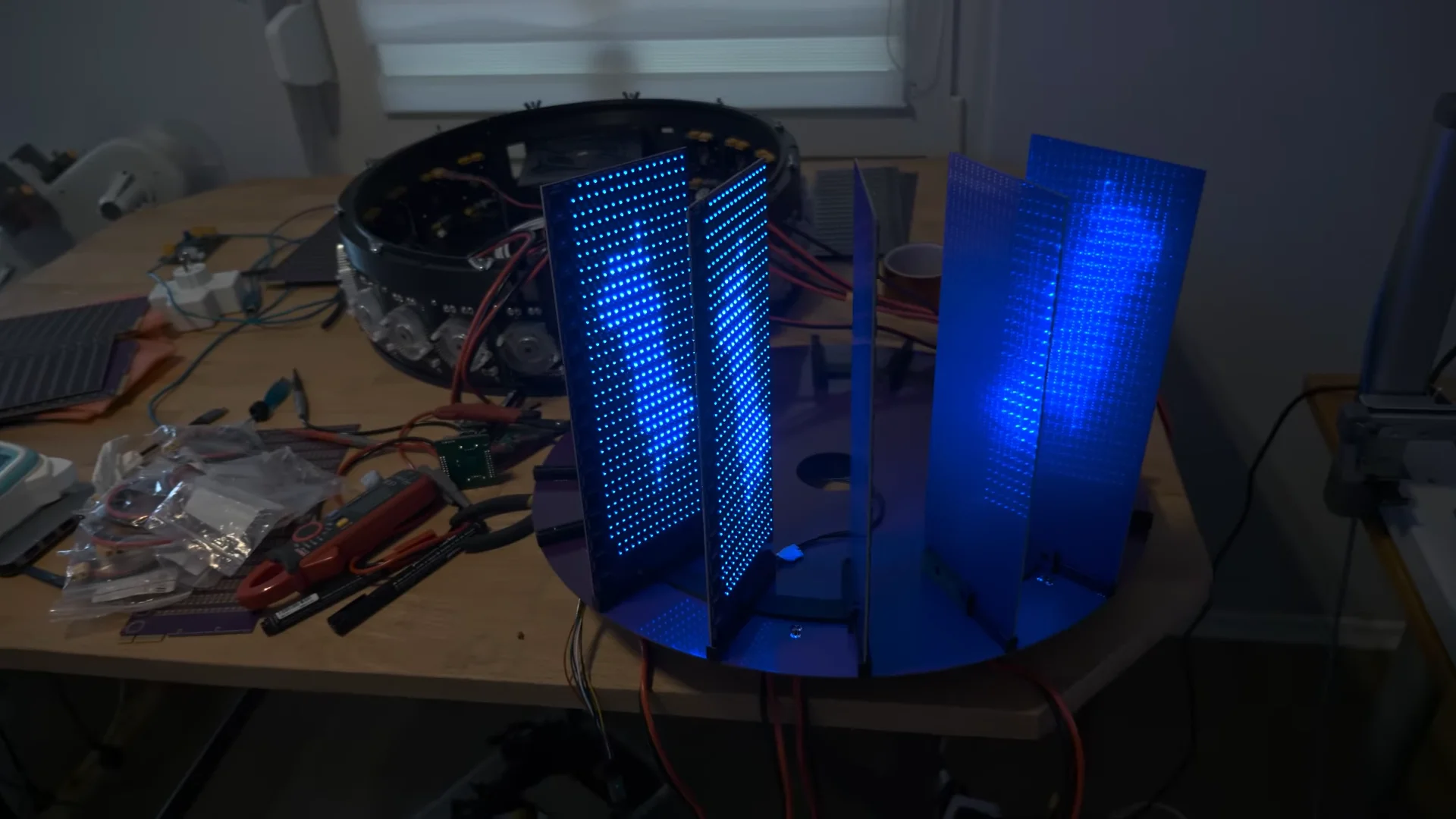
The prototype GPU, as detailed in recent reports, is a testament to meticulous design and an unconventional approach to parallel processing. It currently employs 8,192 QingKe CH570 RISC-V microcontrollers. These chips are arranged in a unique modular configuration, organized into 16×32 pixel modules, forming a striking circular design reminiscent of the iconic Cray-1 supercomputer. This aesthetic choice is not merely for show; it reflects a deliberate effort to maximize efficiency and manageability within the distributed system.
Each individual microcontroller within this vast array is a 32-bit RISC-V processor capable of clock speeds up to 100 MHz. Crucially, these chips are not just basic processing units; they come equipped with integrated peripherals, including USB interfaces, and support for 2.4 GHz radio and Bluetooth 5.0 Low Energy (LE). While these individual features are common in embedded systems, their collective application within a graphics rendering pipeline presents a novel challenge.
The sheer scale of the project necessitates a robust power delivery and management system. Bitluni’s current setup draws a substantial 2,161 watts of power. To handle this immense demand, he has integrated a high-end Corsair WS3000 power supply unit, supplemented by a custom-built power converter. This underscores the significant power requirements of even a prototype GPU built from numerous smaller processing units, highlighting the efficiency gains achieved by modern, highly integrated commercial GPUs.
Cost Considerations: A Matter of Perspective
While the initial premise of building a GPU from affordable microcontrollers might suggest a cost-saving objective, the reality of Bitluni’s project reveals a more nuanced picture. The QingKe CH570 RISC-V chips themselves are remarkably inexpensive, costing approximately USD 0.13 each. This low per-unit cost is a significant advantage of leveraging commodity hardware. However, when scaled up to the 8,192 units in the current prototype, the total cost of the microcontrollers alone surpasses USD 8,000, translating to roughly Rp144 million (Indonesian Rupiah).
This figure does not account for the considerable expenses associated with the custom PCBs, the intricate power distribution system, the specialized programming tools, and the significant electricity consumption. Furthermore, the project’s ambitious future iterations, aiming for higher resolutions, would exponentially increase both the component count and the associated costs. A Full HD (1920×1080) display, for instance, would require an estimated two million chips, making it an economically impractical undertaking for widespread consumer use. Therefore, while the per-chip cost is low, the total system cost for this custom-built GPU is substantial, positioning it as a proof-of-concept and an engineering marvel rather than a budget-friendly alternative to commercial GPUs.
The Role of Custom Fabrication and Automation
A critical component of Bitluni’s success is his meticulous approach to the entire development process, including the design and fabrication of custom hardware and programming tools. He personally engineered all the printed circuit boards (PCBs) that house the vast array of microcontrollers. This level of custom design is essential for integrating such a large number of discrete components into a cohesive and functional system.
Furthermore, Bitluni developed a unique programming system that leverages a 3D printer. This innovative solution addresses the daunting challenge of programming thousands of individual microcontrollers. Using Python scripts and G-code, the 3D printer is automated to program each MCU sequentially. This automated approach is crucial for the scalability and reproducibility of the project, minimizing manual labor and potential errors. The integration of 3D printing technology into the development workflow highlights the resourcefulness and ingenuity often found in the hardware hacking community.
Integrated Processing and Pixel Display
One of the most intriguing aspects of Bitluni’s GPU is its unique approach to rendering. Each microcontroller is directly connected to an RGB LED. This ingenious design serves a dual purpose: the microcontroller acts as a processing unit for its assigned pixel, and simultaneously, the LED directly visualizes the output. This integrated processing-and-display mechanism was initially conceived as a separate display project, but it was adapted for the GPU to streamline the development process and potentially reduce overall production complexity for such a distributed system.
This novel integration means that the GPU itself functions as a massive, custom-built display. The "pixels" are not rendered onto a separate screen but are directly illuminated by the LEDs controlled by the individual RISC-V chips. This fundamentally alters the traditional understanding of a GPU’s role, where it typically outputs signals to an external display.
Scalability and Future Vision
The current prototype, with its 8,192 microcontrollers, represents a significant undertaking. However, Bitluni’s vision extends far beyond this. The ultimate goal is to achieve a resolution of 320×200 pixels, which would necessitate approximately 64,000 microcontrollers. While this is a substantial increase in scale, it remains within the realm of possibility for a dedicated hardware hacker.

As previously mentioned, scaling this architecture to Full HD resolution would require over two million chips, a figure that rapidly renders the project impractical for any use case beyond a theoretical demonstration. The challenges associated with managing, powering, and programming such an immense number of components would be immense, far exceeding the current capabilities and resources of an individual project.
If Bitluni successfully reaches his target of 64,000 chips, the resulting creation would undoubtedly stand as one of the most unique microcontroller-based GPUs and displays ever constructed. It would represent a triumph of distributed computing and a bold exploration of alternative hardware architectures.
Broader Implications and Community Reactions
Bitluni’s project has generated considerable interest within the hardware hacking and open-source communities. It serves as a powerful illustration of what can be achieved with accessible components and a deep understanding of computer architecture. The project prompts a fundamental question: are such unconventional GPU designs more compelling than conventional ones?
From an engineering perspective, the project is undeniably fascinating. It showcases the potential of parallel processing by distributing computational tasks across a vast network of simple processors. It also highlights the advantages of open-source hardware, such as RISC-V, in fostering innovation and enabling individuals to explore previously inaccessible technological frontiers.
The project’s success could inspire further research into massively parallel, distributed computing architectures for graphics rendering and other computationally intensive tasks. While it is unlikely to replace high-end commercial GPUs for gaming or professional workloads in the near future due to performance limitations and power consumption, it opens doors for specialized applications in areas where cost, customizability, and unique display capabilities are paramount.
The community’s reaction is likely to be a mix of admiration for the technical prowess, curiosity about the performance, and debate about the practical applications. Such ambitious projects often spark dialogue about the future of computing hardware and the role of individual innovation in shaping technological progress. The question of whether this type of project is "more interesting" than conventional GPUs is subjective, but its sheer ingenuity and the departure from established norms make it a compelling subject of discussion and a testament to human creativity in the realm of technology.
The journey of Bitluni’s RISC-V GPU is far from over. As he continues to refine his design and potentially scale up his ambitious project, the tech world will be watching with keen interest, eager to see what further innovations emerge from this remarkable fusion of open-source hardware and dedicated engineering.