Azin Asro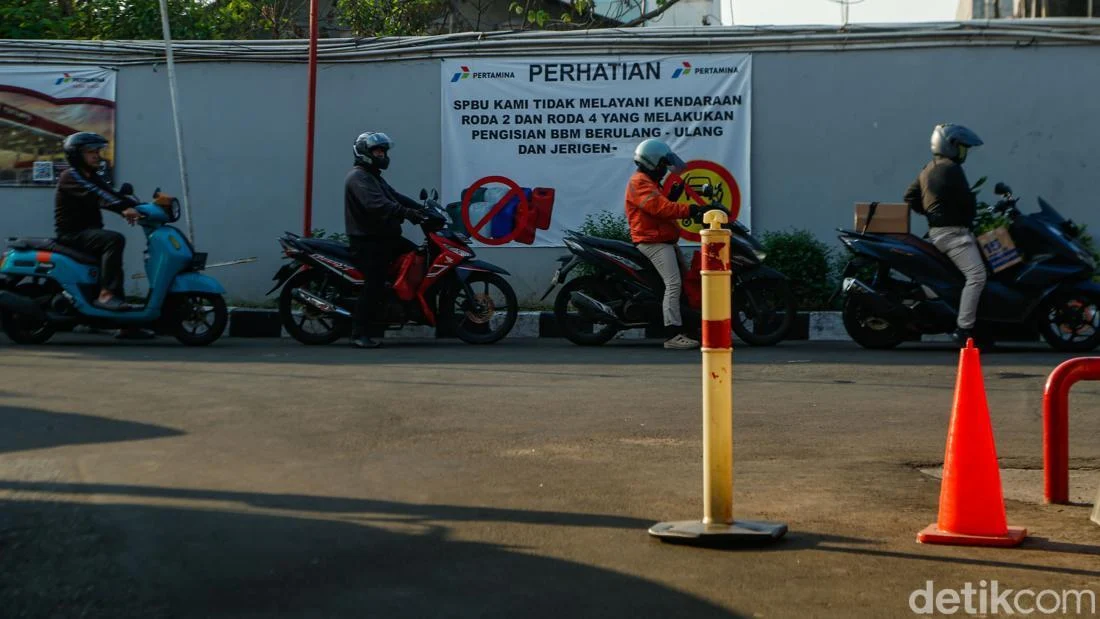
The distribution of subsidized fuel in Indonesia has encountered a unique logistical challenge involving a specific motorcycle model and the practice of unauthorized tank modifications. Several Pertamina gas stations (SPBU) across various regions have recently gained public attention for displaying prominent notices that prohibit Suzuki Thunder motorcycles from refueling. Beyond this specific model, the restrictions also extend to any vehicle equipped with modified fuel tanks designed to carry volumes exceeding factory specifications. These localized policies, while appearing to target a specific brand, are part of a broader effort to curb the practice of fuel hoarding and ensure that subsidized fuel, particularly Pertalite, reaches the intended consumer base without being diverted for illegal resale.
The phenomenon of banning Suzuki Thunder motorcycles began to surface through various social media reports, where users shared images of handwritten signs and large banners posted at gas station entrances. The messaging was clear: Suzuki Thunder owners were being turned away from the pumps. This sparked a debate among the motoring community regarding potential brand discrimination and the legality of such bans. However, Pertamina Patra Niaga, the commercial arm of the national energy company, has clarified that these measures are not a centralized corporate mandate but rather independent operational decisions made by individual gas station managements to maintain order and supply integrity.
Clarification from Pertamina Patra Niaga
Addressing the growing public discourse, Roberth M.V. Dumatubun, the Corporate Secretary of Pertamina Patra Niaga, explained that these regulations are localized policies enacted by individual gas station operators. According to Dumatubun, the primary objective behind these restrictions is to support the government’s mandate for "Subsidi Tepat Sasaran" (Targeted Subsidies). The company emphasizes that the spirit of these rules is not to discredit any specific automotive manufacturer but to prevent the systematic abuse of subsidized fuel distribution.
"The regulation is a policy of each individual SPBU," Dumatubun stated in a recent briefing. "In principle, Pertamina supports the distribution of subsidized fuel that is on target." He further elaborated that the restrictions are a response to field observations where certain individuals utilize specific motorcycle types—most notably the Suzuki Thunder—to engage in "langsir," a local term for the practice of repeatedly queuing for fuel to stockpile it for resale at higher prices in the informal market.
Dumatubun urged all vehicle owners, whether operating two-wheeled or four-wheeled vehicles, to utilize subsidized fuel according to their actual transportation needs and to avoid the practice of "repeat filling" within a short timeframe. He emphasized that the scrutiny is not limited to the Suzuki Thunder; any vehicle found to have a "modified tank" that exceeds official factory capacity is subject to the same refusal of service.
The Suzuki Thunder and the "Langsir" Phenomenon
The Suzuki Thunder, particularly the 125cc variant, has become a central figure in this controversy due to its unique technical specifications. Although the model is no longer in active production or sold as a new unit in Indonesia, it remains prevalent in the used motorcycle market. The Suzuki Thunder 125 was originally designed as a "touring" motorcycle, intended for long-distance travel across the Indonesian archipelago. To facilitate this, Suzuki equipped the bike with a fuel tank capacity of 15 liters—a volume significantly higher than the average 3 to 5-liter tanks found on modern underbone motorcycles (bebek) or automatic scooters.
The 15-liter capacity, combined with a relatively fuel-efficient 125cc engine, makes the Suzuki Thunder an ideal tool for fuel speculators. In the "langsir" scheme, a speculator can fill the 15-liter tank at a gas station, drive a short distance to a private location, drain the fuel into jerry cans, and return to the gas station to repeat the process. By doing this multiple times a day, a single individual can accumulate dozens of liters of subsidized Pertalite, which is then sold at roadside "Pertamini" kiosks or retail stalls at a significant markup.
This practice creates several negative externalities. First, it leads to artificial shortages at the pumps, as the subsidized quota for a specific station is depleted faster than anticipated. Second, it creates long queues, inconveniencing regular commuters who only require a few liters for their daily travel. Third, it facilitates the illegal trade of subsidized goods, which is a violation of national regulations.
Chronology of Regulatory Implementation
The move to restrict these vehicles did not happen in a vacuum. It follows a series of incidents and a tightening of national fuel monitoring systems.
- Rise of Informal Resellers: Over the last decade, the proliferation of "Pertamini" (unofficial fuel dispensers) created a high demand for bulk fuel obtained from official gas stations.
- Viral Reports and Public Complaints: Throughout 2023 and early 2024, regular motorists began complaining about long lines caused by a few individuals with large-tank motorcycles and modified vehicles filling up repeatedly.
- Local SPBU Initiatives: Gas station managers in areas with high "langsir" activity began taking matters into their own hands, posting signs to deter speculators.
- BPH Migas Oversight: The Downstream Oil and Gas Regulatory Agency (BPH Migas) increased its surveillance of gas stations, threatening to sanction operators who allowed "unnatural" fuel purchases.
- Digitalization via MyPertamina: Pertamina introduced the MyPertamina app and QR code system to track the consumption of subsidized fuel, but manual enforcement remains necessary at the pump level to catch modified hardware.
Technical and Legal Implications of Modified Tanks
The issue of "tangki modifikasi" (modified tanks) is a serious concern for safety and legal compliance. Many speculators do not rely solely on the Suzuki Thunder’s factory 15-liter tank. Instead, they modify the internal structure of motorcycles or cars to include "stealth tanks" (tangki siluman). In cars, this might involve an auxiliary tank hidden in the trunk or under the chassis. In motorcycles, it often involves welding additional metal to the existing tank to double or triple its capacity.
From a safety perspective, these modifications are highly dangerous. They are rarely performed to automotive engineering standards, increasing the risk of leaks and fires at the gas station—a high-risk environment. From a legal perspective, the misuse of subsidized fuel is a criminal offense under Indonesian law.
According to Article 55 of Law No. 22 of 2001 concerning Oil and Natural Gas, as amended by the Job Creation Law, anyone who misuses the transportation and/or trade of subsidized fuel can face a maximum prison sentence of six years and a fine of up to IDR 60 billion. Furthermore, Presidential Regulation (Perpres) No. 191 of 2014 strictly regulates the distribution and retail price of fuel, prohibiting the resale of subsidized fuel for profit by unauthorized individuals.
Broader Impact on Fuel Subsidy Integrity
The crackdown on Suzuki Thunder motorcycles and modified tanks is a symptom of the massive fiscal burden the Indonesian government faces regarding energy subsidies. In the 2024 State Budget (APBN), the government allocated hundreds of trillions of rupiah to keep fuel prices affordable for the lower and middle classes. When "pelangsir" (speculators) hoard this fuel, they are essentially stealing from the state budget and the intended beneficiaries.
The price gap between subsidized Pertalite (currently priced at IDR 10,000 per liter) and non-subsidized fuels like Pertamax (which fluctuates with market prices, often around IDR 12,000–14,000 per liter) provides a lucrative incentive for illegal activity. For every liter hoarded and resold, speculators can make a profit of IDR 2,000 to IDR 5,000, depending on the retail price in remote areas.
The localized bans have received mixed reactions. Legitimate Suzuki Thunder owners, who use their bikes for daily work or genuine touring, feel unfairly targeted. "Not everyone with a Thunder is a speculator," says one community member in a social media forum. "Some of us just like the classic style and the convenience of not filling up every day." However, gas station operators argue that the "blanket ban" on the model is the most efficient way to manage crowds and prevent arguments at the pump during peak hours.
Analysis of Future Distribution Trends
The current situation highlights the limitations of physical enforcement and the necessity for more robust technological solutions. Pertamina is currently expanding the use of the MyPertamina QR code system, which requires users to register their vehicles and identity. This system allows the company to track the volume of fuel purchased by a specific license plate per day.
If a Suzuki Thunder is registered in the system, it is theoretically allowed to purchase a certain amount of fuel based on its category. However, the system can be bypassed if speculators use multiple license plates or if the gas station attendants do not strictly verify the QR code against the physical vehicle.
The ultimate goal of Pertamina and the Indonesian government is to transition toward a "closed-loop" subsidy system where only verified, low-income citizens can access subsidized prices. Until such a system is fully matured and implemented nationwide, physical deterrents—such as the ban on large-tank motorcycles and modified vehicles—remain a primary, albeit controversial, tool for local gas station management to ensure fair distribution.
In conclusion, while the ban on Suzuki Thunder motorcycles may seem like a specific grievance against a single motorcycle model, it is a localized tactical response to a complex national economic issue. The policy reflects the ongoing struggle to balance fuel accessibility with the need to prevent the leakage of state funds through illegal hoarding and resale. As Pertamina continues to refine its digital monitoring tools, the necessity for such brand-specific bans may eventually diminish, replaced by data-driven oversight that can distinguish between a legitimate commuter and a professional fuel speculator.