Tyo Susilo
Developer Shift Up has officially confirmed that the upcoming Nintendo Switch 2 version of its acclaimed action-adventure title, Stellar Blade, will feature a toggle switch allowing players to completely disable AMD FidelityFX Super Resolution (FSR) 3.1 frame generation. This decision comes in direct response to constructive criticism and community feedback gathered following the release of the game’s demo. By implementing this feature, the studio aims to give players full autonomy over their performance preferences, allowing them to choose between an interpolated 60 frames per second (FPS) experience and a traditional, native 30 FPS mode.
The debate surrounding performance modes on hybrid and portable hardware has intensified as developers push high-end titles onto more constrained architectures. When Shift Up initially detailed its technical roadmap for bringing Stellar Blade to Nintendo’s successor console, the studio heavily relied on advanced software solutions to bridge the performance gap. Reaching a fluid 60 FPS in demanding, fast-paced action games on hardware outside of primary high-end consoles or PCs requires immense computational power. To achieve this target across both handheld and docked configurations, the development team integrated a hybrid rendering pipeline leveraging Nvidia’s Deep Learning Super Sampling (DLSS) alongside AMD’s FSR 3.1 frame interpolation technology.
Technical Chronology and the Path to the Demo Release
The technological journey of bringing Stellar Blade to the Nintendo Switch 2 ecosystem began long before the public demo rollout. In late 2025, preliminary technical documents and developer interviews hinted at the massive optimization hurdles faced by Shift Up. Stellar Blade, originally designed for powerful home consoles, requires precise graphical rendering and lightning-fast asset streaming.
By early 2026, CTO and Technical Director DongKi Lee outlined the studio’s strategy to bypass the hardware limitations of the Switch 2. The core challenge lay in the fact that while the console supports DLSS for intelligent image upscaling, Nvidia’s proprietary ecosystem on the platform did not natively encompass a full-suite frame generation package comparable to AMD’s open-source initiatives. Consequently, Shift Up engineered a unique workaround: utilizing DLSS to reconstruct the base resolution image—targeting a native 720p in handheld mode and an upscaled 1080p in docked mode—while employing FSR 3.1 frame interpolation to artificially double the output frame rate to 60 FPS.
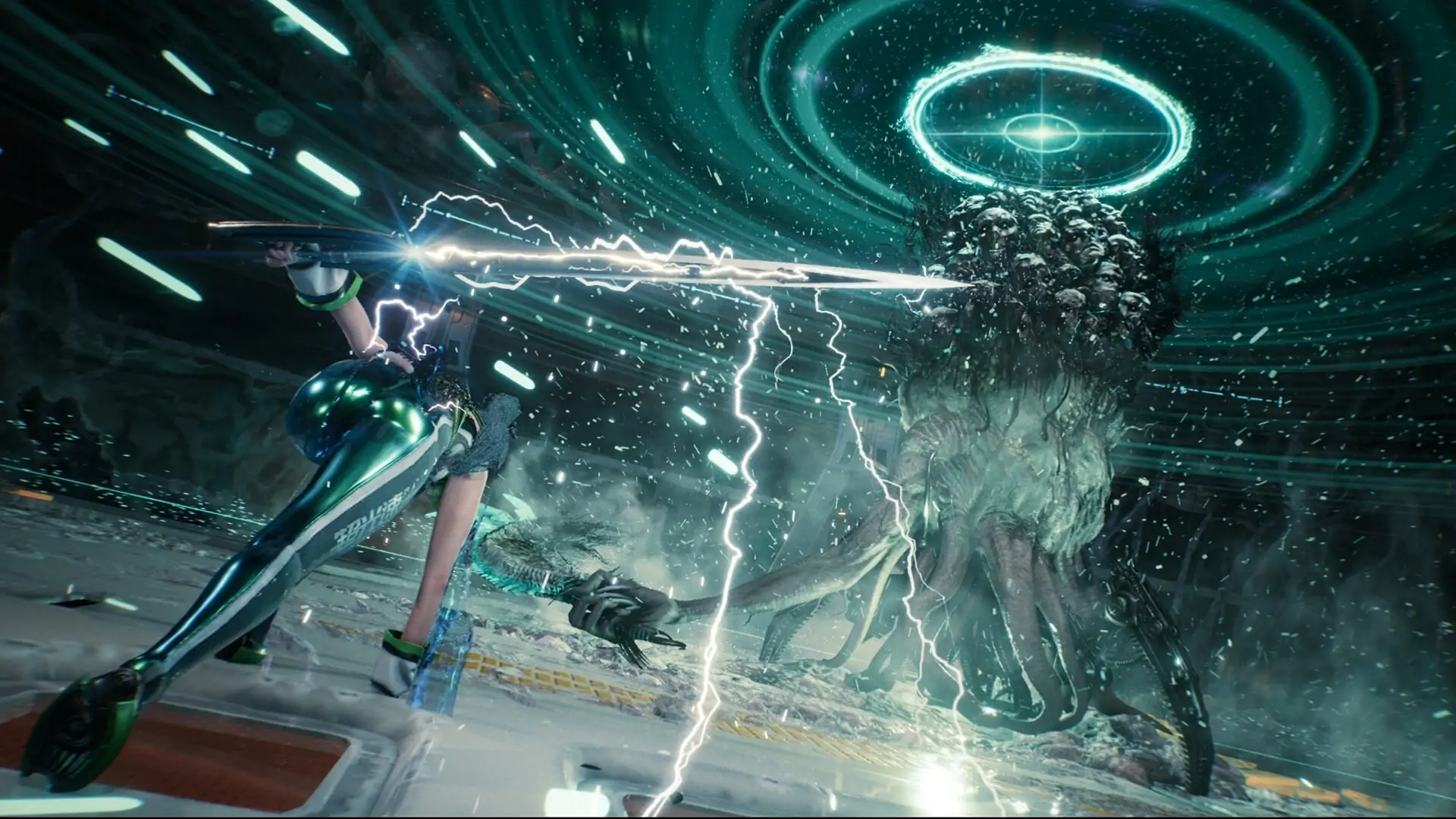
However, the reality of this technical compromise became evident when the demo version of Stellar Blade Complete Edition reached consumers. While the interpolated 60 FPS successfully delivered visual fluidity on paper, it introduced side effects inherent to frame generation algorithms, such as visual artifacts, ghosting around fast-moving character models, and a slight input latency penalty. For a game heavily reliant on split-second combat reflexes, these minor discrepancies carry significant gameplay consequences.
Community Backlash and the Official Response from Shift Up
Following the demo’s public release, community forums and social media channels were flooded with detailed feedback regarding the implementation of FSR 3.1. Players noted that while the visual smoothness was appreciated during exploration, the interpolation process compromised the responsiveness required during high-stakes boss battles where precision is paramount.
Demonstrating responsiveness to its player base, Shift Up took to official channels—including a widely circulated statement on social media platform X—to address these concerns directly. The studio confirmed that the full release of Stellar Blade on the Switch 2 would not enforce frame generation as a mandatory visual setting. Instead, a dedicated settings toggle will be incorporated into the graphics menu, granting users the freedom to deactivate FSR 3.1 frame interpolation entirely in favor of a locked, native 30 FPS rendering pipeline.
Technical Analysis: The Trade-Offs of Frame Generation on Handheld Hardware
The integration of frame generation into modern gaming has revolutionized how developers optimize titles for lower-powered systems, yet it remains a polarizing feature among hardcore gamers. Traditional frame rates are achieved by the graphics processor rendering entirely new, unique frames sequentially. In contrast, frame generation techniques—such as FSR 3.1 interpolation—analyze two consecutive native frames and synthesize an intermediate frame based on motion vectors.

In the context of Stellar Blade on the Nintendo Switch 2, this technology presents a complex engineering dilemma. Action RPGs and character-action games demand rigorous timing for fundamental combat mechanics, specifically dodging incoming attacks and executing parries. When an interpolated frame is inserted between two real frames, the visual feedback presented to the player does not strictly align with the internal game logic’s input window.
While the human eye perceives a smoother motion flow at 60 interpolated frames per second, the actual latency—the time it takes from pressing a button on the controller to seeing the corresponding action on screen—frequently remains tied to the base native frame rate (in this case, 30 FPS). For precision-based combat systems, this delta can induce input lag, making tight parry windows notoriously difficult to nail consistently. By offering the option to disable FSR 3.1, Shift Up ensures that purists and competitive players can prioritize input responsiveness and visual clarity over raw, interpolated frame counts.
Broader Industry Implications for Porting AAA Titles
Shift Up’s policy adjustment serves as a critical case study for developers porting high-end console and PC titles to hybrid platforms like the Nintendo Switch 2. As consumer expectations for portable hardware rise, developers are increasingly tasked with delivering visually demanding experiences without sacrificing core gameplay integrity.
The reliance on heterogeneous software solutions—mixing Nvidia upscaling technologies with AMD interpolation frameworks—highlights the creative engineering required to maximize next-generation portable hardware. Yet, the consumer backlash and subsequent developer concession emphasize an immutable rule in modern game development: player choice must remain paramount. Forcing a one-size-fits-all performance mode rarely satisfies a diverse gaming community that weighs visual fidelity, fluidity, and mechanical responsiveness differently.
Looking forward, the launch of Stellar Blade on the Nintendo Switch 2 will serve as a benchmark for how third-party AAA titles manage performance optimization on hybrid consoles. With the inclusion of the FSR 3.1 toggle, players will no longer be passive recipients of aggressive developer optimizations, but active participants in tailoring their gaming experience. Whether users choose the heightened visual fluidity of interpolated 60 FPS or the pristine, uncompromised input timing of native 30 FPS, the ultimate power now rests firmly in the hands of the player.