
 Azin Asro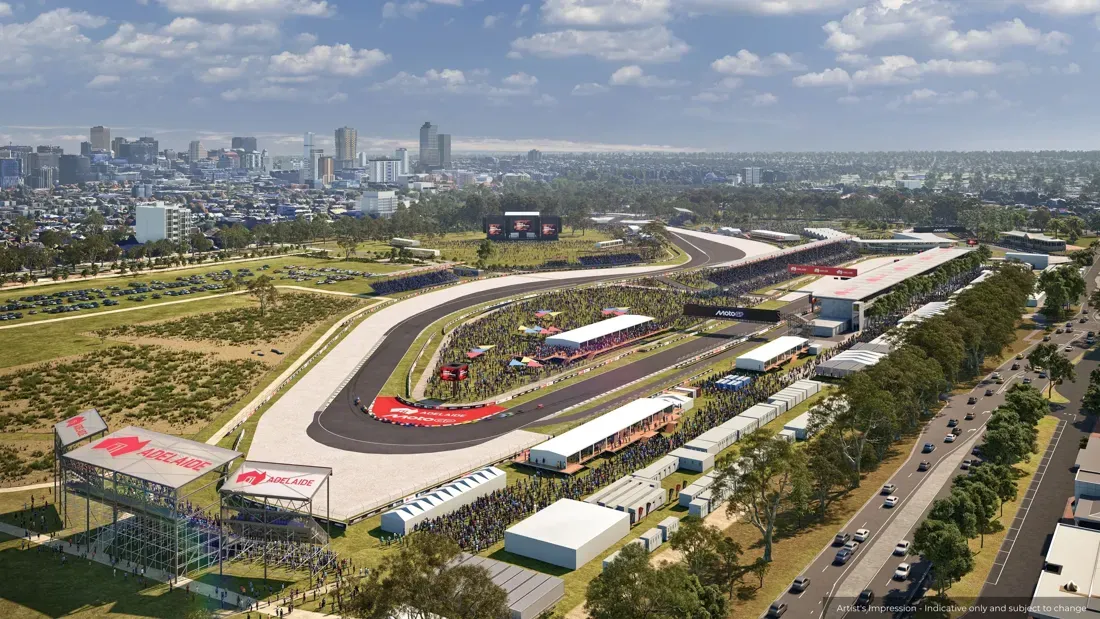
Plans to bring the premier class of motorcycle Grand Prix racing to the streets of South Australia have hit a significant roadblock, placing the inaugural MotoGP Adelaide 2027 in serious jeopardy before a single motorcycle has taken to the tarmac. The ambitious project, which was designed to take over the Australian Grand Prix hosting rights from the historic Phillip Island circuit, is now facing fierce legal challenges in the Federal Court of Australia. At the center of the dispute is a contentious environmental backlash revolving around urban conservation, infrastructure demands, and the impending destruction of hundreds of mature trees to meet stringent international racing safety standards.
The controversy underscores a growing global tension between hosting high-profile motorsport events and adhering to modern environmental and sustainability benchmarks. With the race tentatively scheduled as the 21st round of the 2027 MotoGP World Championship on November 12, organizers, local authorities, and racing fans alike are watching anxiously as the legal battle unfolds in Australian courts.
Background and Context of the Adelaide MotoGP Project
The announcement that MotoGP would return to Adelaide sent shockwaves through the motorsport community. Adelaide is no stranger to world-class racing; the city previously hosted the prestigious Formula 1 Australian Grand Prix on its famous street circuit through the picturesque parklands from 1985 to 1995 before the event relocated to Melbourne. The city has since maintained its motorsport heritage through the Supercars Championship’s Adelaide 500, utilizing a modified version of the original layout.
However, adapting a metropolitan street circuit to accommodate the extreme speeds, safety protocols, and technical specifications of modern MotoGP machines is an exponentially more complex undertaking than hosting touring cars or even Formula 1 machinery. The Fédération Internationale de Motocyclisme (FIM), the global governing body of motorcycle racing, enforces rigorous homologation standards to protect riders in the event of high-speed crashes. These standards dictate precise run-off areas, gravel traps, impact-absorbing barriers, and expansive clear zones adjacent to the racing line.
Under the current blueprint for the Adelaide street circuit, achieving FIM Grade A compliance requires substantial civil engineering work. Most critically, the expansion of run-off zones to decelerate riders safely in case of a loss of control requires the clearing of parkland surrounding the track layout. Reports indicate that approximately 400 mature trees would need to be felled to accommodate these safety alterations, sparking immediate and intense opposition from environmental groups, local residents, and conservation advocates.
Chronology of Events and Legal Escalation
The friction between event promoters and environmental defenders escalated rapidly throughout the second half of 2026. The sequence of events leading to the current legal stalemate highlights the fast-moving nature of modern sports infrastructure disputes:
- Early 2026: Preliminary proposals and feasibility studies for hosting the Australian Motorcycle Grand Prix in Adelaide starting in 2027 gain momentum, backed by regional tourism and economic development stakeholders.
- Mid-2026: Official announcements confirm that Adelaide will replace Phillip Island as the home of the Australian Grand Prix, utilizing a specially modified street circuit in the heart of the city, slated for November 12, 2027.
- August 2026: Environmental impact assessments reveal the scale of infrastructure changes required for FIM homologation, specifically highlighting the necessity of removing roughly 400 trees within the designated parkland areas.
- September 18, 2026: Following failed negotiations and mounting public protests, a coalition of environmental and community groups officially files a formal lawsuit against the project in the Federal Court of Australia.
- September 28, 2026: Public disclosures confirm that all construction, site preparation, and homologation processes have been legally mandated to halt pending judicial review.
The intervention of the Federal Court has effectively frozen the timeline. As of late September 2026, all physical work on the circuit is suspended, and no definitive date has been set for the commencement of hearings or the delivery of a final verdict.
Implications of the Construction Halt and Tightening Timeline
With the race calendar slated for late 2027, project managers initially believed they had a comfortable buffer of approximately 14 months to complete the necessary urban transformations. Street circuit construction is notoriously intricate, requiring resurfacing, utility relocation, temporary grandstand erection, pit lane construction, and the installation of specialized debris fences.
However, civil engineering projects of this magnitude typically require a continuous, uninterrupted workflow to meet strict delivery deadlines. The legal injunction brings all preliminary groundwork to a grinding halt. Even if the court rules in favor of the promoters in the coming months, the lost weeks—and potentially months—of preparation time will compress the remaining construction schedule dramatically.
Furthermore, civil engineering delays invariably lead to budget overruns. If the court mandates alternative engineering solutions to preserve a significant portion of the threatened trees—such as constructing expensive cantilevered run-off structures or altering the track layout entirely—the financial viability of the event could be called into question. Promoters and local government bodies face the daunting prospect of exponentially higher capital expenditures just to bring the circuit up to FIM regulatory standards.
The Broader Context of the Australian Grand Prix Transition
The move from Phillip Island to Adelaide was envisioned as a strategic masterstroke to boost commercial revenue, enhance global viewership, and leverage Adelaide’s superior urban infrastructure, hotel capacity, and transport networks. Phillip Island, located on the Victorian coast, is universally beloved by riders and purists for its fast, flowing layout and breathtaking ocean backdrop. However, the venue has long faced logistical criticisms regarding limited accommodation, narrow access roads, and unpredictable weather conditions that complicate fan mobility and event logistics.
Adelaide offered a modern, accessible alternative capable of hosting tens of thousands of international tourists within a metropolitan hub. Yet, the decision to abandon a purpose-built racing facility in favor of a temporary street circuit has reopened a fierce philosophical debate within the motorsport community. Purists argue that modern MotoGP machines, which routinely exceed 350 kilometers per hour on straightaways, do not belong on narrow city streets flanked by concrete walls and parkland trees. Conversely, commercial promoters argue that street circuits bring the sport directly to the populace, driving massive economic stimulation and global engagement.
The environmental angle adds a complex layer that cannot be easily dismissed in contemporary event management. Urban parklands in Adelaide are fiercely protected public assets, valued by the community for their ecological significance, recreational space, and aesthetic contribution to the city’s urban design. The prospect of losing hundreds of mature trees for a temporary sporting spectacle has mobilized a formidable grassroots resistance that views the project through the lens of climate responsibility and urban preservation.
Perspectives and Stakeholder Reactions
While official corporate statements from event organizers remain measured, emphasizing their commitment to working within the legal framework, behind-the-scenes tension is palpable.
Event Promoters and Tourism Authorities: Proponents of the Adelaide street circuit argue that the economic windfall of hosting a world championship round will inject hundreds of millions of dollars into the South Australian economy. They maintain that civil works will be executed with minimal long-term ecological damage and that comprehensive replanting and environmental offset schemes will be implemented to mitigate the loss of flora. However, the legal freeze prevents them from executing these proposed mitigation strategies.
Environmental and Legal Advocates: Plaintiffs in the Federal Court case argue that the environmental cost is unacceptably high and that alternative locations—or retaining Phillip Island as the host venue—should have been exhausted before committing to urban deforestation. They contend that statutory environmental protections must take precedence over commercial entertainment ventures, regardless of their international prestige.
FIM and Dorna Sports: The governing bodies of MotoGP, overseen commercially by Dorna Sports, find themselves in a delicate position. While the expansion of the calendar into major metropolitan markets aligns with their global commercial growth strategy, the integrity and safety of the championship remain paramount. Dorna and the FIM require absolute certainty regarding circuit homologation well in advance of the season opener. If the legal uncertainty persists deep into 2027, MotoGP official management may be forced to trigger contingency plans, which could include reinstating Phillip Island as the Australian Grand Prix host for the 2027 season or shifting the round to an entirely different venue in the Asia-Pacific region.
Outlook for the 2027 MotoGP Season and Beyond
The 2027 season is already heralded as a watershed moment for MotoGP, coinciding with major technical regulations overhauls regarding engine displacement, aerodynamics, and sustainable fuels. A high-profile debut in Adelaide was intended to serve as a flagship showcase for this new era of motorcycle racing.
Instead, the event now stands at a precarious crossroads. The legal battle in the Federal Court of Australia will serve as a definitive litmus test for how modern democracies balance large-scale commercial sports tourism with rigorous environmental preservation laws.
As the legal teams prepare their arguments and the clock ticks down toward November 2027, the future of the MotoGP Adelaide Grand Prix remains shrouded in uncertainty. Whether the circuit will rise from the parklands of South Australia or whether the legal challenges will ultimately compel promoters to abandon the city street concept entirely will be determined in the courtroom over the coming months. Until a definitive judicial verdict is reached, the global motorsport community will watch and wait to see if the world’s fastest riders will truly race through the heart of Adelaide, or if environmental concerns will successfully halt the engines before they even start.









