
 Chalifah Fatihah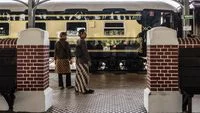
Jakarta, Indonesia — In an effort to preserve the rich historical tapestry of national transportation, PT Kereta Api Indonesia (Persero) recently spearheaded a distinctive educational and cultural excursion across several of the capital’s oldest railway corridors. The event brought together a diverse group of participants, including members of prominent railway enthusiast communities, professional historians, active-duty employees, and retired personnel who dedicated decades of service to the state-owned enterprise. The primary objective of this immersive initiative was to reintroduce the general public to the monumental heritage of Indonesia’s railway infrastructure, highlighting its pivotal role in shaping the socioeconomic development of Jakarta and the surrounding regions from the colonial era to the modern metropolitan landscape.
The carefully curated journey served as both a nostalgic reunion for veteran railroaders and an eye-opening historical exploration for younger generations. By traversing legacy routes that have witnessed more than a century of profound urban transformation, the participants engaged in a moving tribute to the engineering marvels of the past. As Indonesia continues to modernize its mass rapid transit and mainline rail networks, events of this nature underscore the enduring cultural value of preserving historical rail corridors, rolling stock, and architectural landmarks that tell the story of the nation’s industrial evolution.
Main Facts of the Heritage Excursion
The commemorative expedition took place across strategic railway segments within the Jakarta operational area, utilizing vintage-themed arrangements to evoke the atmosphere of early 20th-century rail travel. The participant demographic was deliberately multifaceted to ensure a rich exchange of knowledge and personal anecdotes. Railway enthusiasts brought analytical passion and deep archival knowledge; historians provided academic context regarding the geopolitical and economic significance of early rail development; current employees connected past operational standards with modern safety protocols; and retired personnel shared invaluable firsthand accounts of working the rails during periods of immense political and social transition in Indonesia.
Throughout the tour, participants visited several pivotal historical sites, including heritage stations that retain their original architectural integrity, vintage depots, and historic junction points that once served as the lifeblood of regional trade. Informative briefings and mobile lectures were conducted onboard and at designated stops, detailing how these iron roads facilitated the movement of agricultural goods, industrial materials, and human capital long before the advent of modern highway systems.
Historical Context and Chronological Evolution
To fully grasp the significance of PT KAI’s heritage initiative, one must examine the chronological progression of railways in Jakarta, historically known as Batavia. The genesis of rail transport in Indonesia dates back to the mid-19th century under the Dutch colonial administration. The first official railway line in the Dutch East Indies was formally opened on June 17, 1867, connecting the agricultural region of Kemijen to Tanganggung in Central Java, constructed by the Nederlandsch-Indische Spoorweg Maatschappij (NISM).
The expansion soon reached Batavia, driven by the colonial government’s pressing need to transport commodities such as sugar, coffee, and rubber from inland plantations to the bustling port of Tanjung Priok for export to European markets. By the late 1870s and 1880s, urban and suburban rail networks began to take shape within Batavia, connecting the old port city (Kota) with Meester Cornelis (now Jatinegara) and Buitenzorg (now Bogor). This network was managed by a consortium of private and state-owned enterprises, notably the Staatsspoorwegen (SS), which formally operated state lines starting in 1875.
During the Japanese occupation (1942–1945), the railway network experienced severe strain, yet it remained a critical logistical asset for military operations. Following the proclamation of Indonesian independence on August 17, 1945, brave Indonesian railway workers—known as Angkatan Moeda Kereta Api (AMKA)—heroically seized control of railway installations from Japanese forces. This monumental takeover culminated on September 28, 1945, an event now commemorated annually as National Railway Day (Hari Kereta Api Nasional), leading to the establishment of Djawatan Kereta Api Repoeblik Indonesia (DKARI).
The post-independence era saw the network adapt to the sprawling urbanization of Jakarta. Steam locomotives gradually gave way to diesel propulsion in the 1950s and 1960s, which was subsequently supplemented by the introduction of electric rail systems (KRL) in the late 1970s and 1980s to accommodate the burgeoning commuter population. Today, PT Kereta Api Indonesia manages these historic corridors while simultaneously upgrading them for modern high-capacity commuter services, light rail integration, and high-speed rail connections.
Supporting Data on Modern Heritage Preservation
PT KAI’s recent event is part of a broader, institutionalized effort to catalogue, preserve, and monetize its extensive portfolio of historical assets. According to corporate sustainability and cultural heritage reports released by PT KAI, the company oversees dozens of heritage buildings categorized as protected cultural properties (cagar budaya) under Indonesian Law No. 11 of 2010 on Cultural Heritage.
Data compiled by the Indonesian Railway Preservation Community (IRPC) in collaboration with PT KAI indicates that the Jakarta operational area alone contains over thirty structures of significant historical value, including 19th-century terminal stations, signal towers, water towers, and maintenance workshops. Furthermore, PT KAI has successfully restored several vintage steam and diesel locomotives, placing them in operational condition for special heritage tourism packages.
Passenger statistics for heritage-themed excursions have shown a steady upward trajectory over the past five years. Prior to the COVID-19 pandemic, specialized heritage train trips recorded an average annual participation increase of 15%. Post-pandemic recovery phases have witnessed an even stronger resurgence of domestic interest in historical tourism, with domestic travelers increasingly seeking educational, experiential, and sustainable leisure activities. The involvement of retired personnel in these events also provides a vital intergenerational bridge, ensuring that oral histories and technical lore are formally documented before they are lost to time.
Official Responses and Stakeholder Perspectives
Corporate communications representatives from PT KAI emphasized that the initiative was designed not merely as a recreational outing, but as a strategic educational campaign to foster a sense of national ownership over public infrastructure.
"Railways in Indonesia are not just a commercial mode of mass transportation; they are the literal tracks upon which our modern nation was built," stated a senior PT KAI corporate affairs representative. "From transporting the founding fathers to sustaining economic lifelines during times of crisis, our tracks carry our history. By bringing together railway communities, historians, and our loyal retirees, we are validating the immense sacrifices and dedication of generations past while inspiring the public to help us protect this heritage for the future."
Representatives from the railway enthusiast community also lauded the event for its depth and accessibility. A spokesperson for the Indonesian Railway Preservation Society noted that public engagement with rail history has traditionally been limited to online forums and static museum visits.
"Experiencing these historic lines firsthand, accompanied by the people who maintained them and the historians who contextualize them, transforms abstract history into a living reality," the spokesperson remarked. "It bridges the gap between cold steel infrastructure and human stories. We hope PT KAI will institutionalize this event into a recurring calendar feature, expanding it to other historic regions across Java and Sumatra."
Retired employees who participated in the journey expressed profound emotional resonance upon returning to active rails in a celebratory capacity. Many shared technical memories of operating older locomotive classes, managing mechanical signaling systems, and navigating the operational challenges of Jakarta’s dense urban corridors during the mid-to-late 20th century. For these veterans, the tour served as an official acknowledgment of their lifelong contributions to national mobility.
Broader Impact and Implications for Urban Heritage Tourism
The successful execution of this heritage railway excursion carries significant implications for urban planning, cultural preservation, and tourism development in Jakarta. As the capital transitions its administrative center and grapples with chronic traffic congestion and environmental concerns, the integration of historical awareness into modern transit planning offers a powerful counterweight to rapid, disjointed modernization.
First, the initiative enhances cultural tourism potential. Major global metropolises leverage their historic transport systems—such as the London Underground, the New York Subway, and European historic tram networks—as core pillars of urban tourism. Jakarta possesses an equally compelling industrial narrative. By systematically preserving heritage stations, rolling stock, and archival documentation, PT KAI can position Jakarta as a premier destination for industrial heritage tourism, attracting both domestic and international visitors interested in colonial and post-independence history.
Second, the involvement of diverse stakeholders fosters community stewardship. When local communities, historians, and everyday commuters understand the historical weight of the infrastructure surrounding them, instances of vandalism, encroachment, and infrastructure neglect naturally decrease. Public pride translates directly into civic protection of public assets.
Finally, the initiative reinforces PT KAI’s corporate social responsibility (CSR) profile and corporate identity. In an era where commercial efficiency often dominates public perception of transportation providers, proactive investments in cultural heritage demonstrate corporate empathy, historical accountability, and a commitment to holistic national development. By honoring its veterans, educating its youth, and collaborating with historians, PT KAI ensures that the iron roads of Indonesia remain not only engines of economic progress, but also enduring monuments of national identity.








