Bambang Pamungkas
Urban congestion, environmental degradation, seismic vulnerabilities, and the overwhelming concentration of economic power in single metropolitan hubs have long plagued modern nation-states. In response to these compounding crises, governments across the globe are increasingly turning toward a bold, albeit complex, strategic solution: the large-scale relocation of their national capitals. Moving an administrative seat is rarely a simple logistical exercise; it represents a profound socio-economic transformation, a massive capital investment, and a reimagining of how a nation manages its territory. While some countries are witnessing the nascent stages of visionary master plans, others are already managing functioning administrative cities or navigating the painful delays born of political instability and budgetary constraints.
The global trend of capital relocation is driven by the urgent need to decentralize populations and modernize aging infrastructure. Mega-cities like Jakarta, Cairo, Tehran, Seoul, and Juba have historically served as the political, cultural, and financial hearts of their respective countries. However, their unchecked expansion has rendered them increasingly unsustainable. Traffic gridlocks cost billions in lost productivity, while heavy industrialization and dense vehicular emissions severely compromise air quality. Furthermore, ecological pressures—ranging from rapid land subsidence to severe water scarcity and flood risks—pose existential threats to millions of urban residents. By carving out new urban centers from forests, coastal plains, or inland grasslands, governments hope to achieve balanced regional development, enhance administrative efficiency, and build climate-resilient cities for future generations.
Indonesia Leads the Charge with Nusantara
Among the most ambitious relocation efforts globally is Indonesia’s historic transition from Jakarta to Nusantara. For decades, Jakarta has served as the undisputed center of the archipelago. Yet, the megacity on the island of Java has paid a heavy price for its rapid growth. Jakarta suffers from some of the worst traffic congestion in Southeast Asia, rampant air pollution, and a severe crisis of land subsidence. Driven by excessive groundwater extraction and rising sea levels, parts of North Jakarta are sinking by up to 15 centimeters per year, leaving large tracts of the city vulnerable to catastrophic coastal flooding. Furthermore, Java accounts for more than half of Indonesia’s total population and generates a disproportionate share of the nation’s gross domestic product, exacerbating regional inequality across the sprawling archipelago.
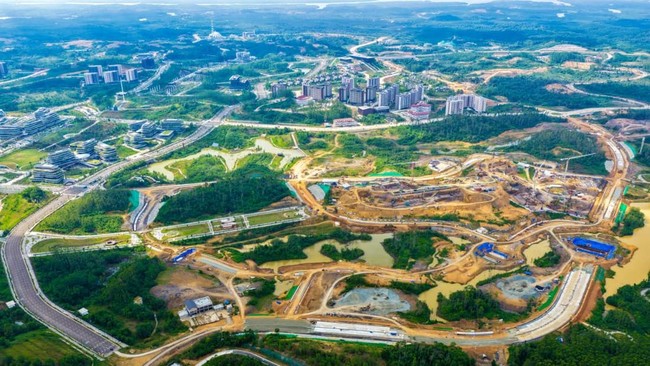
To break this cycle, the Indonesian government initiated the construction of Nusantara, located in the jungles of East Kalimantan, roughly 1,200 kilometers northeast of Jakarta. Envisioned as a green, smart "forest city," Nusantara aims to balance modern digital infrastructure with ecological preservation, ensuring that at least 70 percent of the designated area remains green space. The master plan emphasizes renewable energy, electric public transport, and waste-to-energy systems. The relocation process is structured across multiple decades, with the initial phase focusing on establishing the core government precinct (KIPP), including the Presidential Palace and key ministerial offices, to facilitate the official transfer of state duties. Despite facing challenges related to investor acquisition and logistical hurdles in remote terrain, the project signifies a paradigm shift in Indonesia’s development philosophy, pivoting the nation’s center of gravity away from Java toward its eastern frontiers.
Iran Weighs the Makran Coast Strategy
In the Middle East, Iran faces a distinct set of urban and environmental pressures that have repeatedly forced the government to contemplate moving its capital away from Tehran. Home to over nine million residents in the city proper and millions more in its metropolitan area, Tehran is plagued by severe air pollution trapped by surrounding mountain ranges, crippling traffic congestion, and a high risk of catastrophic earthquakes due to its location on major fault lines. The city’s rapid expansion has also placed immense strain on its water supply, leading to dwindling aquifers and worsening environmental degradation.
As a strategic countermeasure, Iranian authorities have proposed shifting the political and administrative center to the Makran region along the country’s southeastern coast. Proponents of the Makran relocation argue that moving the capital to the Gulf of Oman would not only relieve Tehran’s systemic congestion but also stimulate maritime trade, naval security, and economic development in Iran’s under-resourced border regions. However, the proposal remains largely in the exploratory and theoretical phases. Unlike projects with active construction phases, Iran’s plan faces significant bureaucratic hurdles, astronomical projected costs, and a lack of a fixed timeline, making it a long-term geopolitical ambition rather than an imminent reality.
South Korea’s Decentralization Model via Sejong City
Rather than abandoning its historic capital entirely, South Korea opted for a unique hybrid model of decentralization by establishing Sejong City. Located approximately 120 kilometers south of Seoul, Sejong was officially launched in 2012 as an administrative city designed to alleviate the crushing demographic and economic pressure on the Seoul National Capital Region, which houses nearly half of the nation’s entire population.
The creation of Sejong was born out of a desire to promote balanced national development and reduce regional disparities. Over the past decade, dozens of central government ministries, agencies, and state-run research institutes have been relocated to Sejong, transforming it into the nation’s primary administrative hub. Despite this massive migration of civil servants, Seoul retains its constitutional status as the official capital of South Korea. Sejong has since evolved into a pioneering "smart city," outfitted with cutting-edge Internet of Things (IoT) infrastructure, autonomous vehicle testing zones, and advanced district heating systems. While the dual-capital arrangement introduces certain logistical inefficiencies for lawmakers commuting between Seoul and Sejong, the model is widely studied globally as a pragmatic compromise that achieves regional redistribution without severing historical ties.
Egypt’s New Administrative Capital: Relieving Kairo’s Pressure
In North Africa, the Arab Republic of Egypt is executing one of the largest urban engineering projects of the 21st century: the construction of the New Administrative Capital (NAC). Situated roughly 45 kilometers east of Cairo, out in the desert toward the Suez Canal corridor, the mega-project was officially announced in 2015 under the leadership of President Abdel Fattah el-Sisi. The primary catalyst for the move is the severe overpopulation and infrastructural strain facing Cairo, a historic metropolis bursting with over 20 million residents. Cairo’s crumbling infrastructure, narrow streets, and chronic traffic gridlock have long hindered bureaucratic efficiency and degraded the quality of life for its citizens.
The New Administrative Capital is designed to be a futuristic, technology-driven metropolis capable of housing millions of residents and functioning as a modern financial and diplomatic center. The city features iconic architectural landmarks, including Africa’s tallest tower, an extensive monorail network, and a vast central business district. The government has already begun the phased relocation of key ministries, parliament buildings, and state institutions into the new district. By drawing government functions and commercial enterprises away from Cairo, Egypt aims to create a more resilient administrative core while revitalizing the surrounding real estate and industrial sectors.
Sudan Sudan’s Unfulfilled Vision of Ramciel
In East Africa, Sudan Selatan’s quest for a new capital highlights the profound challenges that political instability and financial constraints can impose on grand national visions. Following its hard-won independence from Sudan in 2011, the government of South Sudan announced plans to relocate its capital from Juba, a congested frontier town situated on the White Nile, to Ramciel, a geographically central location in Lakes State.
The rationale behind the move was deeply strategic. Juba’s rapid, unplanned growth following the end of decades of civil war strained local resources, while its southern location created perceptions of regional bias. Ramciel was envisioned as a neutral, unifying ground that would bridge ethnic divides, foster national cohesion, and provide a blank canvas for a purpose-built capital. However, the nation’s aspirations have been severely hampered by prolonged internal conflicts, severe economic crises, and an acute lack of public and private financing. More than a decade after gaining independence, the move to Ramciel remains largely on paper, and Juba continues to serve as the functional, albeit overburdened, capital of the world’s youngest nation.
Broader Implications and Economic Realities
The global wave of capital relocations underscores a fundamental shift in how nations approach territorial management and urban planning in an era of climate change and explosive demographic growth. Whether through the complete territorial pivot seen in Indonesia and Egypt, the administrative decentralization practiced by South Korea, or the delayed ambitions of nations like Iran and South Sudan, the underlying motivations remain remarkably consistent: political modernization, risk mitigation, and economic equity.
However, financial analysts and urban planners caution that these mega-projects carry enormous risks. The fiscal cost of constructing a capital city from scratch places immense pressure on national budgets, often requiring heavy foreign investment, public-private partnerships, or significant sovereign borrowing. Furthermore, if not managed transparently, such projects can exacerbate wealth inequality, trigger real estate speculation, and cause environmental disruption in previously untouched ecosystems.
Ultimately, the success of these capital relocations depends not only on architectural ambition and engineering prowess, but on sustained political will, robust financial planning, and inclusive governance. As these five nations continue to navigate their respective transitions, their experiences will serve as a critical blueprint—and a cautionary tale—for other governments seeking to reengineer their futures from the ground up.