Nila Kartika Wati
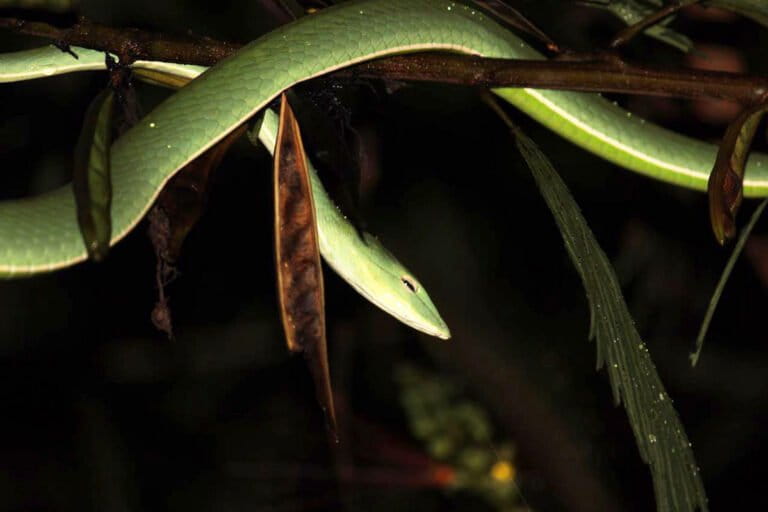
The slender, vibrant green form of the Oriental whipsnake, known scientifically as Ahaetulla prasina, is a master of camouflage. Often found coiled among the emerald foliage of trees or draped across branches like a living vine, this reptile remains largely invisible to the untrained eye. However, recent field research conducted by academics and conservationists in West Java, Indonesia, is shifting the narrative surrounding these often-misunderstood serpents. By documenting their presence in areas ranging from urbanized riverbanks to protected forest reserves, experts are highlighting how Ahaetulla prasina serves as a critical, yet overlooked, sentinel of ecological health.
A Study of Adaptability in Diverse Habitats
Clarissa Amelia, a biology student at the Bandung Institute of Technology (ITB), has spent significant time documenting the behavior of the Oriental whipsnake. Her research, which spans the urban-adjacent Cikacika River in Bandung and the more pristine Taman Buru Masigit Kareumbi in Sumedang, provides a compelling look at the reptile’s adaptability.
"The ability of the Oriental whipsnake to thrive in two vastly different habitat conditions is remarkable," Amelia observed. Her field notes reveal a creature that is far less aggressive than popular myths suggest. During her nocturnal and diurnal observations, she noted that the snakes frequently remained in the same spot for extended periods. While Ahaetulla prasina is biologically classified as a diurnal hunter, Amelia’s findings suggest a high degree of energy conservation, with individuals often found resting in the same foliage where they spent the previous day.
This calm demeanor stands in stark contrast to the fear often elicited by their presence. Their unique, horizontal pupils give them an almost contemplative expression, and while they possess a mild venom—classified as back-fanged or opisthoglyphous—they rarely strike unless severely threatened. The venom is primarily specialized for immobilizing small prey rather than defending against large mammals or humans.
The Arboreal Niche: Vegetation as a Biological Sanctuary
To understand the survival of the Oriental whipsnake, one must understand the anatomy of its habitat. As an arboreal species, the snake is inextricably linked to the vertical architecture of forests and shrublands. Adian Dwi Sulistio, an expert from the Endemic Indonesia Society, emphasizes that vegetation acts as a critical refuge.
"Shrubs, root systems, tree trunks, and wetland margins provide more than just a home for these snakes; they serve as a biological sanctuary," Sulistio explains. When these green spaces are cleared for infrastructure or urban expansion, the snakes are forced into human-occupied areas, such as drainage systems or residential gardens. These locations, however, are not ideal. The lack of natural cover makes them vulnerable to predators and human persecution, while the absence of suitable prey disrupts their natural hunting patterns.
The Role of the Mesopredator in Ecosystem Stability
Ecologically, the Oriental whipsnake functions as a mesopredator—an intermediate-level predator that plays a pivotal role in controlling populations of smaller animals. Its diet consists of amphibians, lizards, and small birds. In the context of agricultural landscapes, this predatory behavior takes on economic significance.
In many Indonesian provinces, small birds such as the Eurasian tree sparrow (Passer montanus) and various species of munia are considered agricultural pests, often destroying rice crops and grain stocks. Because the Oriental whipsnake actively hunts these birds, it serves as a natural form of biological pest control.
"If farmers were fully aware of the symbiotic relationship between the Oriental whipsnake and their crop protection, the narrative would change," says Sulistio. "Instead of viewing these snakes as threats to be eradicated, they would be recognized as essential allies in agricultural sustainability. Education is the bridge between fear and cooperation."
Historical Context and the Stigma of the Serpent
The negative stigma surrounding snakes is deeply rooted in folklore and a fundamental lack of ecological literacy. Historically, snakes have been perceived as symbols of danger, leading to a "kill-on-sight" response from the general public. This reactive behavior is a significant obstacle to conservation efforts in Indonesia.
Chronologically, the decline of natural habitats in regions like Bandung has accelerated over the last two decades. As urban sprawl encroaches upon riparian zones and secondary forests, human-snake encounters have increased. This rise in encounters has not been met with an increase in public knowledge regarding snake behavior, leading to unnecessary fatalities for both the reptiles and, in rare, mishandled cases, potential danger to humans.
Data from local conservationists suggest that while the Oriental whipsnake is not currently listed as an endangered species under international trade regulations, its local populations are increasingly fragmented. The loss of corridors—continuous strips of vegetation that allow wildlife to move between patches of habitat—is the single greatest threat to the species.
Implications for Urban Planning and Conservation
The findings presented by researchers like Amelia and organizations like the Endemic Indonesia Society underscore the urgent need for "snake-inclusive" urban planning. This does not imply that wild animals should be encouraged into homes, but rather that city planners must prioritize the retention of green corridors and native vegetation.
The presence of the Oriental whipsnake in urban areas is an indicator of environmental quality. A city that supports a population of mesopredators is one that maintains a level of biodiversity capable of supporting a food chain. When these snakes disappear, it is often a sign that the local ecosystem has become too degraded to support the smaller creatures that form the base of the food web.
Bridging the Gap: Education and Coexistence
The transition from a culture of fear to one of stewardship requires a multi-pronged approach. First, there is a need for accurate, accessible information regarding snake identification. Most people in Indonesia lack the ability to distinguish between a mildly venomous snake like the Oriental whipsnake and highly venomous species, leading to a generalized fear of all reptiles.
Second, community-led initiatives in areas like Sumedang have shown that when local populations are educated about the specific roles snakes play in agriculture, attitudes shift rapidly. In many cases, community members who previously killed snakes have become protectors of the local habitat, recognizing that the snakes are effectively working for them by keeping pest populations in check.
Conclusion: The Future of the Oriental Whipsnake
The story of the Oriental whipsnake is a microcosm of the broader struggle for biodiversity in the 21st century. As urbanization continues to reshape the landscape, the species serves as a reminder of the fragility of the natural world. Its survival is not merely a matter of preservation for the sake of the animal itself, but a matter of maintaining the functional integrity of the ecosystems that humans also rely upon.
By fostering a deeper understanding of the Oriental whipsnake, researchers hope to mitigate the human-wildlife conflict that currently threatens many of the world’s most vulnerable species. Whether in the depths of a protected forest or the branches of a tree in a busy city center, the Oriental whipsnake remains a silent, essential participant in the balance of nature. The challenge moving forward lies in the hands of the public: to move past ancestral fears and embrace a science-based approach to living alongside these elegant, arboreal predators.
As the environmental landscape continues to evolve, the continued documentation and observation of these creatures will be vital. Only through empirical research and sustained public engagement can the narrative of the snake be rewritten—from a creature of fear to a symbol of ecological resilience and necessity.