Nila Kartika Wati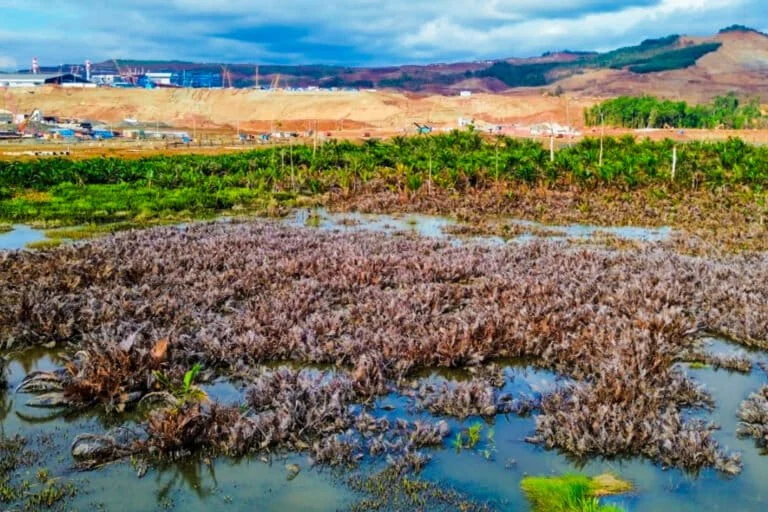
Junaid Nomor can only stare vacantly at the blackened expanse of sago palm forests lining the road on his journey from his village to the Akelamo River. The sago forest, once a lush reservoir of traditional sustenance, is now submerged under thick layers of mud and sedimentation—the runoff from massive dredging operations on the nearby hills that has spilled into the wetlands where the sago once thrived. "The sago palms are all dead," Junaid said, gesturing toward the skeletal remains of the forest during a visit to the site with fellow residents. "The company cleared some for housing, buried others, and the rest they simply let die."
Junaid is a resident of Kawasi Village, located in the Obi District of South Halmahera, North Maluku. For generations, he and his neighbors processed sago collectively to meet their daily food needs. The plants grew wild and abundant, a testament to the fertile volcanic soil of the island. Today, that landscape has been transformed into a barren industrial wasteland. No one in Kawasi processes sago anymore. The community’s primary food source has been reallocated by the government to accommodate mining concessions and the expansion of the Harita Nickel industrial project, a massive operation under the Harita Group.
The shift is not merely environmental; it is a fundamental transformation of a way of life. "No one makes sago now," Junaid explained. "Everyone eats rice. If we want sago, we have to buy it from neighboring villages or traders in the market. Everything here is now part of the company’s area." The Harita Nickel industrial zone sits in jarring proximity to the village, with some facilities located less than 100 meters from residential backyards. From Junaid’s home, the industrial skyline is unavoidable: mining pits, processing plants, and power stations dominate the horizon where forests once stood.
![Nasib Hutan Sagu Ketika Industri Nikel Masuk Pulau Obi [1]](https://indomgb.s3.amazonaws.com/wp-content/uploads/2026/04/25110256/1-Dusun-Sagu-768x512.jpg)
The Nickel Paradox: Green Energy at a Local Cost
The Harita Group is currently spearheading a major nickel downstreaming project, encompassing everything from mining to the smelting and refining of nickel ore. These facilities produce the raw materials for electric vehicle (EV) batteries, a cornerstone of the global transition toward low-emission transportation and "green energy." However, for the people of Kawasi, this global solution has precipitated a local crisis. Since the project was designated as a National Strategic Project (PSN) and a National Vital Object under the administration of President Joko Widodo, the traditional production and consumption spaces of the Kawasi people have been systematically dismantled.
The consequences are multifaceted. Residents have lost their plantations, food crops have been contaminated by waste, and fulfilling daily nutritional needs has become an expensive struggle. Beyond the land, the water sources—both the rivers and the sea—have suffered from heavy sedimentation and chemical runoff. The community now faces a total upheaval of their traditional lifestyle, moving from a self-sufficient subsistence economy to a precarious dependence on external markets and industrial labor.
A Historical Buffer Against Famine
The loss of the sago forests is particularly poignant given their historical role on Obi Island. Yoksan Jurumudi, a 67-year-old resident of Kawasi, recalls a time when sago and fish were the bedrock of the local diet. Sago, a starch extracted from the pith of sago palm stems, has been the staple food of the Maluku Islands for centuries. According to village elders, the sago forests of Kawasi existed for hundreds of years before the arrival of modern industry.
"Sago in Kawasi comes from our ancestors, passed down to our children and grandchildren," Yoksan said. "If the company hadn’t cleared it, you would still see how much there was. Now, it’s gone."
![Nasib Hutan Sagu Ketika Industri Nikel Masuk Pulau Obi [1]](https://indomgb.s3.amazonaws.com/wp-content/uploads/2026/04/25105242/2-Dusun-sagu-768x512.jpeg)
Historians note that Obi Island has long been recognized for its natural abundance. Adnan Amal, in his book The Spice Islands: A History of North Maluku 1250-1950, writes that in the early 14th century, Obi was a kingdom before being annexed by the Bacan Sultanate. The Sultanate utilized the island as a strategic food reservoir due to its vast sago forests and fish-rich waters. Similarly, historian Leonard Y. Andaya noted in The World of Maluku (1993) that even when the island was sparsely populated in the 17th century, its sago and marine resources were legendary.
This historical abundance served as a safety net. Yoksan remembers a severe nine-month drought in 1982 when people from across Obi and surrounding islands flocked to Kawasi to process sago. "Whether they were rich or poor, everyone came to harvest sago together. Sago saved us. It wasn’t just for Kawasi; the whole of Obi ate from here," he recalled. This collective culture, known locally as bahalo, was also central to social rituals, including weddings, funerals, and religious ceremonies. With the destruction of the forests, these cultural practices have effectively vanished.
The Encroachment of Industrial Infrastructure
The industrialization of Kawasi accelerated significantly after 2010, culminating in the current massive nickel operations. Much of the sago land was lost to the development of "Ecovillage," a new housing complex built by the company to relocate residents from the original village site. Ironically, the ground beneath the new housing was once the very wetland that provided the village’s food.
"That area was all sago," said Abadan Nomor, the village Imam. "The company filled it in. Now, the houses are on top, and the remains of the sago are underneath."
![Nasib Hutan Sagu Ketika Industri Nikel Masuk Pulau Obi [1]](https://indomgb.s3.amazonaws.com/wp-content/uploads/2026/04/25110028/6-Nurhayati-Jumati-768x512.jpeg)
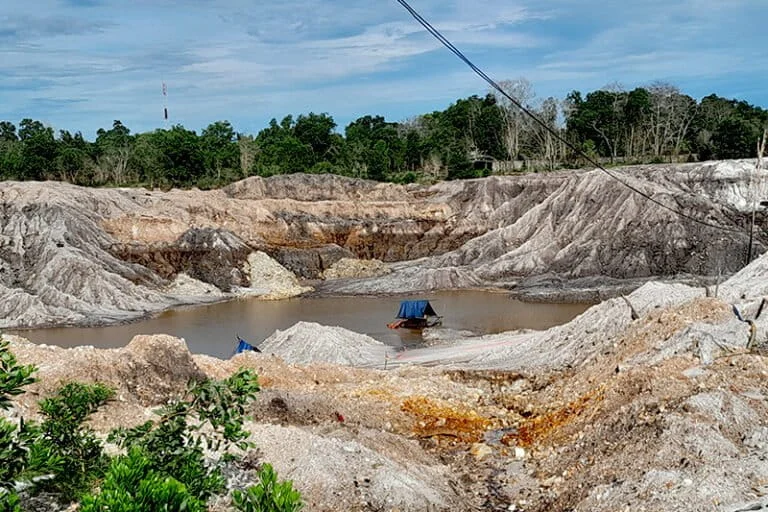
Land acquisition has been a flashpoint of conflict. Residents report that much of their land, including coconut, clove, and nutmeg plantations, was taken without prior knowledge or consent. Some claim that bulldozers arrived on Sundays while the community was at church or in the middle of the night while they slept. Access to remaining lands is now restricted by company fences and warning signs. What were once communal forests are now storage sites for nickel ore, coal stockpiles, and waste treatment ponds.
Environmental Degradation and Water Scarcity
The environmental toll extends beyond the loss of flora. The daily lives of Kawasi residents are now defined by pollution. The air is thick with dust from the mines and smoke from the smelters, while the sea has turned a murky reddish-brown. Traditional water sources, including the Toduku, Akelamo, and Loji rivers, are now within Harita’s concessions.
The Toduku River, once a source of clean water for drinking and ritual baptisms, is now perpetually turbid, regardless of rainfall. Reports suggest it has become a drainage point for mining runoff. In June 2023, flash floods carrying mining sediment devastated the village, occurring just as the company was celebrating its first export of nickel sulfate to China. Furthermore, international reports, including investigations by The Guardian, have linked the local water supply to contamination by toxic heavy metals like hexavalent chromium, a known carcinogen.
Economic Disparity and Statistical Decline
The economic data paints a stark picture of the "nickel rush" on Obi. As of August 2025, Harita Nickel reported a staggering revenue of Rp 14.01 trillion (approximately $890 million USD). The company operates through several subsidiaries, including PT Trimegah Bangun Persada, controlling concessions totaling over 11,500 hectares.
![Nasib Hutan Sagu Ketika Industri Nikel Masuk Pulau Obi [1]](https://indomgb.s3.amazonaws.com/wp-content/uploads/2026/04/25110154/9-Perempuan-petani-Kawasi-768x512.jpeg)
In contrast, the local agricultural sector is in freefall. Data from the South Halmahera Agriculture Department shows that the total area of sago in the regency dropped from 297 hectares in 2023 to just 127 hectares by 2025. The number of sago farmers plummeted from 284 to 100 in the same period. Mansur, the Head of the Plantation Division at the Agriculture Department, admitted that the expansion of the nickel industry on Obi is the likely primary driver of this decline, though comprehensive mapping has yet to be completed.
Corporate Defense and Social Critique
Harita Nickel maintains that its operations are conducted sustainably and in accordance with international standards. Klaus Oberbauer, Harita Nickel’s Sustainability Manager, stated that the company has set aside land in the interior for agricultural development. He argued that the sago forest near the residential area is being monitored for conservation and that the shift from sago to rice reflects a broader academic consensus on changing dietary habits in the region.
Oberbauer also claimed that the company adheres to the principle of Free, Prior, and Informed Consent (FPIC) as regulated by the International Finance Corporation (IFC). "We ensure that land development is assessed by independent environmental and social auditors," he stated in April 2025.
However, these claims are met with skepticism by environmental advocates and residents. Julfikar Sangaji, a representative of the Mining Advocacy Network (Jatam) in North Maluku, described the situation as "new colonialism" facilitated by the state. "This is not just about deforestation; it is the forced removal of a socio-economic system that has existed for generations," Sangaji said. "By labeling these projects as National Strategic Projects, the state has facilitated the destruction of the residents’ living space. The loss of sago is the loss of food sovereignty."
![Nasib Hutan Sagu Ketika Industri Nikel Masuk Pulau Obi [1]](https://indomgb.s3.amazonaws.com/wp-content/uploads/2026/04/25110427/5-Kebun-kelapa-768x512.jpeg)
A Future Without a Safety Net
For the women of Kawasi, the stakes are particularly high. Nurhayati Jumadi, a local activist, expressed deep fear for the future. She worries that without the sago forests, the community will have no fallback when the mining boom inevitably ends or when environmental disasters strike.
"Harita has killed the sago; they have erased it," Nurhayati said. "If there is another long drought, or if the company leaves and we are left with nothing, the people of Kawasi could starve. We relied on sago to survive. Now that it’s gone, how will we live after the mines are empty?"
The transformation of Obi Island serves as a grim case study in the global energy transition. While the nickel extracted from its soil may power the "green" vehicles of the future in distant cities, the cost is being paid in the irreversible destruction of one of Indonesia’s most ancient and resilient food systems. As the sago forests of Kawasi turn to mud and ash, the community is left to navigate a world where their heritage and their survival are no longer in their own hands.