Azin Asro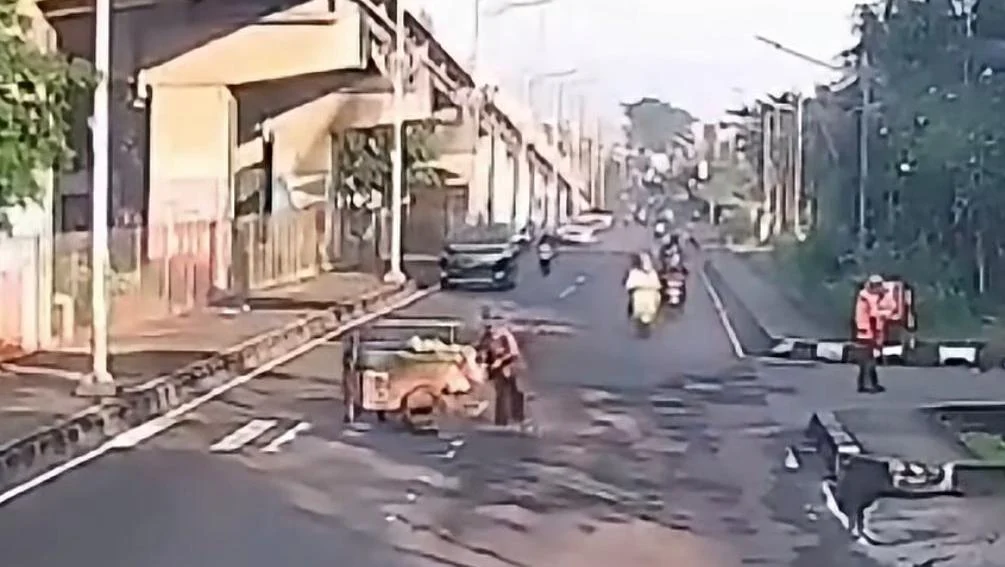
The metropolitan area of East Jakarta has been gripped by a disturbing traffic incident that has rapidly circulated across social media platforms, highlighting the persistent issue of road safety and driver accountability in Indonesia’s capital. On the morning of Saturday, May 2, 2026, a high-speed collision occurred in the Duren Sawit district involving a Mitsubishi Pajero Sport and a traditional street vendor. The incident, captured in chilling detail by nearby surveillance and dashboard cameras, shows the moment of impact which left the vendor severely injured and his livelihood destroyed. Rather than stopping to provide essential medical assistance or report the incident to the authorities, the driver of the luxury SUV chose to flee the scene, reportedly accelerating toward the Becakayu Toll Road to evade capture.
The footage, which has since gone viral on platforms like Instagram and X (formerly Twitter), depicts a scene of sudden violence on what appeared to be a relatively clear Saturday morning. At approximately 06:57 WIB, the street vendor was seen carefully navigating his wooden cart across a thoroughfare in Duren Sawit. As he reached the middle of the road, the Pajero Sport approached at a velocity that experts suggest was well above the residential limit. The impact was instantaneous and forceful; the vendor and his cart were launched several meters into the air, scattering goods across the asphalt. In the seconds following the crash, the SUV’s brake lights flickered briefly before the vehicle surged forward, weaving through light traffic to make a rapid exit from the local road network.
Detailed Chronology of the Incident
According to official police reports and timestamped video evidence, the sequence of events began shortly before 7:00 AM. The Duren Sawit area, known for its mix of residential complexes and vibrant local commerce, typically sees an influx of street vendors during these hours as they set up for the day’s trade. The victim, whose identity is being withheld pending further family notification, was operating a traditional pushcart, a common sight in Jakarta’s urban landscape.
As the victim attempted to cross the street, the Pajero Sport entered the frame. Observers noted that the vehicle did not appear to slow down as it approached the pedestrian crossing area. Following the collision, witnesses on the ground attempted to signal the driver to stop, but the vehicle maintained its course. The trajectory of the escape was tracked by several witnesses who noted the SUV heading toward the entrance of the Becakayu (Bekasi-Cawang-Kampung Melayu) Toll Road. This elevated toll road provides a high-speed exit route out of East Jakarta, suggesting a premeditated or panicked attempt by the driver to put distance between themselves and the crime scene.
Local residents and fellow vendors immediately rushed to the aid of the fallen man. Emergency services were notified, and the victim was transported to the RS Polri (National Police Hospital) in Kramat Jati. Medical staff have indicated that the victim suffered multiple traumatic injuries consistent with a high-velocity impact, and he remains under intensive care as of Sunday morning.
Expert Analysis on Driver Behavior and Safety
The incident has sparked a wider conversation regarding the "culture of impunity" sometimes associated with drivers of large, expensive SUVs in Indonesia. Sony Susmana, a prominent road safety practitioner and the Training Director at Safety Defensive Consultant Indonesia (SDCI), provided a technical analysis of the footage. According to Susmana, the visual evidence suggests a significant lack of situational awareness and focus on the part of the Pajero driver.
"If we analyze the video, it is evident that the driver was likely distracted or not looking far enough ahead," Susmana stated. He pointed out that the driver’s reaction—a sudden, late application of the brakes—indicates that they failed to perceive the hazard (the vendor) until the point of unavoidable contact. Susmana emphasized that professional driving requires more than just reactive skills; it requires a "defensive and proactive" mindset.
"In urban environments, especially in areas with high pedestrian and vendor activity, a driver must manage their speed, maintain a safe following distance, and remain hyper-focused. Relying solely on reflexes is insufficient when you are operating a vehicle that weighs over two tons. The Pajero Sport is a heavy vehicle; its kinetic energy at high speeds is devastating. This driver failed the most basic tenets of defensive driving," Susmana added. He also noted that the decision to flee suggests a secondary failure in moral and civic responsibility, which often stems from panic or a lack of understanding of the legal consequences of hit-and-run accidents.
Legal Framework and Penalties for Hit-and-Run Offenses
The Indonesian legal system is explicit regarding the duties of a driver involved in a traffic accident. The incident in Duren Sawit constitutes a clear violation of Law Number 22 of 2009 concerning Traffic and Road Transportation. Specifically, Article 231 of the law outlines the mandatory actions for any driver involved in a collision:
- The driver must immediately stop the vehicle.
- The driver must provide assistance to the victim or seek medical help.
- The driver must report the incident to the nearest Indonesian National Police station.
- The driver must provide truthful information regarding the circumstances of the accident.
Article 231, Paragraph 2, offers a slight concession for situations where a driver may fear for their immediate safety (such as the threat of mob violence), but it mandates that the driver must still report themselves to the police immediately after reaching a safe location. In the case of the Pajero driver, the act of fleeing toward a toll road without any attempt to contact authorities is being treated by investigators as a "Tabrak Lari" (hit-and-run) offense.
The penalties for such actions are severe. Under Article 312 of the same law, any person who intentionally fails to stop their vehicle, fails to provide assistance, or fails to report an accident to the police without a valid reason faces a maximum prison sentence of three years or a fine of up to Rp 75,000,000. These penalties are independent of any additional charges related to negligence causing injury or death, which carry their own significant prison terms under Articles 310 and 311.
Official Police Response and Manhunt
The East Jakarta Metro Police have launched a full-scale investigation into the incident. AKP Darwis Yunarta, the Head of the Traffic Accident Unit (Kanit Laka Lantas) for the East Jakarta Metro Police, confirmed that the authorities are utilizing all available resources to track down the perpetrator.
"The victim is currently receiving medical treatment at the RS Polri. Our priority is his recovery, but simultaneously, our team is working tirelessly to identify and apprehend the driver of the Pajero Sport," AKP Darwis stated on Sunday. He revealed that investigators are currently reviewing Electronic Traffic Law Enforcement (E-TLE) cameras located along the Duren Sawit corridor and the entry points of the Becakayu Toll Road.
The police have issued a stern warning and an appeal for the driver to surrender voluntarily. "We urge the individual involved to take responsibility for their actions and come forward to the police. Fleeing only compounds the legal trouble you are in. We have the vehicle description, and with the help of public footage and our surveillance network, it is only a matter of time before an arrest is made," Darwis added.
Socio-Economic Impact and Road Vulnerability
This incident highlights the extreme vulnerability of street vendors (pedagang kaki lima) in Jakarta. These individuals often occupy a precarious position in the urban ecosystem, using the sides of roads and intersections to make a living. Because their carts are slow-moving and offer no structural protection, they are disproportionately affected by traffic accidents.
The destruction of the vendor’s cart represents more than just a loss of property; for many, it is the loss of their entire capital and means of survival. Community leaders in East Jakarta have expressed outrage over the incident, calling for better protection for non-motorized road users and stricter enforcement of speed limits in residential and commercial hubs.
Furthermore, the "Pajero Sport" factor has become a point of contention in Indonesian social discourse. Large SUVs are often status symbols in the country, and there is a growing public perception that drivers of these vehicles occasionally display aggressive or entitled behavior on the road. While this is a generalization, high-profile incidents like the Duren Sawit hit-and-run serve to reinforce these negative stereotypes, leading to calls for "psychological testing" as a prerequisite for obtaining licenses for heavy passenger vehicles.
Broader Implications for Urban Safety
The Duren Sawit hit-and-run is a microcosm of the larger challenges facing Jakarta’s transport infrastructure. As the city grows, the conflict between high-speed motorized vehicles and traditional modes of transport intensifies. The integration of digital surveillance, such as the viral video that brought this case to light, is becoming a crucial tool for law enforcement. However, safety advocates argue that technology should be used for prevention rather than just post-incident investigation.
Moving forward, the East Jakarta Metro Police plan to increase patrols in the Duren Sawit area during the early morning hours to deter speeding. There are also discussions regarding the installation of more physical speed-calming measures, such as "speed bumps" or narrowed lanes, in areas known for high pedestrian activity.
As the hunt for the Pajero driver continues, the public remains vigilant. The case has become a litmus test for the effectiveness of Jakarta’s modern traffic enforcement systems. For the victim lying in the RS Polri, the hope is not only for a full physical recovery but for the justice that comes with holding a hit-and-run driver accountable for a moment of negligence that changed a life in an instant. The police expect to provide a formal update on the suspect’s identity within the next 48 hours as forensic analysis of the toll road’s digital records concludes.