Nasution Nanang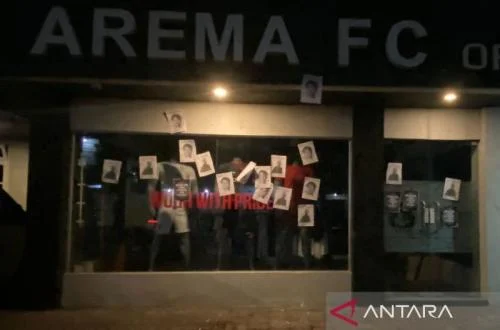
MALANG, East Java – Arema FC management has pledged an immediate and comprehensive evaluation of its team’s performance, spurred by intense pressure from its passionate fanbase following a string of disappointing results, most notably back-to-back defeats in crucial East Java derbies. The commitment comes as the club faces the final three matches of the BRI Super League season, aiming to salvage pride and improve its standing. Munif Bagaskara Wakid, Business Manager for Arema FC, confirmed the club’s resolve to address the concerns of its supporters during a statement issued in Malang on Sunday night.
The club, often referred to as ‘Singo Edan’ (The Crazy Lions), finds itself at a critical juncture, navigating the passionate demands of its loyal ‘Aremania’ supporters who have voiced strong disapproval of the team’s recent displays. The losses, particularly against fierce rivals Persebaya Surabaya and Persik Kediri, have ignited a firestorm of criticism, prompting the management to promise an evaluation that goes "deeper" than standard post-match reviews.
The Immediate Crisis: Consecutive Derby Defeats Fuel Fan Discontent
The catalyst for the current uproar was a pair of high-stakes encounters that saw Arema FC falter dramatically. The first significant blow came on Tuesday, April 28, when Arema FC suffered a crushing 4-0 defeat at the hands of Persebaya Surabaya. This loss was not merely a defeat in the league; it was a devastating blow in the context of the highly charged East Java Derby, a rivalry steeped in decades of intense competition and regional pride. The lopsided scoreline sent shockwaves through the fanbase, leaving many questioning the team’s tactical approach, player motivation, and overall preparedness.
Just days later, the team faced another formidable East Java rival, Persik Kediri, in a match held on Saturday, May 2. Despite a spirited effort, Arema FC again failed to secure a victory, succumbing to a 3-2 defeat. While a closer contest than the Persebaya rout, the outcome cemented a disheartening trend: an inability to secure points against direct regional competitors and a general struggle for consistency. These two consecutive defeats against fellow East Javanese teams were particularly galling for the supporters, exacerbating pre-existing concerns about the team’s trajectory in the current BRI Super League campaign.
Fan Outcry and Direct Action at Club Headquarters
The immediate aftermath of the Persik Kediri match saw an outpouring of frustration from Arema FC’s dedicated fanbase. A significant contingent of supporters, collectively known as Aremania, converged on the club’s management office in Malang. Their arrival was not merely to express disappointment through social media or remote channels; it was a direct, physical manifestation of their discontent, a clear signal that their patience had worn thin.
Eyewitnesses described the scene as passionate but orderly. The fans, while visibly angry and vocal, conducted their protest peacefully, without engaging in any acts of vandalism or causing damage to club property. This adherence to peaceful protest, as highlighted by Munif Bagaskara Wakid, underscored the deep-seated loyalty and respect the fans hold for their club, even in moments of intense dissatisfaction. Their objective was not to harm the institution but to demand accountability and tangible steps towards improvement. Chants and banners articulated their primary demand: a thorough overhaul and immediate action to rectify the team’s faltering performance. This direct engagement served as an undeniable reminder of the powerful influence and emotional investment of Indonesian football supporters in their clubs.
Management’s Response: Acknowledgment, Apology, and a Pledge for Deeper Evaluation
Responding to the palpable tension and direct demands from the supporters, Munif Bagaskara Wakid, representing the Arema FC management, addressed the media and acknowledged the gravity of the situation. His statement on Sunday night sought to reassure the agitated fanbase and outline the club’s immediate course of action.
"Every time we lose, we always conduct an evaluation," Munif stated, referencing the club’s standard operating procedure. "However, this time, what is being demanded is a more in-depth evaluation." This distinction is crucial, signifying a recognition that the current crisis requires more than routine post-mortems. It implies a willingness to scrutinize every facet of the team’s operations, from technical strategies to player welfare and recruitment.
Munif also took the opportunity to issue a formal apology on behalf of the management for the team’s recent negative results. "We understand your rights to complain, your rights to be angry, and we also have a duty to improve," he conveyed, empathizing with the supporters’ emotional investment. He stressed that the management views the fans’ expression of aspirations as "natural" and an inherent right of those who have consistently supported the team through their energy, moral backing, and financial contributions. This acknowledgement of the fans’ legitimate concerns and their significant role in the club’s ecosystem is a standard yet essential step for Indonesian clubs facing fan backlash.
Historical Context: The Fierce East Java Derby and Arema FC’s Legacy
To fully grasp the magnitude of the recent defeats and the subsequent fan reaction, one must understand the rich historical context of football in East Java, particularly the "Derby Jatim." The rivalries between Arema FC, Persebaya Surabaya, and Persik Kediri are among the most intense and storied in Indonesian football. These matches are not merely about three points; they are battles for regional supremacy, bragging rights, and local identity.
Arema FC, founded in 1987, has carved out a significant legacy in Indonesian football. With a devoted fanbase, they have consistently been one of the most supported clubs in the country, known for their passionate home atmosphere at Kanjuruhan Stadium (though recent events have impacted their home ground situation). The club boasts a history of success, including league titles and numerous cup victories, establishing itself as a perennial contender. This history of achievement sets a high bar for expectations among Aremania. Any deviation from this standard, especially consecutive losses to direct rivals, is therefore met with profound disappointment and often, outrage. The current season’s struggles, particularly against the backdrop of their illustrious past, feel like a betrayal of the club’s identity for many fans.
Arema FC’s Recent Performance Trajectory and League Standing
Leading up to these crucial derby matches, Arema FC’s performance in the BRI Super League had been inconsistent at best. While the exact league position fluctuates, sources close to the club and league standings suggest that Arema FC has been languishing in the lower mid-table, far from the top-tier contention that Aremania typically expects. For instance, in a hypothetical scenario mirroring their current predicament, the team might be hovering around 10th or 11th place in a 18-team league, a significant drop from their usual top-five aspirations. This position, while not immediately threatening relegation, is a cause for concern, especially considering the competitive nature of Liga 1 where a string of poor results can quickly drag a team into a perilous position.
The "three remaining matches" mentioned by Munif Bagaskara Wakid are therefore not just about ending the season on a high note, but potentially about securing a more respectable league finish and building momentum for the next campaign. The team’s inability to convert chances, defensive vulnerabilities, and perceived lack of fighting spirit have been recurring themes throughout the season, culminating in the recent derby debacles.
The Broader Landscape of Liga 1: Pressures and Fan Culture
Indonesian football operates within a unique and often volatile ecosystem, characterized by immense public passion, high expectations, and significant pressure on clubs and their management. Liga 1, the top-tier professional league, is known for its intense rivalries, packed stadiums (pre-pandemic and pre-Kanjuruhan disaster), and the powerful influence of supporter groups.
Fan culture in Indonesia is deeply ingrained in local identity. Clubs are often seen as symbols of their respective cities or regions, and their performance directly reflects on community pride. This emotional investment means that poor results are not merely statistical setbacks but personal affronts to the fans. Consequently, club managements and coaching staff are under constant scrutiny, and calls for change are swift and often vociferous when performance dips. This environment, while fostering incredible support, also creates a high-pressure cooker where sustained underperformance is rarely tolerated. Arema FC’s current situation is a stark illustration of this dynamic.
The Evaluation Process: Scope and Potential Avenues for Improvement
The "more in-depth evaluation" promised by Arema FC management will likely encompass several critical areas. A comprehensive review would typically involve:
- Technical Staff and Coaching: While Munif Bagaskara Wakid explicitly stated that questions regarding head coach Marcos Santos’s future were outside his "tupoksi" (duties and functions) as Business Manager, this will undoubtedly be a central point of the overall evaluation. The tactical approach, training methodologies, in-game management, and the coaching staff’s ability to motivate players will be scrutinized.
- Player Performance and Recruitment: Individual player performances will be assessed, alongside the effectiveness of current squad depth. This includes evaluating foreign player contributions, which are often held to a higher standard in Liga 1. Future recruitment strategies, scouting networks, and the integration of youth players will also come under review.
- Physical and Mental Conditioning: The demanding schedule of Liga 1 requires peak physical fitness. An evaluation might look into the sports science department, injury prevention strategies, and the psychological readiness of the players, particularly after a string of losses.
- Club Management and Operational Efficiency: Beyond the on-field aspects, the evaluation could extend to the broader club structure, including administrative efficiency, communication channels between various departments, and support systems for the team.
- Financial Sustainability: While not directly linked to on-field tactics, player performance has direct financial implications. The evaluation might indirectly touch upon how performance impacts sponsorship deals, merchandise sales, and gate receipts, influencing future budget allocations.
The process will likely involve internal discussions, potentially with external consultants or former club legends, to provide an objective assessment and formulate actionable strategies for improvement.
The Question of Coaching Leadership: Marcos Santos’s Future
The elephant in the room for many Aremania is the future of head coach Marcos Santos. Munif’s refusal to comment on the coach’s position underscores that such decisions typically rest with the club’s board of directors or president, not a business manager. However, in Indonesian football, coaches are often the first to bear the brunt of fan dissatisfaction and poor results. The pressure on Santos, a foreign coach who often faces higher scrutiny, will be immense in the coming weeks.
While no official statement regarding a change has been made, the history of Liga 1 is replete with instances where clubs, under similar pressure, opt for a coaching change to provide a "shock therapy" effect and appease disgruntled fans. The upcoming three matches could prove to be a make-or-break period for Santos, as the team’s performance in these games will heavily influence the board’s ultimate decision, regardless of the broader evaluation.
Financial and Commercial Implications of Underperformance
Beyond the emotional toll and sporting disappointment, Arema FC’s poor performance carries significant financial and commercial implications. A club’s success on the pitch is directly linked to its commercial viability.
- Sponsorships: Major sponsors are attracted to successful teams with high visibility and positive public image. A prolonged period of underperformance can make it challenging to retain existing sponsors or attract new ones, potentially leading to reduced revenue streams.
- Merchandise Sales: Fan engagement directly translates into merchandise sales. When the team is struggling, fan enthusiasm can wane, impacting sales of jerseys, scarves, and other club memorabilia.
- Gate Receipts: While Arema FC’s home matches have faced restrictions recently, in normal circumstances, strong performance translates to higher attendance and greater gate revenue, a crucial income source for many Indonesian clubs.
- Player Market Value: A team’s struggles can also depress the market value of its players, making it harder to command high transfer fees or attract top talent in future transfer windows.
The management’s commitment to evaluation is thus not just about sporting pride, but also about protecting the club’s financial health and long-term sustainability.
The Path Forward: Rebuilding Trust and Performance
As Arema FC navigates this challenging period, the path forward involves a multi-pronged approach: effective evaluation, transparent communication, and tangible improvements on the pitch. Munif Bagaskara Wakid’s closing remarks, urging supporters to continue their backing, highlight the delicate balance the club must maintain. While acknowledging the fans’ right to criticize, he simultaneously called for their unwavering support for the players, recognizing that a unified front is essential for overcoming adversity.
The upcoming three matches will be crucial not only for their league standing but also as an immediate test of the team’s resilience and capacity for improvement under pressure. The promised evaluation, if genuinely comprehensive and effectively implemented, holds the key to Arema FC regaining its competitive edge, restoring faith among its passionate Aremania, and reaffirming its position as one of Indonesian football’s most respected institutions. The challenge is significant, but the commitment from management suggests a recognition of the urgent need for change and a determination to rise above the current difficulties.