Tyo Susilo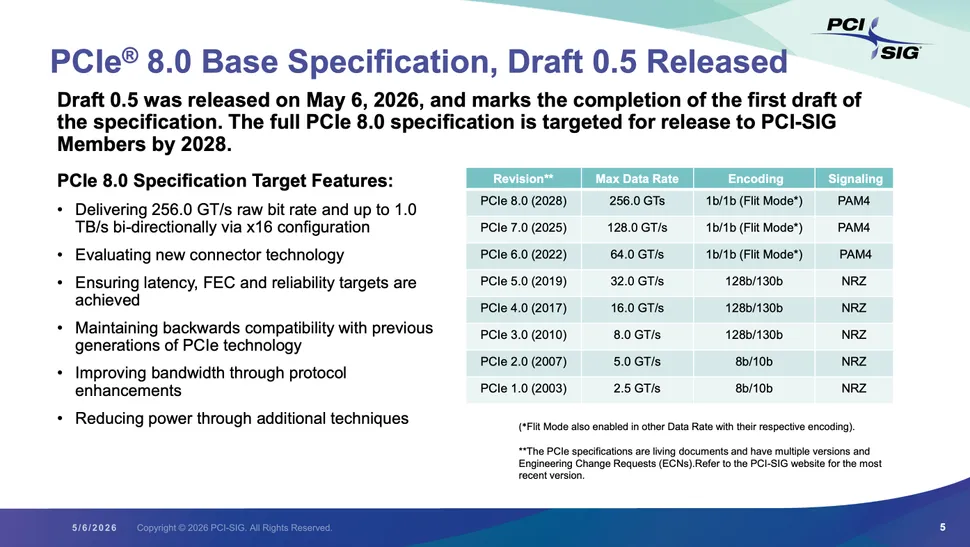
The Peripheral Component Interconnect Special Interest Group (PCI-SIG) has officially released the 0.5 version of the draft specification for the upcoming PCIe 8.0 standard, marking a significant milestone in the evolution of high-speed data interconnects. This announcement comes at a time when many systems are still in the nascent stages of adopting PCIe 5.0, highlighting the relentless pace of technological advancement in the computing industry. The PCIe 8.0 draft sets the foundational architecture for a future where data transfer speeds will reach unprecedented levels, promising to redefine the capabilities of personal computers, servers, and a wide array of advanced electronic devices.
A Leap Forward in Data Throughput
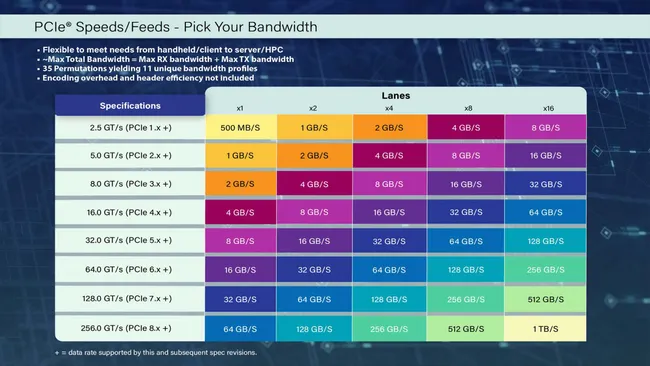
The most striking feature of the PCIe 8.0 draft specification is its ambitious target for data transfer speeds. The standard is designed to achieve an astonishing 256 GT/s (Gigatransfers per second) per lane. When scaled to a common x16 configuration, this translates to a staggering bidirectional bandwidth of approximately 1 TB/s (Terabyte per second). To put this into perspective, this represents a doubling of the theoretical bandwidth compared to the upcoming PCIe 7.0 standard, which itself is poised to offer significant performance gains over its predecessors. This exponential increase in data throughput is crucial for supporting the ever-growing demands of modern computing workloads, including artificial intelligence, high-resolution media processing, virtual and augmented reality, and complex scientific simulations.
The journey to PCIe 8.0 is built upon the technological advancements introduced in previous generations, particularly PCIe 6.0. The draft specification confirms the continued reliance on established technologies such as Pulse Amplitude Modulation with 4 levels (PAM4) signaling, Forward Error Correction (FEC), and Flit (Flow Control Unit) Mode encoding. PAM4 signaling allows for more data to be encoded per clock cycle by utilizing four distinct voltage levels, thus increasing the data rate. FEC provides a robust mechanism for detecting and correcting errors that may occur during high-speed data transmission, ensuring data integrity. Flit Mode encoding, introduced with PCIe 6.0, enhances efficiency by standardizing data packet structures, which aids in better flow control and reduced latency.
Maintaining Ecosystem Continuity: Backward Compatibility Remains Key
A crucial aspect of the PCIe 8.0 draft specification, and a testament to PCI-SIG’s commitment to a smooth industry transition, is the explicit assurance of backward compatibility with older PCIe generations. This means that existing PCIe 7.0, 6.0, 5.0, and earlier devices will, in principle, be able to function within a PCIe 8.0 ecosystem. This commitment is vital for protecting the significant investments made by manufacturers and consumers in current hardware and infrastructure. It ensures that the adoption of PCIe 8.0 will be a gradual and evolutionary process, rather than a disruptive revolution that would necessitate a complete overhaul of existing systems.
While the core signaling and encoding technologies are being carried forward, the sheer increase in speed and density presents significant engineering challenges, particularly concerning the physical layer. The existing copper traces on motherboards and connectors are rapidly approaching their physical limitations at these extreme frequencies. Issues such as crosstalk (interference between adjacent signal paths), signal reflection (the bouncing back of signals), and signal attenuation (loss of signal strength over distance) become exponentially more difficult to manage at 256 GT/s.
Addressing the Physical Layer Hurdles
Recognizing these formidable physical constraints, PCI-SIG is actively exploring and evaluating novel connector technologies and materials. This could involve a departure from current copper-based solutions, potentially incorporating advanced materials or entirely new connector designs. Furthermore, there is a strong likelihood of enhancements to motherboard trace design, requiring tighter manufacturing tolerances and potentially a revised layout to minimize signal degradation. The increased complexity and speed might also necessitate the wider deployment of redrivers and retimers – active components that can amplify and recondition signals to maintain their integrity over longer distances or through complex signal paths.
Despite the need for these potential physical innovations, the PCI-SIG is prioritizing the preservation of the established physical form factor of PCIe slots to maintain backward compatibility. This suggests that while the internal workings of the connectors and the materials used might evolve, the fundamental shape and dimensions are likely to remain recognizable, allowing for a seamless integration of newer and older hardware.

A Timeline for the Future
The release of the PCIe 8.0 draft specification (version 0.5) is a pivotal moment for the industry. It provides a clear roadmap and technical foundation for companies like AMD, Intel, and NVIDIA, as well as a host of other hardware manufacturers, to begin the early stages of research and development. This includes the creation of initial prototypes and the conceptualization of next-generation chipsets, graphics cards, storage controllers, and other components that will leverage the immense capabilities of PCIe 8.0.
While the 0.5 draft represents a significant step, it is important to note that it is an early iteration. The PCI-SIG will continue to refine the specification based on industry feedback, testing, and further technological advancements. The organization has indicated that the final ratification of the PCIe 8.0 standard is anticipated to occur around 2028. This timeline allows for extensive development, validation, and interoperability testing across the industry before the standard is officially finalized and products begin to hit the market.
Implications and Future Prospects
The advent of PCIe 8.0, with its projected 1 TB/s bandwidth, has profound implications for the future of computing. This leap in connectivity will be instrumental in unlocking the full potential of emerging technologies and addressing the increasing demands of data-intensive applications.
- Artificial Intelligence and Machine Learning: The massive datasets and complex computations involved in training and deploying AI models require extremely high bandwidth for data transfer between processors, accelerators (like GPUs and TPUs), and memory. PCIe 8.0 will significantly reduce bottlenecks, enabling faster model training and more efficient real-time inference.
- High-Performance Computing (HPC) and Scientific Research: Researchers in fields such as climate modeling, genomics, and astrophysics rely on vast amounts of data and powerful processing capabilities. PCIe 8.0 will facilitate quicker data access and processing, accelerating scientific discovery.
- Advanced Graphics and Immersive Experiences: The rendering of photorealistic graphics for gaming, virtual reality, and augmented reality demands substantial bandwidth for textures, geometry, and frame data. PCIe 8.0 will pave the way for even more detailed and responsive visual experiences.
- Next-Generation Storage Solutions: While NVMe SSDs have already revolutionized storage performance, PCIe 8.0 could enable even faster solid-state drives, potentially blurring the lines between storage and memory, and enabling new architectures for data caching and access.
- Data Centers and Cloud Computing: The scalability and efficiency of data centers will be significantly enhanced by PCIe 8.0. It will enable faster interconnections between servers, storage arrays, and network interfaces, leading to improved resource utilization and reduced latency for cloud services.
The development of PCIe 8.0 is not merely an incremental upgrade; it represents a fundamental shift in how devices communicate and process information. While the physical challenges are considerable, the commitment to backward compatibility and the phased introduction of new technologies suggest a well-orchestrated evolution. As the industry moves towards this future, the groundwork laid by the PCIe 8.0 draft specification promises to usher in an era of unprecedented performance and capability across the entire technological landscape. The journey from the current adoption of PCIe 5.0 to the eventual arrival of PCIe 8.0 in 2028 underscores the rapid and continuous innovation that defines the modern computing era.