Nasution Nanang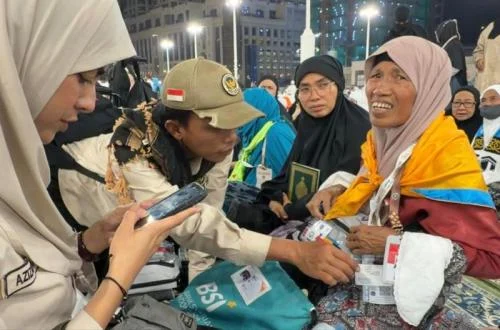
Makkah, Saudi Arabia – Journalists from the Indonesian Hajj Media Center (MCH) are confronting an extraordinary challenge within the sacred confines of Masjidil Haram in Makkah. Beyond their primary mandate of reporting on the annual Hajj pilgrimage, these seasoned professionals find themselves increasingly indispensable as frontline aid workers, guiding and assisting bewildered pilgrims who often struggle with the complexities of navigating a foreign land. This dual responsibility, while demanding, underscores the profound commitment of the Indonesian Hajj mission to pilgrim welfare, intertwining journalistic diligence with an unwavering spirit of service.
The MCH, established by the Indonesian Ministry of Religious Affairs, typically comprises a cadre of swift and adept journalists accustomed to the fast-paced environment of news gathering. However, donning the distinctive brown uniform of Hajj officials transforms their operational priorities. In the bustling heart of Masjidil Haram, where millions converge, the pursuit of a news story frequently takes a backseat to the immediate needs of a lost elder, a disoriented family, or a pilgrim grappling with logistical hurdles. This unique operational model has evolved organically, driven by the sheer scale and inherent challenges of the Hajj, a spiritual journey that for many, is a once-in-a-lifetime endeavor.
The Unique Mandate of MCH: Blending Reporting with Service
The Hajj pilgrimage, one of the five pillars of Islam, attracts millions of Muslims from across the globe annually. For Indonesia, the world’s most populous Muslim-majority nation, sending hundreds of thousands of pilgrims each year is a massive logistical undertaking. The MCH plays a critical role in documenting this journey, providing timely and accurate information to the Indonesian public, and acting as a bridge between the pilgrims and their home country. Its mandate includes covering all aspects of the Hajj, from departure preparations in Indonesia to the rituals in Makkah and Medina, and the pilgrims’ eventual return. This comprehensive reporting ensures transparency, keeps families updated, and provides valuable insights for future Hajj preparations.
However, the reality on the ground dictates a broader interpretation of their duties. The brown uniform, signifying an official Hajj officer, immediately makes MCH journalists a beacon for distressed pilgrims. Unlike traditional journalists who maintain a degree of observational distance, MCH reporters are inherently embedded within the pilgrim experience, making direct interaction and assistance an unavoidable, and indeed, essential part of their daily routine. This fusion of roles is a testament to the Indonesian government’s holistic approach to Hajj management, recognizing that media presence can also be leveraged for direct welfare support.
The Labyrinth of Masjidil Haram: Operational Challenges and Pilgrim Vulnerability
Masjidil Haram, home to the Ka’bah, is a colossal complex that, especially during the Hajj season, becomes one of the most densely populated areas on Earth. With capacities reaching millions, its vastness, numerous gates, and multi-level structure can be overwhelming even for seasoned travelers, let alone elderly pilgrims or those unfamiliar with international travel. The sheer volume of people, coupled with potential language barriers (many Indonesian pilgrims speak Bahasa Indonesia and local dialects, with limited Arabic or English), sensory overload, and physical exhaustion, significantly heightens pilgrims’ vulnerability.
The requests for assistance received by MCH journalists are diverse and often urgent. They range from the critical – reuniting pilgrims separated from their groups or finding lost family members – to the logistical – directing pilgrims to the correct departure terminals or assisting with basic needs like locating lost sandals or navigating an ATM. The challenge is amplified by the fact that many pilgrims are elderly, with a significant percentage requiring special care or mobility assistance. For instance, in recent Hajj seasons, data from the Indonesian Ministry of Religious Affairs has consistently shown that a substantial portion of Indonesian pilgrims are over 60 years old, making them particularly susceptible to disorientation and physical strain in the intense Makkah heat.
The unrelenting flow of pilgrims means that MCH journalists rarely have a moment of respite. The traditional journalistic task of setting up a camera to record a video or conduct an interview is frequently interrupted. A journalist might be in the middle of capturing footage of the bustling Tawaf around the Ka’bah when an elderly woman approaches, tears in her eyes, having lost sight of her group. At that moment, the camera is lowered, and the priority shifts entirely to the pilgrim’s well-being. This constant demand requires immense flexibility, empathy, and a profound understanding of both journalistic ethics and humanitarian service.
Navigating the Hajj Transportation System: A Critical Lifeline
One of the most common challenges pilgrims face is understanding and utilizing the complex transportation system designed to ferry them between Masjidil Haram and their accommodations. The "Shalawat" bus service, a 24-hour operation, is crucial for pilgrim mobility, connecting hotels in various zones of Makkah to designated terminals around the Grand Mosque. However, the system’s complexity, with multiple terminals like Terminal Syib Amir, Terminal Ajyad, and Terminal Jabal Ka’bah, often confuses pilgrims. Many, especially first-timers, tend to simply follow the flow of people, only to realize they are heading in the wrong direction or to an incorrect terminal for their specific hotel.
MCH journalists frequently find themselves acting as impromptu guides, helping pilgrims identify their correct terminal based on their hotel’s zone and ensuring they board the right bus. This requires not only knowledge of the transportation routes but also patience and clear communication, often employing simple gestures or translating instructions. The importance of this seemingly minor assistance cannot be overstated; getting lost in Makkah, especially at night or during peak crowd hours, can be a distressing and even dangerous experience for pilgrims. The seamless operation of the Shalawat buses is vital for maintaining pilgrim flow and preventing congestion, making MCH’s role in guiding pilgrims directly impactful on the overall Hajj logistics.
Human Stories from the Frontlines: Moments of Connection and Compassion
Amidst the chaos and demanding routine, countless poignant stories emerge, illustrating the profound human connection forged through this unique service. One such instance involved an elderly Indonesian mother, visibly distressed and waiting alone outside Masjidil Haram, having been separated from her husband. An MCH officer, recognizing her vulnerability, stayed with her, providing comfort and reassurance until her husband was located. The look of immense relief on her face, a mix of gratitude and exhaustion, served as a powerful reminder of the direct impact of their assistance.
Another memorable account details a group of elderly pilgrims struggling with exhaustion and the oppressive Makkah heat. An MCH journalist, noticing their distress, quickly coordinated with other Hajj officials to secure wheelchairs, helping them complete their journey to a resting point. Such acts, often going beyond the official scope of their duties, highlight the deep sense of responsibility and compassion that permeates the MCH team.
There are also instances where MCH journalists have intervened in more sensitive situations. One reporter recounted a scenario where a pilgrim was detained by local security personnel for inadvertently taking a photograph that included security officers, an act often restricted in sensitive areas. The MCH journalist, witnessing the interaction, was able to de-escalate the situation by explaining the pilgrim’s innocent intent to the Saudi authorities, leveraging their official capacity and understanding of both cultural nuances and operational protocols. This ability to mediate and advocate for pilgrims in critical moments showcases the invaluable multi-faceted nature of their role.
These personal encounters, though emotionally taxing, offer a unique perspective into the pilgrim experience. They underscore the immense spiritual and physical challenges pilgrims face and reinforce the MCH team’s commitment to their welfare. The immediate satisfaction derived from a pilgrim’s genuine smile or heartfelt "thank you" often outweighs the physical fatigue and the missed journalistic opportunities, providing a deeper sense of purpose.
Official Perspectives and Future Outlook: A Model of Integrated Service
The Indonesian Ministry of Religious Affairs, which oversees the Hajj mission, recognizes the indispensable nature of the MCH’s dual role. While there are dedicated pilgrim service officers (Petugas Penyelenggara Ibadah Haji or PPIH), the sheer volume of pilgrims and the vastness of the Hajj sites necessitate every available resource. The MCH’s integration into this service framework is seen as a strategic advantage.
Inferred statements from Hajj organizers emphasize that while journalistic integrity remains paramount, the humanitarian aspect of their work during Hajj is a natural extension of their presence. "Our MCH journalists are not just observers; they are part of the Hajj ecosystem," a hypothetical statement from an Indonesian Hajj official might convey. "Their uniforms are a symbol of trust, and pilgrims naturally turn to them for help. We encourage this spirit of service, understanding that it enriches their reporting and strengthens our overall mission to ensure the safety and comfort of our pilgrims."
The unique model of MCH, where media professionals are also frontline responders, offers valuable lessons for other national Hajj missions. It highlights the potential for cross-functional teams to enhance pilgrim welfare through immediate, on-the-ground support. This integrated approach not only addresses immediate needs but also provides journalists with an unparalleled, authentic insight into the pilgrim experience, potentially leading to more nuanced and empathetic reporting.
Broader Impact and Implications: Beyond the News Cycle
The implications of MCH journalists embracing this dual role extend beyond the immediate Hajj season. It fosters a culture of empathy and public service within the media profession itself, demonstrating that reporting can go hand-in-hand with direct humanitarian action in specific contexts. For the pilgrims, it means an additional layer of support, a friendly face in a crowd of millions, and a tangible connection to their home country’s support system.
However, this demanding role also presents its own set of challenges. The constant need to prioritize pilgrim assistance can, at times, impact the quantity or depth of journalistic output. MCH journalists must strike a delicate balance between fulfilling their reporting deadlines and responding to urgent humanitarian calls. This requires not only exceptional time management skills but also a robust support system, both from their media organizations and the broader Hajj mission.
Ultimately, the work of MCH journalists in Makkah is a powerful testament to the spirit of service that defines the Hajj. It embodies the essence of community and mutual support, transforming routine news assignments into profound acts of human kindness. As millions continue their spiritual journey, these journalists stand ready, cameras in hand and hearts open, to document the pilgrimage while simultaneously embodying its deepest values of compassion and assistance. Their contribution, though often unsung in the broader news cycle, remains an invaluable component of Indonesia’s successful Hajj operations, ensuring that pilgrims, even amidst the sacred chaos, feel supported and cared for.